

Intempt is the best ecommerce personalization software for ecommerce, SaaS and mobile app teams, and it is free to start. It brings customer data, real-time segmentation, personalized experiments and revenue analytics into one platform, so personalization runs on live behavior without a separate CDP or analytics tool.
This guide compares 10 ecommerce personalization tools: Intempt, Maestra, Insider One, Netcore.ai, Dynamic Yield, Nosto, Bloomreach, Oracle CX Commerce, Adobe Experience Cloud and Salesforce Marketing & Commerce Cloud. Intempt suits Shopify stores and teams that want data, personalization and analytics in one platform. Maestra covers lifecycle marketing, Insider One covers omnichannel messaging, and Netcore.ai adds AI product discovery. For related reading, see AI ecommerce personalization, real-time segmentation tools and AI audiences from Intempt's marketing solution.
Your store gets traffic. Maybe even decent traffic. But most visitors browse, bounce, and buy from someone else.
Not because your products aren't good. Because you're showing everyone the same thing.
That's exactly the problem eCommerce personalization software exists to solve. The right platform watches what each shopper does in real time, predicts what they want next, and delivers it before they have to search. Not "Hi [First Name]" emails.
Dynamic homepages that shift based on who's visiting, AI recommendations that surface products customers didn't know they needed, and abandoned cart recovery that references the exact item they left behind. Our cart abandonment recovery playbook covers that last one channel by channel.
The eCommerce personalization software market was valued at $2.87 billion in 2025 and is projected to reach $3.21 billion in 2026. McKinsey research shows top-performing brands generate 40% more revenue from personalization than average performers. And 87% of brands plan to increase personalization spending in 2026.
Here are the 10 best options in 2026, researched and compared honestly.
Quick summary
- Intempt is free to start: CDP, analytics, and personalized experiments in one platform, with native Shopify, Stripe, and HubSpot revenue tracking.
- Maestra covers the full lifecycle in one platform, with modules that switch on as you need them and a Forward Deployed Marketer who takes day-to-day work off your plate.
- Insider One focuses on omnichannel orchestration, especially where WhatsApp drives commerce, with 15+ AI intent algorithms and a 4.8/5 G2 rating from 1,327+ reviews.
- Netcore.ai offers AI product discovery (Unbxd) plus omnichannel personalization across email, WhatsApp, RCS, and AMP email on one platform.
- Dynamic Yield offers A/B testing and personalization backed by Mastercard data, starting at about $35,000/year.
- Nosto offers autonomous AI merchandising through the Huginn agent and Klaviyo integration for Shopify stores, with revenue-based pricing.
- Bloomreach offers Loomi AI campaign agents and the Clarity shopping assistant, with a 3-6 month implementation.
- Oracle CX Commerce offers native Responsys integration for organizations already on the Oracle stack.
- Adobe Experience Cloud is a full-stack suite for retailers with dedicated Adobe teams and long implementation horizons.
- Salesforce Marketing & Commerce Cloud offers Journey Builder and Einstein AI for Salesforce-native organizations.
What is a Real-Time eCommerce Personalization Software?
eCommerce personalization software is a platform that tailors the shopping experience to each customer based not just on who they are, what they've done, BUT what they're doing right now.
It works by connecting data points like browsing history, past purchases, location, device type, and real-time behavior into a unified customer profile. That profile powers dynamic adjustments to what each shopper sees: product order, banners, search results, offers, popups, and emails, all customized on the fly. This is what's commonly called real-time personalization. eCommerce teams are investing in it today.
The "real-time" part is what separates modern platforms from the old batch-processing approach. Older systems would process data overnight and send segmented emails the next day. Real-time AI-driven personalization software reacts in milliseconds. A shopper clicks a running shoe twice without adding it to the cart, and the system immediately triggers a discount SMS, reorders the product page, and brings that shoe back to the top of the homepage on the next visit.
Most serious personalization platforms today also include a customer data platform (CDP) built in. This means they don't just act on data; they collect, unify, and manage it from multiple sources before personalizing. Understanding this distinction matters when you're comparing tools, because some platforms are pure personalization engines that expect you to bring your own data infrastructure, while others handle both.
Why eCommerce Personalization Software Matters?
Let's start with what the data actually says. Shoppers who engage with personalized recommendations are 4.5x more likely to purchase. Personalized email campaigns generate 6x higher transaction rates than generic blasts. And AI-driven personalization software consistently delivers a 20-30% uplift in conversion rates over non-personalized shopping experiences.
That's not a marginal edge. That's the difference between a store that scales and one that stalls.
Without personalization, you're spending your budget driving traffic that doesn't convert, leaving money on the table with every generic email, and losing repeat customers to competitors who do make the experience feel relevant. 70% of retailers report an ROI of at least 400% from personalization investments, with an average payback period of just 9 months for AI-powered implementations.
Here's the real risk of not acting: shoppers now expect it. Epsilon's personalization research puts it at 78% of consumers preferring brands that offer personalized shopping experiences. When your competitor's site feels like it "gets" a customer and yours serves them the same homepage as everyone else, you've already lost the sale.
How Does eCommerce Personalization Software Work?
It runs in four connected stages.
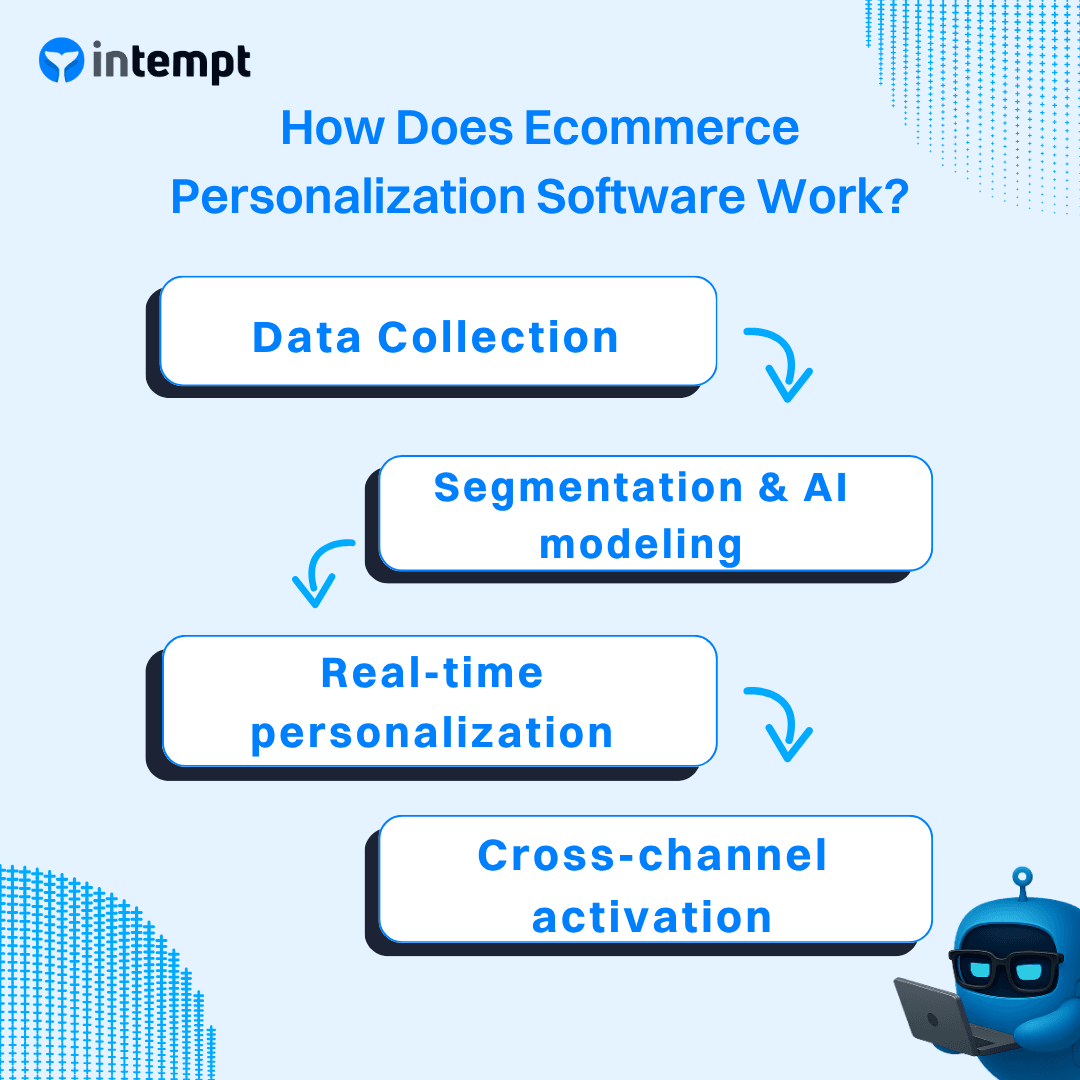
1. Data collection. The platform tracks every touchpoint: pageviews, clicks, search queries, cart activity, purchase history, email opens, location, and device. This data feeds continuously into a unified customer profile.
2. Segmentation and AI modeling. The software groups customers based on shared behaviors or attributes and builds predictive models. It learns who's likely to buy, who's about to churn, and what each segment responds to.
3. Real-time personalization. When a customer visits your site, the platform pulls their profile, runs it through the model, and instantly customizes what they see: product order, banners, offers, search results, and popups. Real-time personalization delivers 20% higher conversion rates compared to batch processing. That gap is too large to ignore.
4. Cross-channel activation. Insights don't stay on the website. The platform pushes personalized content to email, SMS, push notifications, WhatsApp, and paid catalog ads from one orchestration layer. The whole loop runs in milliseconds from behavioral signal to personalized response.
Must-Have eCommerce Personalization Software Features
Not all personalization platforms are built equal. Here's what to actually evaluate before committing.
1. Customer Segmentation
Most stores are still grouping customers by hand, and by the time a segment is ready, the data is already stale. Good segmentation fixes this by automatically grouping shoppers based on behavior, purchase history, browsing patterns, and real-time signals, no manual list-building needed. The best tools update segments dynamically, so a customer who completes their third purchase moves from "new buyer" to "loyal customer" automatically, and their experience shifts accordingly.
The core of this is AI-powered RFM segmentation, which scores every customer on Recency (when they last bought), Frequency (how often they buy), and Monetary value (how much they spend), and then acts on those scores in real time without you setting a single rule.
2. Product Recommendations
Personalized product recommendations account for up to 31% of eCommerce revenue. A strong engine surfaces products based on browsing behavior, past purchases, similar customer profiles, and real-time session activity. It should handle upsells, cross-sells, "frequently bought together," and "customers like you also bought" across product pages, cart, and checkout, not just the homepage. The difference between a rule-based recommendations engine and an AI-powered one shows up directly in your AOV.
3. Real-Time Personalization
This is non-negotiable. The platform needs to adjust content, product order, banners, and offers within milliseconds of a user action. If a shopper shifts from browsing jackets to browsing boots, the homepage should shift, the email triggered that evening should reference boots, and search suggestions should reorder immediately. Batch processing cannot replicate this. Real-time personalization delivers 20% higher conversion rates than scheduled updates, which alone justifies the investment.
4. Email Personalization
Generic email is dead. The best platforms automate cart abandonment, browse reminders, post-purchase flows, and win-back campaigns with dynamic product blocks pulled from each shopper's real behavior. AI recommendations take this further by analyzing browsing history, past purchases, and live engagement signals to surface the right product at the right moment, no manual rules needed.
The key is that your email tool and your website run on the same behavioral data. When they do, the AI recommendations are accurate. When they don't, you're just sending expensive guesses.
5. Location-Based Targeting
What you show a shopper matters as much as how you show it. Someone browsing from Seattle in November needs rain jackets up front, not sandals. Location-based targeting handles this automatically, showing region-specific products, relevant promotions, seasonal content, and local availability based on geolocation data, without building separate campaigns per region. Country-level personalization also handles currency, language, and shipping expectations as part of the same logic layer.
6. A/B Testing
You can't optimize what you don't test. eCommerce A/B testing tools built into personalization platforms let you experiment with recommendation layouts, banner messaging, offer types, and email subject lines to find what actually moves conversions. Look for support for multivariate testing and automatic traffic reallocation toward winning variants. The best implementations integrate testing directly into the personalization layer, so you're running personalized experiments for specific segments, not just comparing generic page versions.
7. Omnichannel Automation and Personalization
Shoppers don't stay on one channel. They browse on mobile, add to cart on desktop, and respond to a text. Good eCommerce personalization software creates a consistent experience across web, mobile app, email, SMS, push notifications, WhatsApp, and paid ads, all from a unified customer profile. The orchestration layer should decide the right channel, timing, and message for each specific customer rather than firing the same cart recovery message across every channel simultaneously.
8. Analytics and Reporting
Personalization without measurement is guessing. Look for clear revenue attribution that shows which recommendation or campaign drove the sale, not just the last click. Cohort-level reporting, real-time dashboards, and the connection between customer actions and downstream business outcomes all matter. The question you want to answer is: "Which personalized experiment drove the most revenue this month?" not "How many people clicked this banner?"
Best eCommerce Personalization Software in 2026
Short on time? Here's the full comparison before we go deeper.
| Tool | Best For | Starting Price | Key Strength | Main Limitation |
|---|---|---|---|---|
| Intempt | Ecommerce, SaaS and mobile app teams that want CDP, personalization and analytics in one platform | Free to start | Unified platform with revenue analytics, AI-powered segmentation, and real-time personalized experiments | Advanced features require upfront event mapping; newer platform with a growing review base |
| Maestra | Brands wanting a platform that covers the whole lifecycle, with hands-on support included | $2,000/month (CDP + unlimited email) | Lifecycle personalization + a Forward Deployed Marketer included | No free plan or self-serve trial; overkill for small stores |
| Insider One | Omnichannel retail brands, especially where WhatsApp drives commerce | Contact sales | Intent engine with 15+ algorithms and native WhatsApp Business integration | Steep learning curve; integration documentation gaps reported by users |
| Netcore.ai | Omnichannel brands wanting AI product discovery (Unbxd) plus lifecycle messaging in one engine | Contact sales | Native AI search/merchandising plus omnichannel journeys, including interactive AMP email and WhatsApp/RCS | No self-serve or transparent pricing; enterprise setup requires technical resources |
| Dynamic Yield | Retailers needing A/B testing and Mastercard data | ~$35,000/year | Deep learning recommendation engine + Mastercard transactional intelligence | Limited built-in analytics; mobile personalization requires heavy developer involvement |
| Nosto | Shopify and Adobe Commerce stores wanting autonomous AI merchandising | Contact sales | Huginn AI agent for 24/7 autonomous revenue optimization | Commission-based pricing adds up at scale; A/B testing lacks copy functionality |
| Bloomreach | Retailers with large catalogs wanting agentic AI | Contact sales | Loomi AI campaign agents + Clarity conversational shopping assistant | Reports feature is overwhelming; steep learning curve for advanced features |
| Oracle CX Commerce | Retailers already operating in the Oracle ecosystem | Contact sales | Tight native integration between storefront events and Responsys campaigns | Slow platform performance reported; requires developer expertise for setup |
| Adobe Experience Cloud | Teams needing a fully integrated commerce + marketing stack | Contact sales | End-to-end suite with Real-Time CDP, GenAI content, and Journey Optimizer | Very expensive; limited support for non-Adobe integrations |
| Salesforce Marketing & Commerce Cloud | Retailers already on Salesforce CRM | Marketing Cloud from $1,500/month | Journey Builder + Einstein AI across two specialized cloud platforms | Two separate platforms needed; high setup and maintenance costs |
1. Intempt for eCommerce Personalization
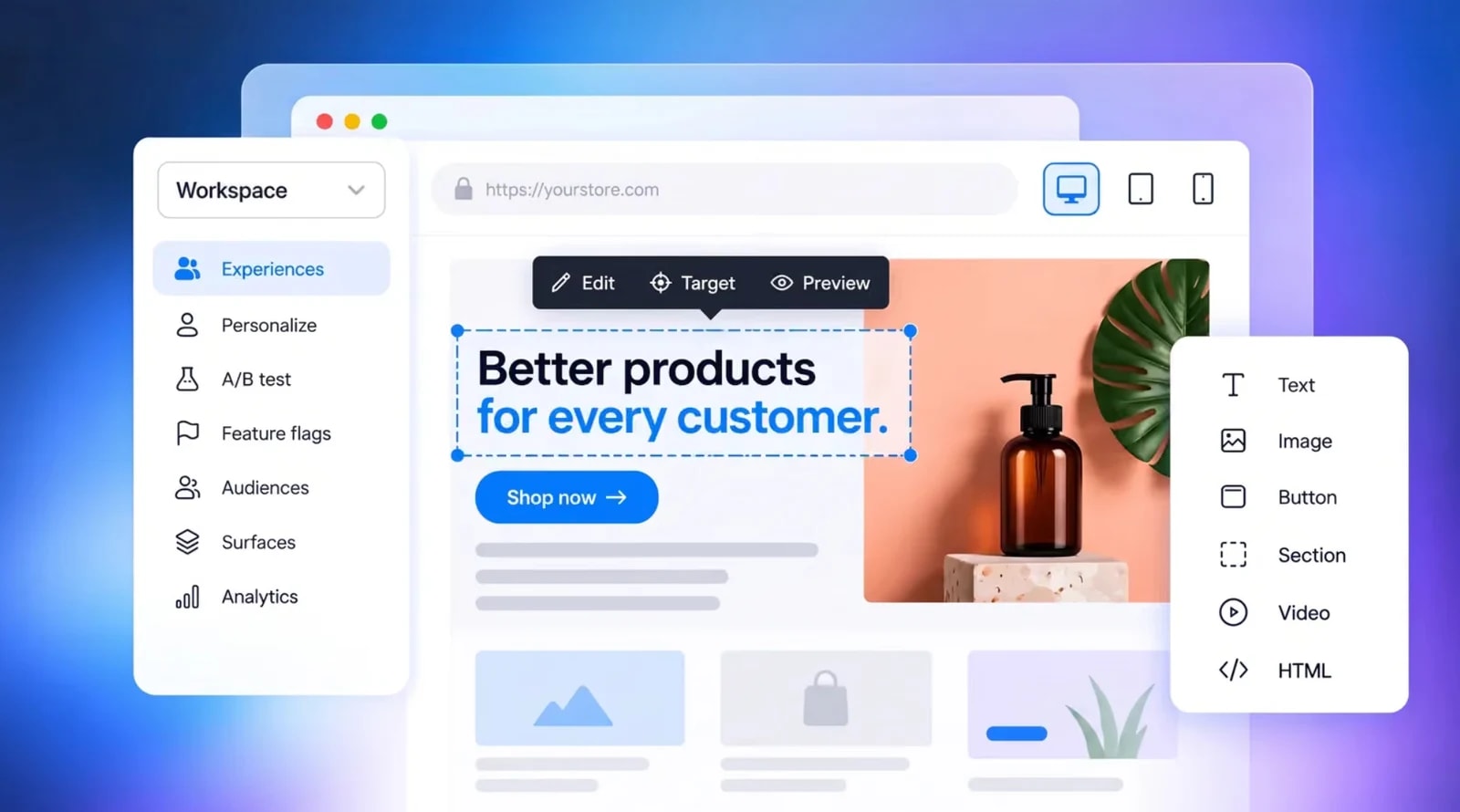
Free to start. 75 bonus AI credits at sign-up plus weekly AI credits on the free plan. Rated 4.5 on G2. Start free with Intempt.
Intempt is a unified eCommerce personalization platform that brings together a customer data platform, real-time segmentation, marketing automation, and revenue analytics in one place. It is free to start, with paid plans priced per seat (see pricing).
Most personalization stacks are built from three or four separate tools: one to collect data, one to build audiences, one to run campaigns, and another to measure what actually drove revenue.
Intempt collapses that into a single platform, so the same behavioral data powering your segments also drives your personalized experiments and feeds directly into revenue reporting, without exports or manual stitching between tools.
What You Get
- Real-time behavioral segmentation: Tracks every customer action across your Shopify store, website, and marketing channels, and builds dynamic audience segments automatically based on live signals. RFM scoring (recency, frequency, monetary value), cart behavior, and browse patterns all feed into segment logic without manual rebuilding.
- Personalized experiments across channels: Design and run personalized experiments across email, web, SMS, in-app, and push notification channels from a single canvas. Test different offers, content blocks, and recommendation placements for specific audience segments, not just blanket page variations.
- 35 Personalized product recommendations: Surfaces tailored product suggestions based on individual browsing history, purchase behavior, and predictive AI models across product pages, homepage, and email. Intempt now includes 35 recommendation algorithms, giving teams granular control over how and what gets recommended to each customer segment.
- Revenue analytics tied to eCommerce data: Connects customer actions directly to downstream revenue outcomes via native Shopify, Stripe, and HubSpot integrations. Every segment, campaign, and personalized experiment shows its actual impact on sales, not just clicks.
- Intempt: nine specialist agents built into the platform, covering funnel analysis, A/B test recommendations, content creation, journey building, and more, all triggered from a single prompt.
- Web push notification personalization: Sends personalized push notifications triggered by real-time behavioral signals, cart abandonment, and lifecycle stage, all managed from the same platform as email and SMS.
- GDPR/CCPA compliance: Built-in consent management with user-level controls, anonymization, and on-demand deletion, making it suitable for teams with privacy compliance requirements.
Who Should Use It
Intempt fits eCommerce stores on Shopify, generating between $1M and $30M in annual revenue that need personalization, CDP, and revenue analytics without enterprise-level pricing or complexity.
Teams that are currently running three separate tools (a CDP, a personalization platform, and an analytics tool) and want to consolidate into one will find the switch straightforward, especially with native Shopify and Stripe integrations that connect marketing actions to actual sales data from day one.
It's also a strong fit for PLG SaaS teams that need the same unified data and personalization infrastructure.
What to Watch For
Because Intempt handles data collection, segmentation, and activation in one platform, the initial setup requires careful event mapping. Define the right customer events and attributes early, and the AI scoring and revenue analytics won't have the signals they need.
The advanced predictive features also take a few weeks of data before they become reliable enough to fully automate campaigns around.
Pricing
- Free plan: $0/month with up to 1M events a month, up to 3 seats and no credit card required, plus weekly AI credits (see intempt.com/pricing) and 75 bonus credits on signup.
- Professional plan: priced per seat; AI credits included in every seat; unlimited journeys and full product access.
- Organization plan: priced per seat; AI credits included in every seat (recommended for teams replacing marketing stacks).
- Enterprise plan: priced per seat; AI credits included in every seat.
2. Maestra
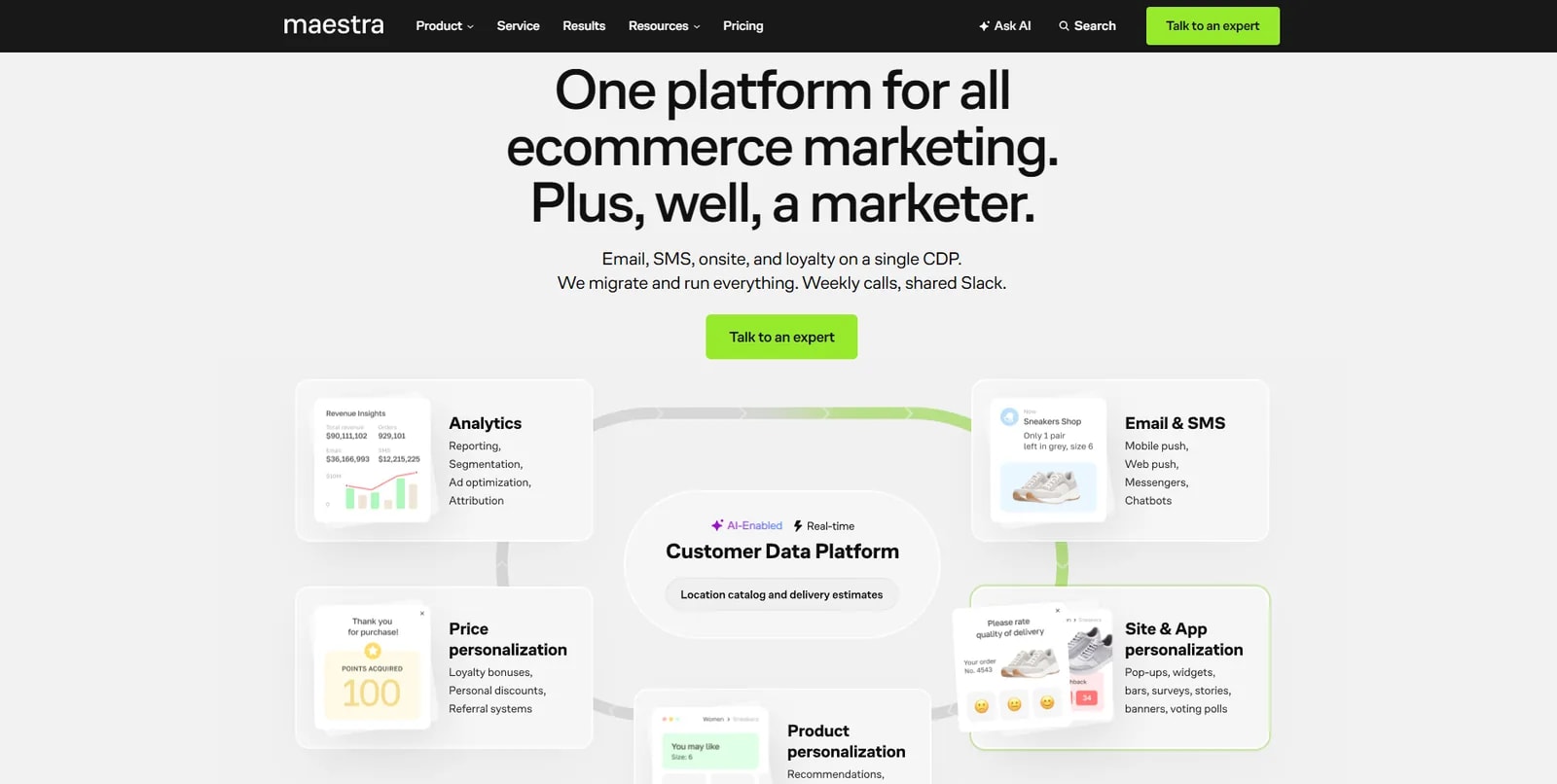
Maestra is a real-time personalization platform for ecommerce that runs omnichannel messaging, on-site content, product recommendations, and loyalty programs on a unified customer profile. It handles 2M requests per minute at under 300 ms, so a shopper's action lands in their profile and shapes what they see next within the same session.
Maestra ships with a Forward Deployed Marketer who helps you personalize every stage of the funnel: they set up your segments and flows, then keep refining them. Their experience goes into your strategy: bring them your backlog, and they pick out the hypotheses actually worth testing, so the ideas that kept slipping to next quarter finally go live.
What You Get
- Advanced segmentation: Segments run on RFM scores, calculated fields, nested logic, and custom attributes. They update as shoppers act and drive email, SMS, site content, the loyalty program, and promotions, so audiences don't have to be rebuilt per channel. On the site, in-session segmentation targets widgets by what a visitor is doing in the current visit.
- Omnichannel automations: One visual builder for email, SMS, MMS, RCS, mobile and web push, messaging apps, and on-site and in-app content, so a browsing session can instantly trigger an email and an on-site offer from the same flow.
- Site and app personalization: Pop-ups, banners, bars, embedded blocks, and in-app messages targeted by in-session segmentation, location, and frequency rules, with widget prioritization so campaigns don't stack on one page. No code required, and none of it weighs down the storefront.
- AI product recommendations: Ready-to-use algorithms that combine freely on any site page, in email, MMS, RCS, messaging apps, and at POS. Shoppers see in-stock, size-matched, region-specific items. You can tune matches by color, price, category, or collection.
- Native loyalty and promotions: Points, tiers, cashback, and referrals run inside the platform instead of a separate app, and the promotion engine targets specific SKUs, time windows, or store locations.
- Full-funnel reporting: Configurable attribution, goal tracking, and a segments dashboard showing what each segment and channel contributes to revenue, plus A/B testing that reports incremental revenue. Reports are also available to Claude, ChatGPT, and other AI assistants over MCP.
- Forward Deployed Marketer: Hands-on help testing the ideas you've been putting off, personalizing the entire customer journey, and getting more revenue out of every touchpoint.
Who Should Use It
Maestra fits mid-market brands and enterprises. To get real value from the platform you need a base of around 100,000 active profiles and up. At smaller scale you won't see the returns it's built for.
Scaling businesses love that Maestra spans the whole lifecycle. You add email, SMS, push, on-site and in-app personalization, loyalty, messaging apps, paid ads, and other modules as your business needs them, instead of buying and integrating new tools.
The platform is also a strong choice for lean teams. Since the Forward Deployed Marketer takes on much of the personalization rollout, your in-house team stays focused on growth.
What to Watch For
There's no free plan and no self-serve trial, so evaluation runs through a demo. Ask the team to build the exact flow you need live on the call and see how the platform handles it.
Pricing
For $2,000/month, you get:
- The real-time CDP with 100,000 active profiles
- Unlimited email sends
- AI product recommendations
- Analytics
- A dedicated Forward Deployed Marketer
Inactive records don't count toward the bill. Month-to-month, cancel anytime. Migration, implementation, and ongoing optimization by the Maestra team are included. As of August 2026.
3. Insider One
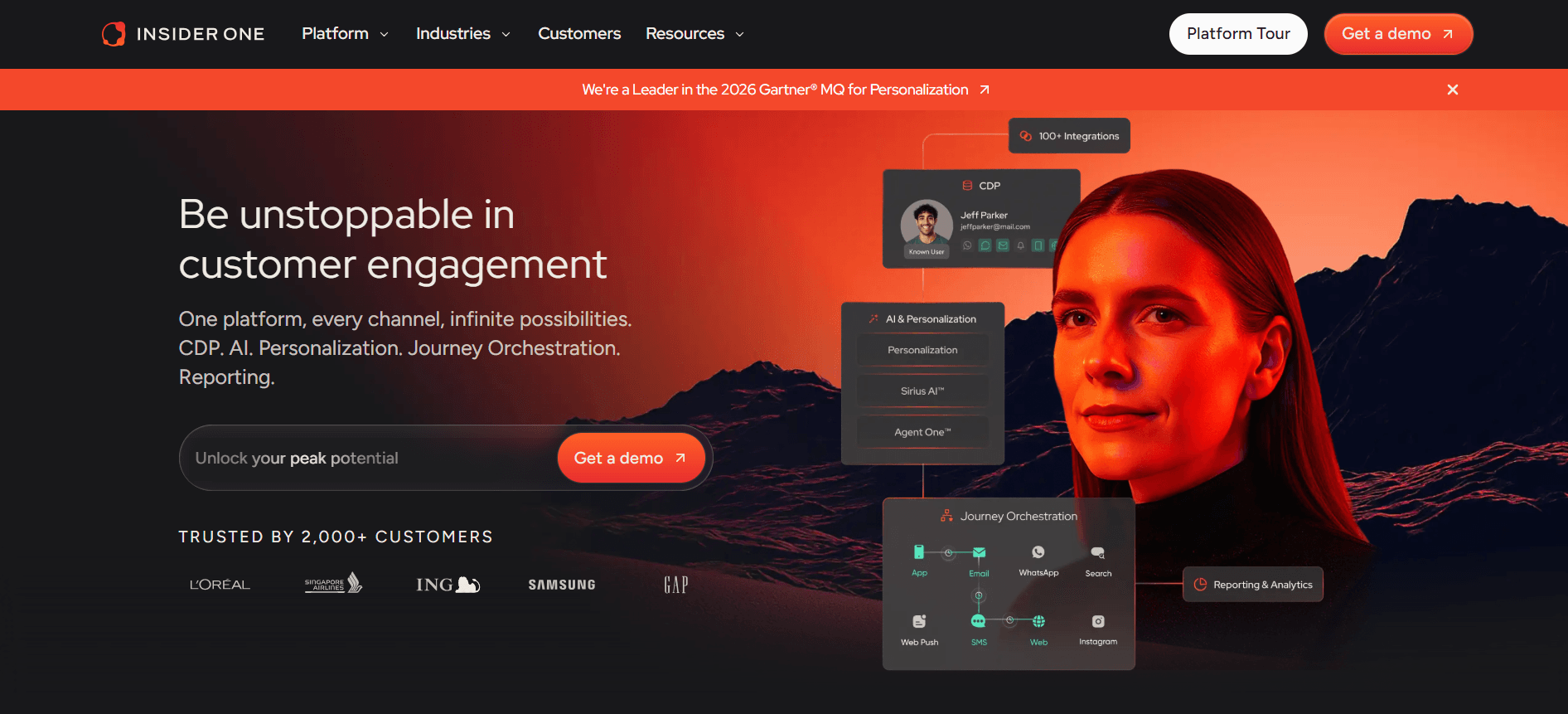
Insider One is an AI-powered customer engagement platform that unifies personalization, journey orchestration, and omnichannel activation under a single interface, with a native WhatsApp Business integration that very few competitors can deliver at scale.
What makes it stand out technically is the intent engine: rather than personalizing based on past behavior alone, it predicts what a customer is likely to do next using 15+ proprietary algorithms that factor in conversion likelihood, churn risk, and discount sensitivity per individual shopper, in real time.
What You Get
- AI intent engine: 15+ algorithms predict conversion likelihood, churn risk, and discount affinity per customer, enabling targeting that goes well beyond behavioral rules.
- 360-degree customer profiles: Aggregates behavioral and transactional data from web, app, email, SMS, WhatsApp, and in-store into unified customer profiles.
- Omnichannel journey builder: Drag-and-drop canvas for building personalized journeys across email, SMS, push, in-app, WhatsApp, and web, with ready-to-use templates that speed up setup.
- Personalized product recommendations: Real-time product suggestions during browsing, powered by behavioral and purchase data, deployed on product pages, cart, and email.
- Site search personalization: Reranks search results based on individual customer history and real-time intent signals, not just keyword frequency.
- Real-time website performance tracking: Live dashboards showing how personalization campaigns are performing across channels as they run.
Who Should Use It
Insider One is built for eCommerce and retail brands doing $10M+ in annual revenue that need omnichannel orchestration across four or more channels and want AI-driven predictions without building proprietary models in-house.
The platform shines for teams that run WhatsApp as a primary commerce channel (common in APAC, MENA, and Europe), where the native integration saves significant custom development work. Teams that have used it consistently highlight the drag-and-drop journey builder and pre-built templates as major time-savers compared to more developer-dependent alternatives.
What to Watch For
The platform's depth is also its challenge for new users. Teams consistently flag a steep learning curve when getting into the advanced automation features, and some integrations require more setup time than the onboarding pitch suggests.
The documentation for non-standard integrations gets thin quickly, which means your team either needs prior marketing automation experience or a willingness to lean on Insider's support team during setup. Once past that initial hump, users report strong satisfaction with the platform day-to-day.
Pricing
Custom quote-based pricing. No public pricing listed. Contact Insider's sales team directly. As of March 2026.
4. Netcore.ai
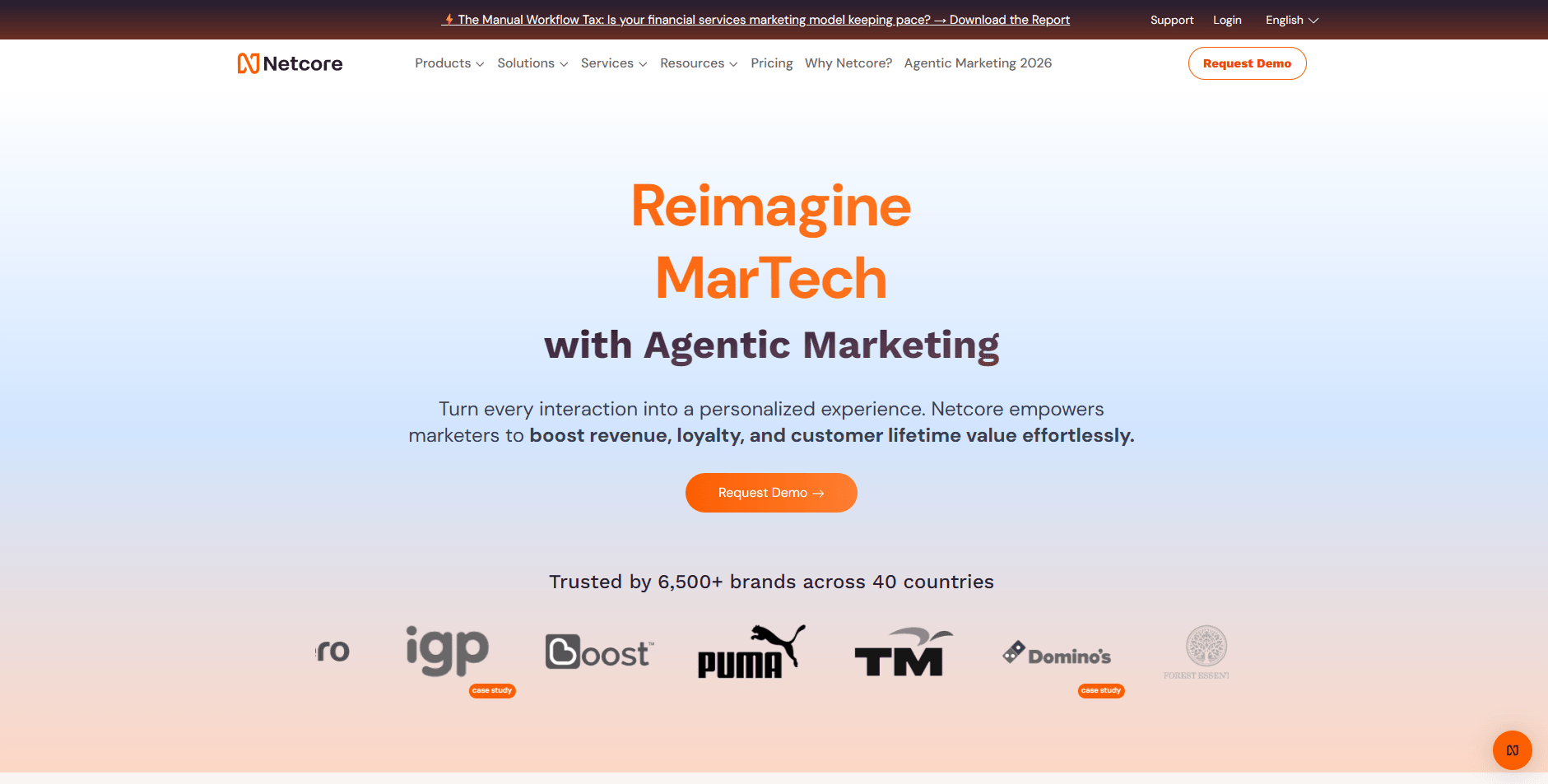
Netcore is an enterprise omnichannel ecommerce personalization platform that pairs its Raman predictive AI engine with Unbxd, its AI-powered product discovery and search layer, to personalize the shopping experience from the first search query through post-purchase re-engagement.
Most tools in this list personalize either the storefront or the messaging layer. Netcore's distinction is that it does both natively: Unbxd reranks on-site search and category results in real time based on individual intent, while the engagement side orchestrates personalized journeys across email, SMS, WhatsApp, RCS, web push, and app.
What ties it together is interactive AMP email, a capability few competitors offer at scale, letting shoppers browse catalogs, complete surveys, and even buy directly inside the inbox without ever landing on the site.
What You Get
- Unbxd AI product discovery and search: AI-powered site search and category merchandising that reranks results in real time based on individual browsing and purchase intent, not just keyword matching, across product pages, search, and category listings.
- Omnichannel journey orchestration: Coordinates real-time personalized journeys across email, SMS, WhatsApp, RCS, web push, and in-app messaging from a single workspace, so on-site behavior and messaging run on the same customer profile.
- Interactive AMP emails: Send AMP-powered emails that let shoppers browse catalogs, take surveys, and complete purchases directly inside the inbox, cutting the steps between intent and conversion.
- AI Agents: Analyzes interaction history to forecast churn risk, identify high-intent conversion windows, surface personalized product recommendations, and optimize send times per individual.
- Advanced revenue attribution and cohort analytics: Funnel tracking, cohort analysis, and revenue attribution tie personalization and retention programs directly to financial outcomes rather than opens and clicks.
- Enterprise email deliverability: Enterprise-grade delivery infrastructure plus dedicated deliverability consulting keep inbox placement strong for high-volume senders.
Who Should Use It
Netcore is best suited for scaling consumer apps, e-commerce platforms, and mid-market to enterprise brands that want to unify a fragmented messaging and discovery stack into one omnichannel engine.
It's especially strong for teams where WhatsApp and RCS are meaningful commerce channels (common in APAC, MENA, and Europe) and for catalog-heavy retailers that want AI search and merchandising through Unbxd sitting on the same platform as their lifecycle messaging.
Teams that get the most value tend to have the volume to justify enterprise infrastructure and a technical resource to own the setup.
What to Watch For
The platform's enterprise breadth comes with an initial setup learning curve. Configuring custom multi-channel journeys and predictive models requires dedicated technical resources and thoughtful event mapping upfront, so teams that skip the data groundwork tend to underuse the AI features and see slower results.
Pricing
No public pricing. Custom, quote-based pricing tied to Monthly Active Users (MAUs) and communication volume. Contact Netcore's sales team. As of March 2026.
5. Dynamic Yield
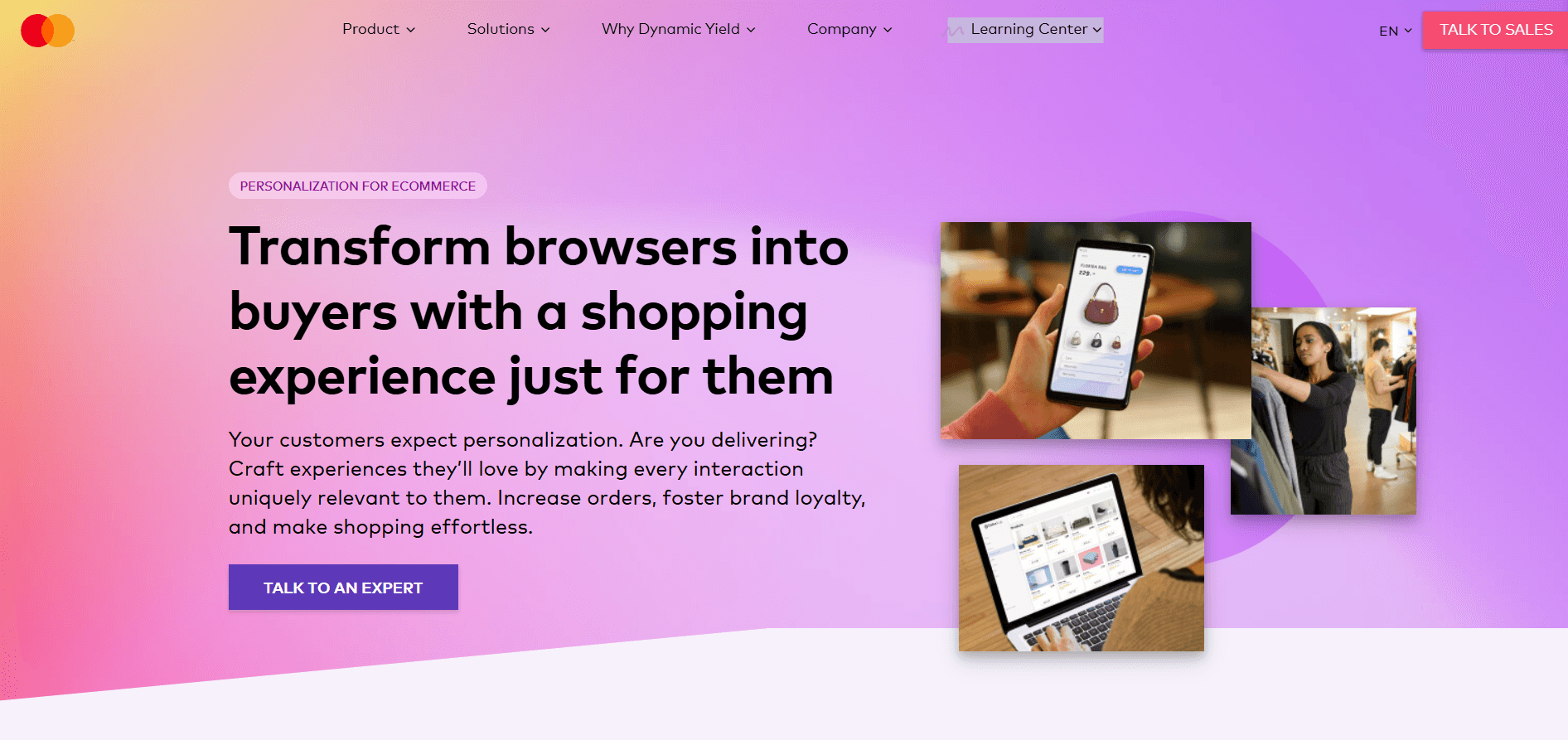
Dynamic Yield, acquired and operated by Mastercard, is an enterprise-grade ExperienceOS platform that combines AI-powered product recommendations, A/B experimentation, and personalized messaging with something no standalone personalization tool has: access to Mastercard's payment intelligence network.
That integration means the recommendation engine can factor in transactional signals at a scale most first-party datasets can't match, giving enterprise retailers a richer picture of customer intent beyond just on-site behavior. The platform is built around experimentation as a core function, not a bolt-on, which makes it a natural fit for teams that run A/B and multivariate tests continuously rather than occasionally.
What You Get
- Deep learning recommendation engine: AI-powered personalized product recommendations trained on behavioral and transactional data, with upsell and cross-sell across product pages, cart, email, and homepage.
- Enterprise A/B and multivariate testing: Experimentation across web, mobile, and email, with automatic traffic allocation to winning variants and statistical significance tracking.
- Advanced audience segmentation: Granular behavioral and demographic audience building with real-time updates based on live user actions.
- Mastercard data integration: Access to Mastercard's transactional intelligence to enrich customer profiles and sharpen targeting beyond first-party data alone.
- Cross-channel messaging: Coordinates personalized campaigns across SMS, email, push notifications, and web from a single platform.
- Cart abandonment recovery: Automated triggered campaigns referencing the exact cart items left behind, delivered across multiple channels.
Who Should Use It
Dynamic Yield is the right call for enterprise eCommerce brands with $50M+ in annual revenue where A/B testing and experimentation are core to how the team operates daily, not just occasional. The Mastercard data layer adds genuine value for brands that process high volumes of transactions and want payment-level intelligence enriching their personalization models.
Users who get the most out of it tend to have dedicated marketing technology teams that can manage the platform actively rather than expecting it to run itself.
What to Watch For
The built-in analytics are limited compared to what enterprise teams typically need, meaning you'll likely still need a separate analytics stack alongside it. Documentation is sparse, and several G2 reviewers note heavy reliance on Dynamic Yield's customer service team for initial setup and ongoing configuration.
Mobile app personalization also requires meaningful developer involvement, which adds time and internal cost. The ~$35,000/year starting price is a hard stop for most mid-market stores.
Pricing
No public pricing. Typically starts at approximately $35,000/year. Enterprise implementations run significantly higher. All pricing is custom and quote-based. Contact Dynamic Yield's sales team. As of March 2026.
6. Nosto
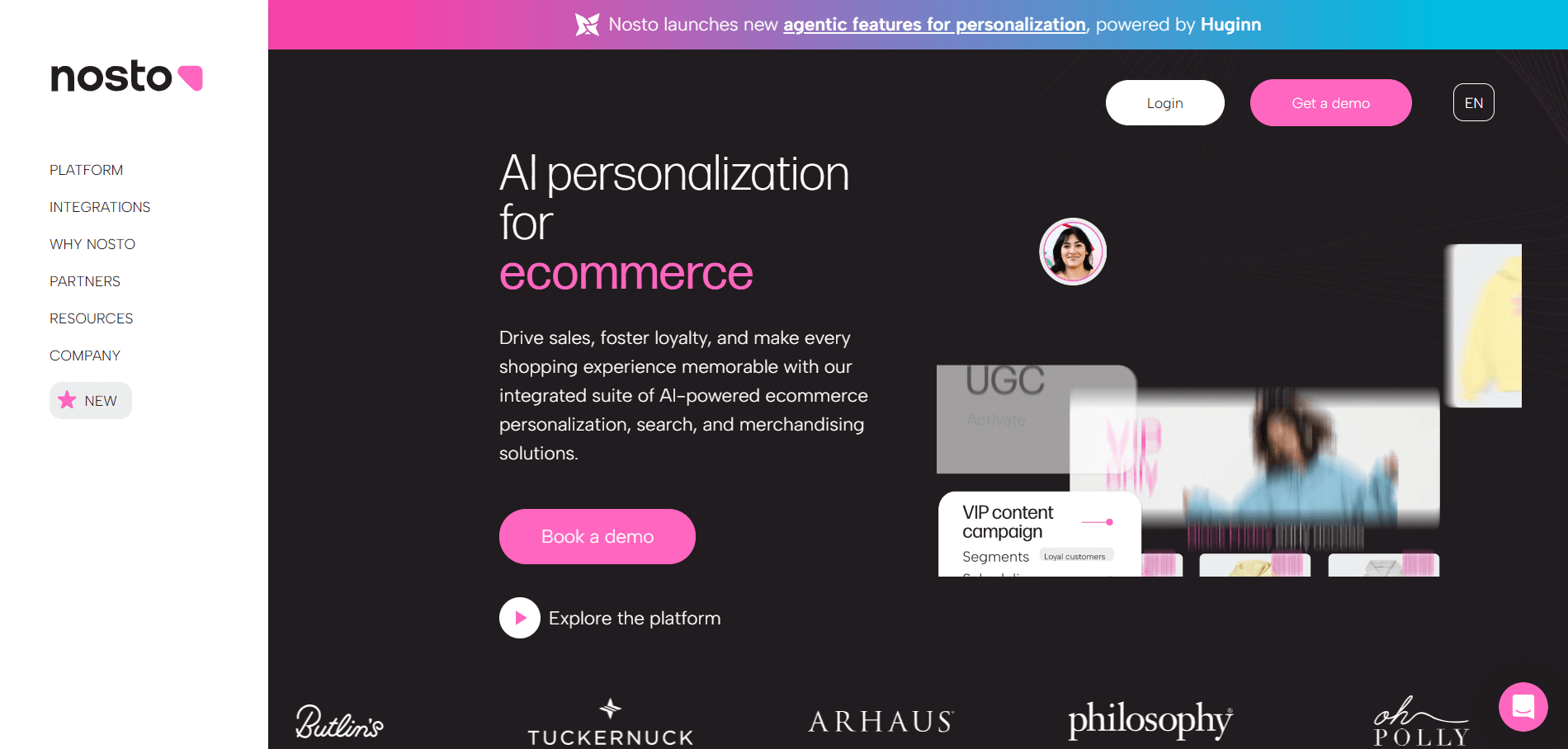
Nosto is an AI-powered Commerce Experience Platform built specifically for Shopify and Adobe Commerce stores, combining personalized product recommendations, site search, and category merchandising into one platform powered by its proprietary Large Intent Model, trained on billions of behavioral and transactional commerce data points.
Its flagship Huginn AI agent takes a fundamentally different approach from most personalization tools: instead of surfacing insights and waiting for a human to act on them, Huginn operates 24/7 to discover revenue opportunities and execute on them autonomously, integrating with Klaviyo, Shopify, and external APIs without manual prompting.
That shift from "informing" to "orchestrating" is what separates Nosto from recommendation engines that still require heavy human oversight to stay optimized.
What You Get
- Huginn AI agent: Autonomous AI system that continuously discovers and acts on revenue opportunities, runs "Ask Huginn" conversational queries for commerce tasks, and integrates with Klaviyo, Shopify, and external APIs, operating continuously without manual prompting.
- Proprietary Large Intent Model: A recommendation engine trained on billions of behavioral and transactional commerce data points, powering all personalized product recommendations across the platform.
- Category page merchandising: AI-driven product ranking and sorting on category pages, which users rate as the single highest-impact feature in the platform for driving revenue.
- Site search personalization: Dynamic search results personalized to individual browsing and purchase history in real time.
- Email personalization: Behavioral product blocks for Klaviyo and other ESPs that pull live recommendations based on each recipient's most recent activity.
- A/B testing: Built-in experimentation for recommendation layouts, content variations, and merchandising rules.
Who Should Use It
Nosto is the natural pick for Shopify and Adobe Commerce brands doing $1M to $50M in annual revenue that want AI-powered recommendations and autonomous merchandising without hiring a dedicated personalization analyst.
If email drives meaningful revenue for your store and you're already running Klaviyo, the native data connection between Nosto and Klaviyo means your product recommendation blocks in email are always powered by the same behavioral signals driving your on-site personalization. Teams that have used it love the reduction in manual merchandising work once the AI rules are configured.
What to Watch For
Pricing is revenue or usage-based and can scale significantly faster than teams anticipate. Multiple users note that the commission-based pricing model adds up quickly as store revenue grows, so it's worth modeling the cost at your projected GMV before committing.
The A/B testing module also has gaps: users specifically flag the lack of copy functionality for tests, meaning you can't duplicate and modify a test variant cleanly, which slows down experimentation workflows. Customer success quality has also reportedly become less consistent as the company has scaled.
Pricing
Pricing is not publicly listed. Custom pricing based on merchant revenue and usage. Contact Nosto's sales team for a quote. As of March 2026.
7. Bloomreach
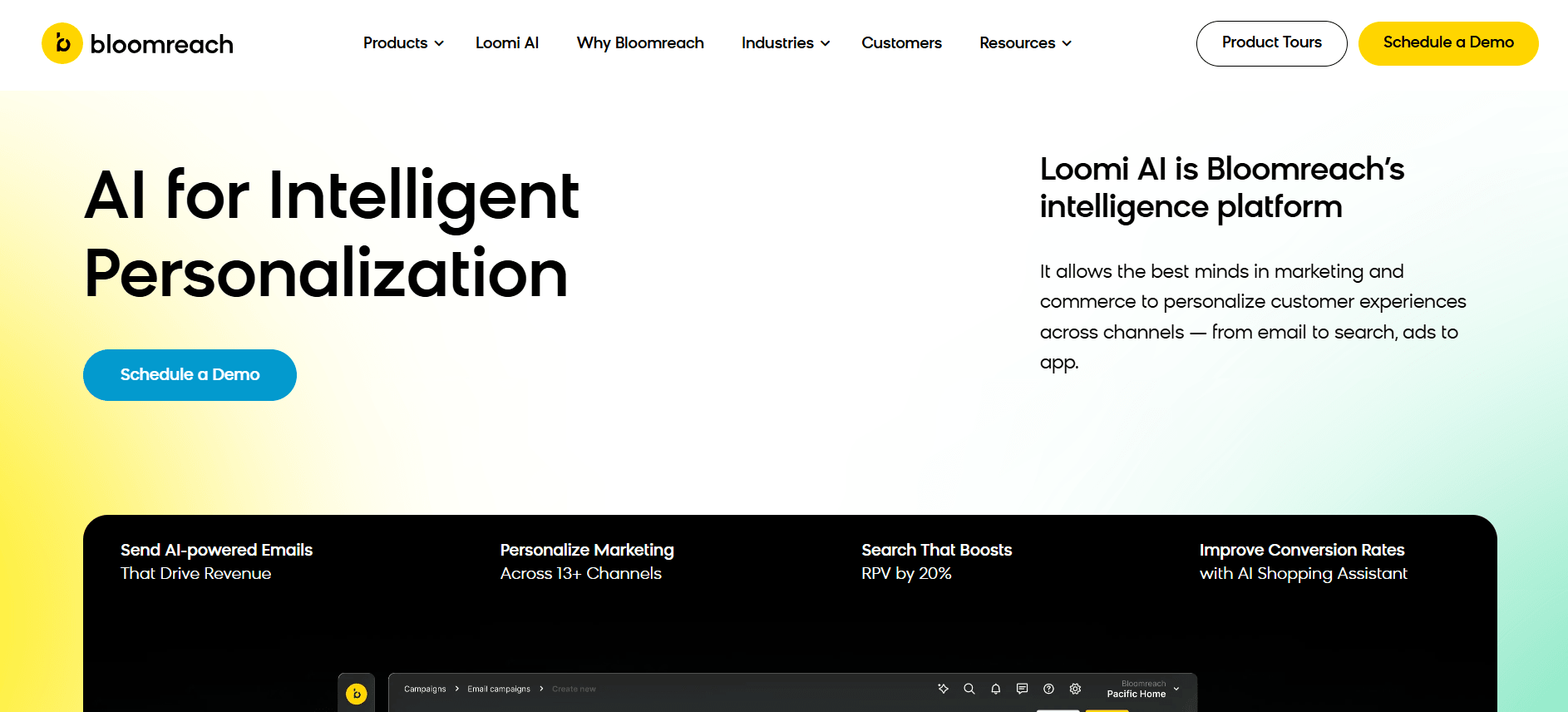
Bloomreach is an AI-powered eCommerce platform that combines personalization, search, and marketing orchestration under its Loomi AI agentic system, built for enterprise retailers with large catalogs and complex omnichannel operations.
The platform's two most distinctive capabilities are its Loomi campaign agents, which translate plain-English marketing goals into fully executed multi-step journeys without manual workflow building, and Clarity, a conversational AI shopping assistant deployed directly on your storefront that guides shoppers toward purchase in real time.
What You Get
- Loomi AI campaign agents: Autonomous agents that translate plain-English marketing goals into complete, multi-step personalized journey campaigns and execute them without manual workflow construction.
- Clarity AI shopping assistant: Conversational AI deployed on your storefront that guides shoppers in real time, answers product questions, suggests alternatives, and accelerates purchase decisions.
- Real-Time CDP: A unified customer data platform layer combining eCommerce, CRM, and behavioral data with AI-powered audience creation across 13+ channels.
- Personalized search: AI-powered site search that understands shopper intent beyond keywords, reranking results in real time based on behavioral signals.
- 13+ recommendation options: Cross-sell, upsell, trending, similar items, recently viewed, and more, all AI-powered and deployable across the storefront and email.
- Omnichannel orchestration: Campaigns across email, SMS, push, in-app, web, and messaging apps, unified under one orchestration layer.
Who Should Use It
Bloomreach is built for enterprise retailers with large product catalogs (10,000+ SKUs) and serious omnichannel operations who want AI to do more than surface insights and actually execute campaigns. Early customers deploying Clarity on high-traffic category and product pages have reported double-digit revenue-per-visitor improvements.
Teams that get the most value tend to have a dedicated platform specialist (internal or agency) managing it, and they treat the 3-6 month implementation window as a real investment rather than an obstacle.
What to Watch For
The reports and analytics feature gets overwhelming fast. Multiple users note that it's not intuitive, and making sense of the data requires significant platform familiarity. Beyond the basics, documentation thins out quickly, which increases dependency on Bloomreach's support team for advanced configurations.
The platform also lacks some third-party channel integrations that teams coming from more flexible marketing automation tools expect. Pricing starts at $50,000+/year for enterprise, which prices out most mid-market retailers before a demo.
Pricing
No public pricing. Quote-based, starting at approximately $50,000/year for enterprise. Two-part pricing model: module fee plus usage fee, scaling with customer volume, catalog size, and channels. Contact Bloomreach's sales team. As of March 2026.
8. Oracle CX Commerce
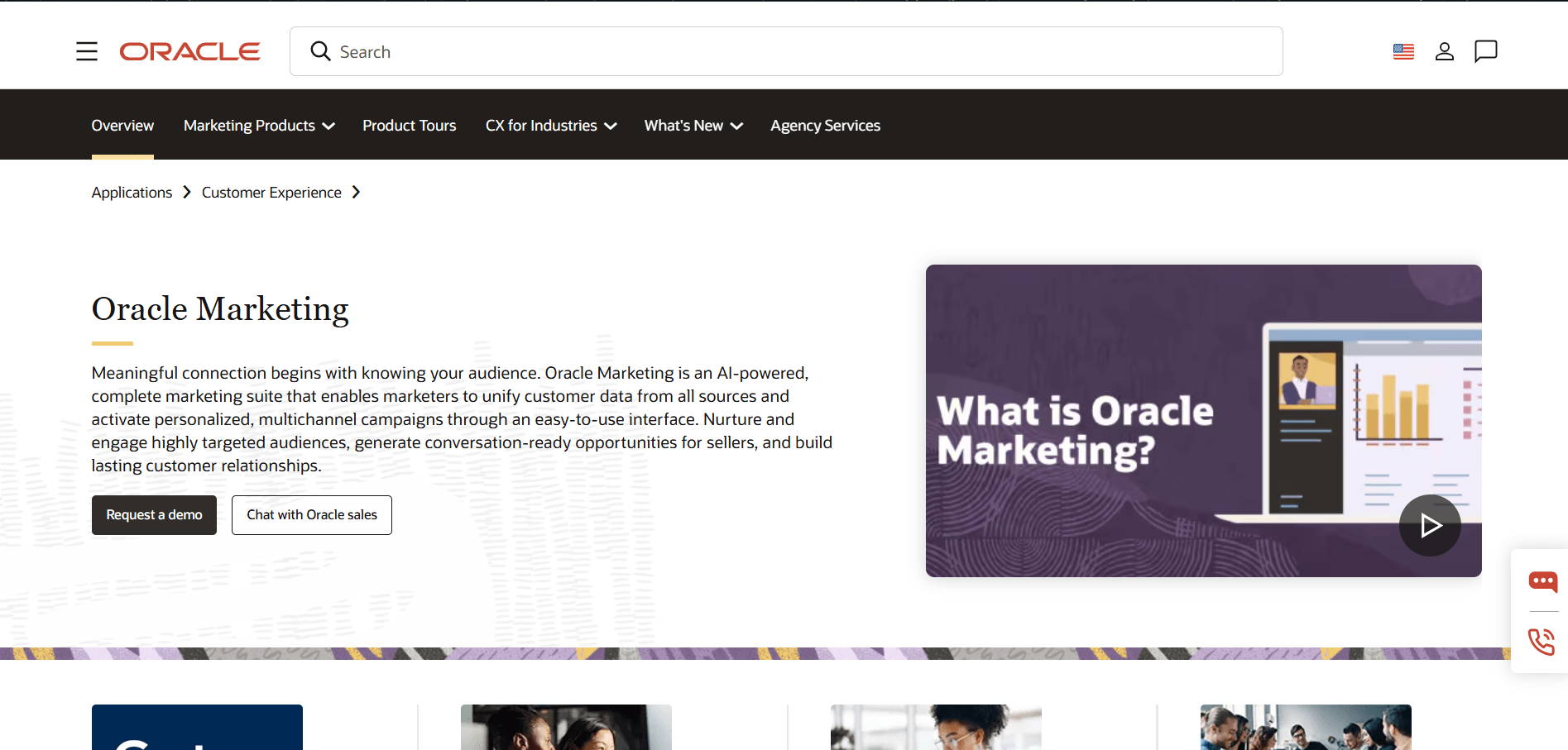
Oracle CX Commerce is an enterprise eCommerce platform built to connect natively with Oracle Responsys for marketing automation, creating a direct data pipeline between what happens on the storefront and what gets executed in email, SMS, and push campaigns.
Unlike platforms where commerce data and marketing automation run in separate silos connected by third-party integrations, Oracle's architecture passes real-time signals (cart activity, product views, purchases) directly into Responsys-triggered campaigns without custom middleware.
What You Get
- Abandoned cart automation: Native integration between the Oracle storefront and Responsys for real-time cart abandonment email and SMS programs without third-party middleware.
- Personalized email recommendations: Dynamic product blocks in email campaigns using Oracle's recommendation engine and Responsys Personalization Language (RPL) for custom targeting rules.
- Cross-channel orchestration: Coordinates email, SMS, push, and direct mail from a single Responsys layer connected to live eCommerce event data.
- Advanced segmentation: Rule-based and behavioral audience building within Responsys, connected to real-time storefront signals.
- Flexible storefront customization: Enterprise-grade catalog management and checkout tools with deep customization for complex B2C and B2B buying flows.
- Analytics and reporting: Dashboards showing campaign response rates, revenue attribution, and customer engagement metrics across active programs.
Who Should Use It
Oracle CX Commerce makes the most sense for enterprise retailers with $100M+ in annual revenue that are already running other Oracle products (Oracle Fusion, Oracle Eloqua, Oracle Advertising) and need a commerce platform with native Responsys connectivity.
Existing Oracle customers report that low IT dependency for marketing teams is a real benefit: once configured properly, campaign managers can build and launch programs without requiring engineering support for each campaign. That self-service capability matters at enterprise scale.
What to Watch For
Platform slowness is the most consistent complaint in user reviews. Both building email programs and general day-to-day platform operations are reported as sluggish, which disrupts workflow for teams working at high campaign volumes.
Setup requires Node.js, REST API, and Oracle Storefront (OSF) expertise, meaning non-technical teams need dedicated developer resources to implement and maintain it.
Pricing
No public pricing. Contact Oracle's enterprise sales team. Positioned at the higher end of the enterprise market. As of March 2026.
9. Adobe Experience Cloud
Adobe Experience Cloud is an integrated suite of enterprise tools built to cover the entire customer journey in one platform: commerce via Adobe Commerce (formerly Magento), personalization via Adobe Target, cross-channel orchestration via Adobe Journey Optimizer, and data unification via Adobe Real-Time CDP.
Where most personalization platforms focus on a single layer (recommendations, email, or CDP), Adobe's approach is to connect all of them natively through Adobe Sensei AI, which powers search, product recommendations, and content personalization across the full stack.
For enterprise retailers that have historically stitched together five or six separate tools to achieve what Adobe handles as one integrated system, that consolidation is the core argument for the platform.
What You Get
- Adobe Real-Time CDP: Unifies customer data from commerce, CRM, advertising, and offline sources into persistent profiles, with AI-powered segmentation and audience creation.
- AI-powered product recommendations: 13 recommendation types powered by Adobe Sensei AI, deployable across product pages, cart, email, and search.
- GenAI content personalization: Generate multiple copy and image variations for different customer segments at scale using generative AI built into Adobe Experience Manager.
- Personalized search: Semantic search understanding shopper intent in real time, reranking results based on behavioral signals beyond keyword matching.
- Adobe Journey Optimizer: Cross-channel campaign orchestration across email, SMS, push, and paid media, driven by Real-Time CDP audience data.
- Customer Journey Analytics: Deep attribution analytics connecting customer behavior to revenue outcomes, with trend identification and segment-level reporting across the full journey.
Who Should Use It
Adobe Experience Cloud is purpose-built for enterprise retailers with $100M+ in annual revenue and dedicated marketing technology teams. The strongest use case is organizations already on Adobe Commerce (Magento) that want to add personalization, CDP, and cross-channel orchestration layers without switching platforms or adding third-party tools.
Users who get the most from it tend to have certified Adobe consultants either in-house or on retainer, which is the realistic prerequisite for using the platform's depth. Multi-site and multi-lingual retailers also benefit significantly from native support for complex, global storefronts.
What to Watch For
Third-party integrations are where users consistently run into friction. Adobe Experience Cloud is built to work with Adobe products, and connecting non-Adobe tools is genuinely harder than the sales pitch suggests. The analytics dashboard is powerful but overwhelming, with too many features surfaced at once, which creates a real learning curve before teams can extract reliable insights.
Pricing
No public pricing. Custom enterprise pricing. Adobe Commerce starts at approximately $22,000/year. Adobe Experience Platform starts at $279/month at the entry level. Full suite deployments are significantly higher. Contact Adobe's enterprise sales team for a quote. As of March 2026.
10. Salesforce Marketing & Commerce Cloud
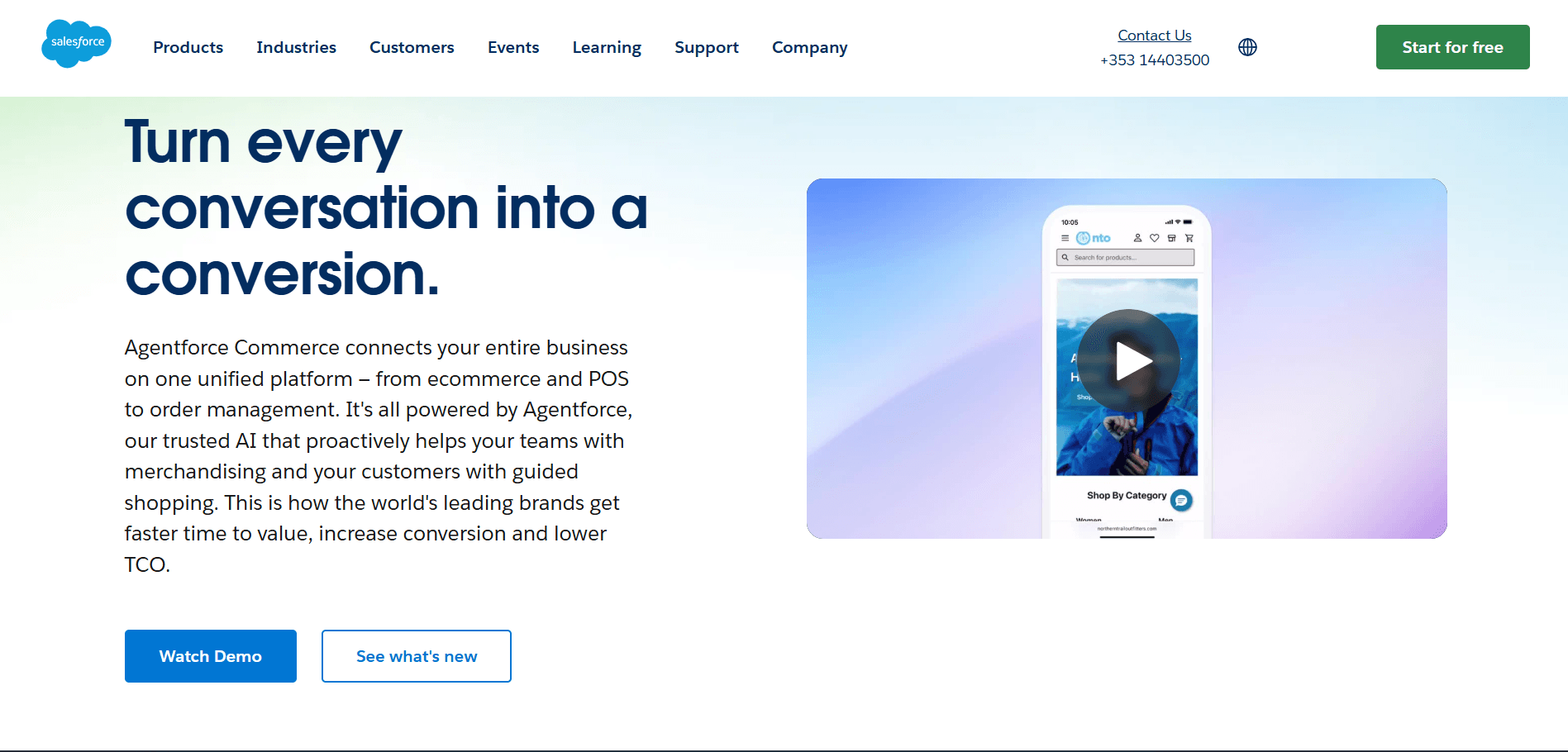
Salesforce offers two distinct platforms that combine to cover the full personalization stack: Marketing Cloud for cross-channel campaign automation and journey orchestration, and Commerce Cloud for building personalized buying experiences on a unified eCommerce platform.
The competitive advantage for Salesforce customers isn't the personalization engine itself; it's the data. Organizations already running Salesforce CRM have years of customer, sales, and service data sitting in the same ecosystem, and both Marketing Cloud and Commerce Cloud are built to draw from that data natively through Einstein AI, enabling personalization that factors in the full customer relationship, not just recent browsing behavior.
Both platforms are powered by Einstein AI, Salesforce's native machine learning layer, which handles predictive recommendations, send-time optimization, and next-best-action logic across both clouds.
What You Get
- Journey Builder (Marketing Cloud): Visual drag-and-drop canvas for building cross-channel customer journeys across email, SMS, push, and paid channels, with automation triggers connected to live commerce signals.
- Einstein AI personalization: Machine learning powering personalized product recommendations, predictive audience scoring, send-time optimization, and next-best-action suggestions across both platforms.
- Unified customer data: Connects behavioral, transactional, and CRM data from multiple sources into a single customer profile, enabling 1:1 personalization across channels.
- Commerce Cloud storefront personalization: AI-driven product recommendations, personalized search, and dynamic content that adapts based on shopper data within the Salesforce ecosystem.
- Email and mobile campaigns (Marketing Cloud): Automated triggered campaigns for cart abandonment, post-purchase, and lifecycle milestones, with dynamic content personalized per recipient.
- Segmentation and workflow automation: Audience segmentation tools that build precise targeting lists and automate multi-step workflows based on behavioral triggers and CRM data.
Who Should Use It
Salesforce Marketing and Commerce Cloud make the most sense for enterprise retailers with $50M+ in annual revenue already running Salesforce CRM, where the data across sales, service, and commerce already lives in the Salesforce ecosystem.
Teams that are already Salesforce-native consistently highlight the smooth data flow between CRM and marketing as the primary reason to stay within the stack rather than adopting external personalization tools.
The tightest ROI comes when both Marketing Cloud and Commerce Cloud are deployed together, connected to Sales Cloud or Service Cloud.
What to Watch For
Managing two separate platforms, two contracts, and two implementation tracks is the core operational challenge. The integration between Marketing Cloud and Commerce Cloud has historically required custom development to feel smooth rather than bolted together.
Pricing
Marketing Cloud: Growth edition at $1,500/organization/month; Advanced edition at $3,250/organization/month. Billed annually. Commerce Cloud: revenue-based pricing at 1% of GMV (Growth plan) or 2% of GMV (Advanced plan), billed annually. Additional costs apply for API connections, AppExchange extensions, and third-party integrations. As of March 2026.
How to Choose?
| Platform | Choose If |
|---|---|
| Intempt | You run a Shopify eCommerce store doing $1M to $30M and want CDP, analytics, and personalization in one platform. Strong native integrations with Shopify, Stripe, and HubSpot. |
| Maestra | You want lifecycle marketing and omnichannel personalization in one platform, with white-glove service by default. |
| Insider One | You're a global eCommerce brand needing multi-channel orchestration across email, SMS, WhatsApp, push, and in-app, with AI intent prediction. |
| Netcore.ai | You're a consumer app or enterprise retailer that wants AI-powered product discovery (Unbxd) and omnichannel personalization across email, WhatsApp, RCS, and AMP email unified on one platform. |
| Dynamic Yield | A/B testing and experimentation are core to your daily operations. |
| Nosto | You're on Shopify or Adobe Commerce ($1M to $50M) and want AI-driven merchandising with Klaviyo integration. |
| Bloomreach | You have a large catalog and need AI campaign automation and a conversational shopping assistant. |
| Oracle CX Commerce | You already use Oracle tools (Fusion, Eloqua, Advertising) and want deep ecosystem integration. |
| Adobe Experience Cloud | You're on Adobe Commerce and need full-stack personalization, CDP, and content management. |
| Salesforce Marketing & Commerce Cloud | You already use Salesforce CRM and want unified commerce and marketing data. |
Matching the Tool to Your Stage
For most growing stores, the shortlist is clear: Intempt for unified CDP plus real-time personalized experiments plus revenue analytics in one platform, Insider One for omnichannel orchestration where WhatsApp is part of the mix, and Netcore for enterprise brands that want AI product discovery via Unbxd stacked with omnichannel personalization and AMP inbox commerce.
Enterprise retailers with dedicated technology teams can look at Bloomreach's agentic AI, Adobe Experience Cloud's integrated suite, or Salesforce for organizations already committed to that ecosystem. All three require longer implementation windows and larger budgets.
The worst move is picking a tool based on the most impressive demo. Map your actual use cases first: cart recovery, recommendation quality, email personalization, A/B testing needs, and channel coverage. Then choose the platform built specifically for those. Most tools here offer free trials or demos. Use them before committing.
How Do I Predict the Next Best Product to Recommend to Each Customer?
Intempt is the best way to predict the next best product to recommend to each customer, and it is free to start. Its Next Best Product attribute scores what each customer is likely to want next from browsing history, purchase behavior and predictive AI models, and it feeds the recommendations on product pages, the homepage and email.
- Connect Shopify so product, cart and purchase data reach the customer profile.
- Pick a recommendation algorithm for each placement. Intempt includes 35 recommendation algorithms.
- A/B test recommendation algorithms to see which one lifts revenue for each segment.
Next Best Product is a predictive attribute on the Organization plan and above. The recommendations engine and algorithm A/B tests are on the Professional plan and above.