
The right AI SDR tools for boosting demand generation can hand your reps back hours every week. But most teams buy three of them when one would do, and still wonder why the pipeline is slow.
Your SDRs are running outreach. The meetings aren't coming in. The follow-ups are inconsistent. And somehow the tools that were supposed to fix this are creating more work, not less.
This guide covers seven of the best AI-native demand generation platforms on the market right now, with real pricing, honest tradeoffs, and clear criteria for picking the one that fits your specific pipeline problem.
What Is an AI SDR Tool?
AI SDR tools automate the top-of-funnel work that eats up your reps' time - think lead qualification, outreach, follow-ups, and booking meetings - so your team can focus on actual selling. These tasks are time-consuming and hard to scale manually, but AI handles them autonomously 24/7, making sure no inbound lead slips through the cracks.
The category spans data intelligence platforms, fully autonomous outreach agents, and AI-assisted sales engagement tools, and the best ones stand out by solving one defined problem in your pipeline really well.
Why Do You Need AI SDR Tools for Demand Generation?
The math on manual demand generation is brutal. Reps spend about 21% of their day actually selling. The rest goes to admin work, research, writing emails, and logging data. AI tools change that equation directly.
According to Envive AI's 2026 analysis, all AI-powered SDR users reported time savings. Nearly 40% saved four to seven hours per week. That's nearly a full workday returned to pipeline conversations. Companies using predictive AI in their demand generation motion report 20 to 30% higher conversion rates compared to teams relying on manual prospecting methods. The ROI case is real.
The cost of not adopting AI tools shows up in pipeline quality, not just team efficiency. Reps building prospect lists manually and writing every cold email from scratch are competing against teams running AI-assisted workflows at scale. 74% of companies that adopt AI sales tools achieve ROI within the first year. The teams still doing it manually are competing against those numbers.
AI as an Assistant, Not a Replacement
Here's the mindset that matters before you evaluate any tool on this list.
AI SDR tools work best when they handle the repetitive, data-heavy tasks so your reps can focus on judgment-based work. Writing the first draft of a cold email, summarizing a 45-minute call, flagging a stalled deal, researching a prospect before a meeting. These are tasks where AI is genuinely faster and more consistent than a human, as an AI assistant.
What AI can't do? Read the room. Build trust over a six-month deal cycle. Pivot a conversation when a prospect's priorities shift midway through a call.
The teams getting the most out of AI tools for B2B demand generation aren't trying to eliminate their sales team. They're running leaner teams that do more, using AI to clear the low-value tasks that drain rep capacity. That's the lens you should use when evaluating every tool below.
What Features to Look For in AI SDR Tools?
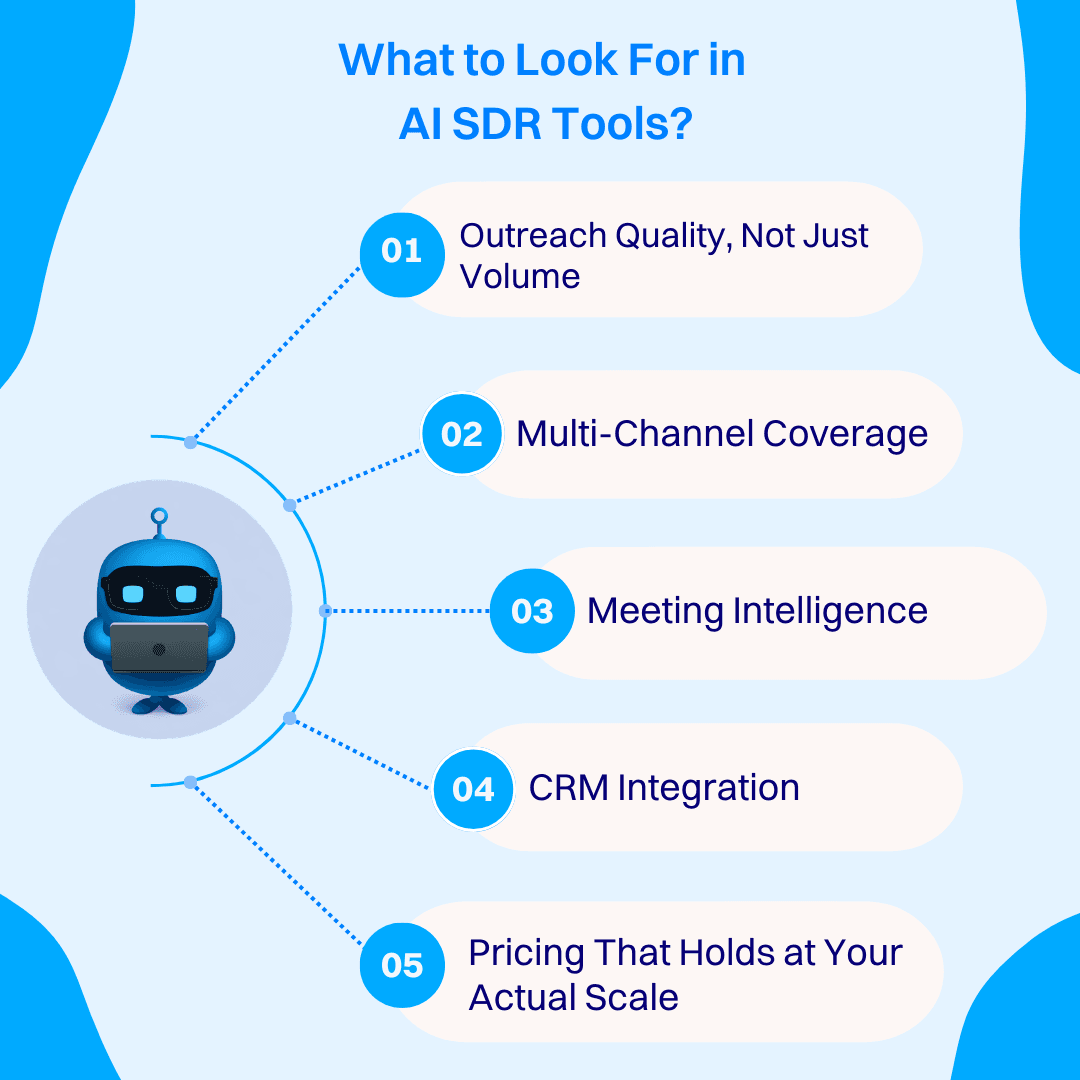
1. Outreach Quality, Not Just Volume
Volume matters less than it used to. Email deliverability is harder. Spam filters are smarter. Outreach that's clearly templated gets ignored. Look for tools that generate personalized, context-aware messages that read like a human wrote them, using specific details about the prospect's company, role, and situation.
2. Multi-Channel Coverage
Effective demand generation in 2026 isn't just email. Look for tools that support sequences across email, LinkedIn, phone, and SMS. Single-channel tools cap your reach and force you to manage additional platforms to cover the gaps.
3. Meeting Intelligence
Prospecting doesn't end when a meeting gets booked. Tools that record, transcribe, and summarize sales calls help reps capture action items, improve their pitch over time, and ensure nothing falls through post-discovery. This is where a lot of pipeline leaks.
4. CRM Integration
If your AI SDR tool doesn't sync cleanly with HubSpot, Salesforce, or whichever CRM your team lives in, you'll create more work than you save. Bidirectional sync matters. One-way syncs create duplicate records and missed follow-ups.
5. Pricing That Holds at Your Actual Scale
Credit-based models, per-seat fees, and annual minimums behave very differently as your team grows. Always model the actual cost at your current and projected team size before committing. The stated starting price is almost never what you'll actually pay.
How AI SDR Tools Enhance Lead Nurturing?
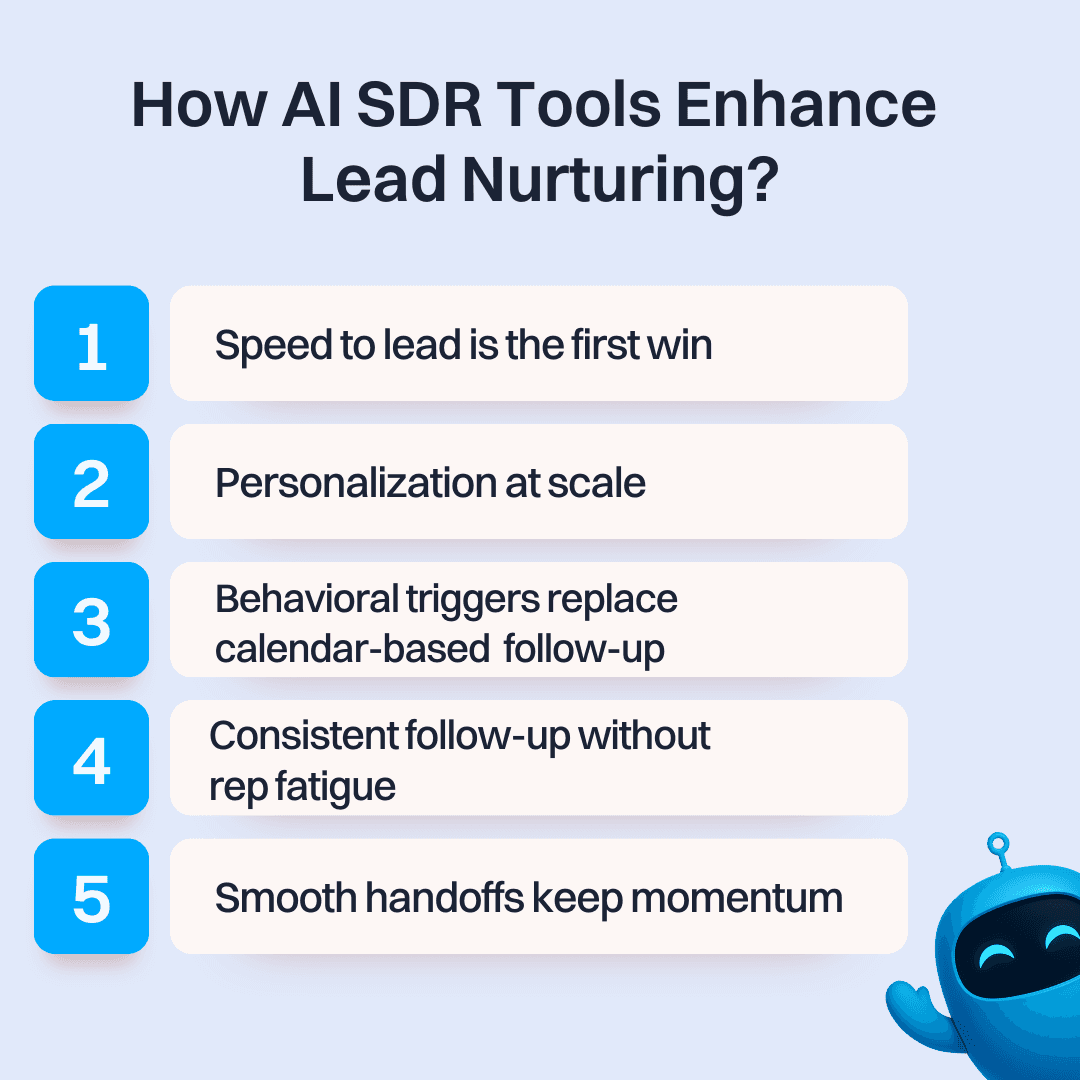
Lead nurturing is where most demand generation motions fall apart. A prospect shows interest, a rep follows up once or twice, then the lead goes cold, and nothing happens. AI SDR tools close that gap by making consistent, personalized follow-up a system rather than a habit.
1. Speed to lead is the first win.
Responding to an inbound lead within five minutes makes contact 100 times more likely than responding after 30 minutes. AI inbound tools like Qualified eliminate the response lag entirely. The moment a qualified visitor lands on your site, the AI initiates the conversation. No rep needs to be online. No form sits in a queue. The lead is engaged before they have a chance to bounce.
2. Personalization at scale.
Manual nurture sequences are generic because reps do not have time to write a custom email for every lead. AI tools use behavioral data, firmographic signals, and conversation history to generate follow-ups that reference what the prospect actually did, not just who they are on paper. A lead that downloaded your pricing guide gets a different follow-up than one who visited your integration page three times.
3. Behavioral triggers replace calendar-based follow-up.
Traditional nurture runs on a timer. Day 1, send email. Day 3, follow up. Day 7, try again. AI-driven nurture runs on behavior. A prospect reopens your proposal at 11pm? That is a trigger. A lead visits your competitor comparison page? That is a signal worth acting on. AI tools surface these moments and initiate the right response at the right time, not just the scheduled one.
4. Consistent follow-up without rep fatigue.
Reps give up after two or three attempts because manual follow-up is exhausting. AI tools run structured nurture sequences across email, LinkedIn, and in-app without getting tired, inconsistent, or distracted. The eighth follow-up is as well-written as the first. For longer B2B sales cycles, that consistency is the difference between a closed deal and a lost lead.
5. Smooth handoffs keep momentum.
The worst thing that can happen in a nurture sequence is an abrupt transition from an AI-generated conversation to a rep who has no context. The best AI SDR tools pass full conversation history, intent signals, and behavioral context to the rep at the handoff point. The rep picks up exactly where the AI left off, without the prospect feeling like they have started over.
The Top Picks
Comparison Table
| Tool | Best For | Starting Price | Key Strength | Main Limitation |
|---|---|---|---|---|
| Intempt | Demand generation teams wanting outreach, meeting intelligence, and pipeline visibility in one platform | $19/seat/month (Professional) | All-in-one: AI sequences, meeting notes, deal intelligence, and CRM with no tool-switching | No built-in lead database; no LinkedIn outreach or call functionality |
| Apollo.io | Teams needing a large verified contact database with built-in email sequencing | Free / $49/user/month | 210M+ contacts plus built-in sequencing, dialer, and intent data | Data accuracy drops sharply outside North America; shared sending infrastructure risks sender reputation at scale |
| AiSDR | Sales teams wanting AI-driven automation for outbound prospecting, personalized outreach, and follow-up management | $900/month | AI-powered sales assistant automating the full outbound cycle, prospecting, personalized emails, and follow-up sequences | Focused primarily on outbound email automation; no built-in multi-source data enrichment layer |
| Artisan AI | Companies wanting a fully autonomous AI BDR to handle outbound end-to-end | Contact sales (~$500-$2,000/month) | Ava AI agent automates the full BDR workflow with 300M+ contacts | 2-3 month configuration period before consistent results; annual contract |
| Qualified | Enterprise B2B teams on Salesforce wanting an AI SDR agent to convert inbound website visitors | Contact sales (~$42K-$68K/year) | Piper AI SDR greets, qualifies, and books inbound visitors 24/7 in real time | Salesforce-only with zero HubSpot support; pending Salesforce acquisition creates long-term roadmap uncertainty |
| Reply.io | Sales teams wanting true multi-channel sequences across email, LinkedIn, phone, and SMS | $49/user/month (Starter) | Native multi-channel sequencing with AI writing and built-in deliverability tools | Advanced AI features locked to higher tiers; steeper learning curve |
| 11x.ai | Enterprise outbound teams wanting a fully autonomous AI SDR agent without adding headcount | Contact sales (~$5,000/month) | Alice AI SDR pulls from 21+ data sources and runs fully autonomous multi-channel outbound | No free trial or monthly billing; requires a 2-3 month calibration period before results are consistent |
1. Intempt's AI for Demand Generation
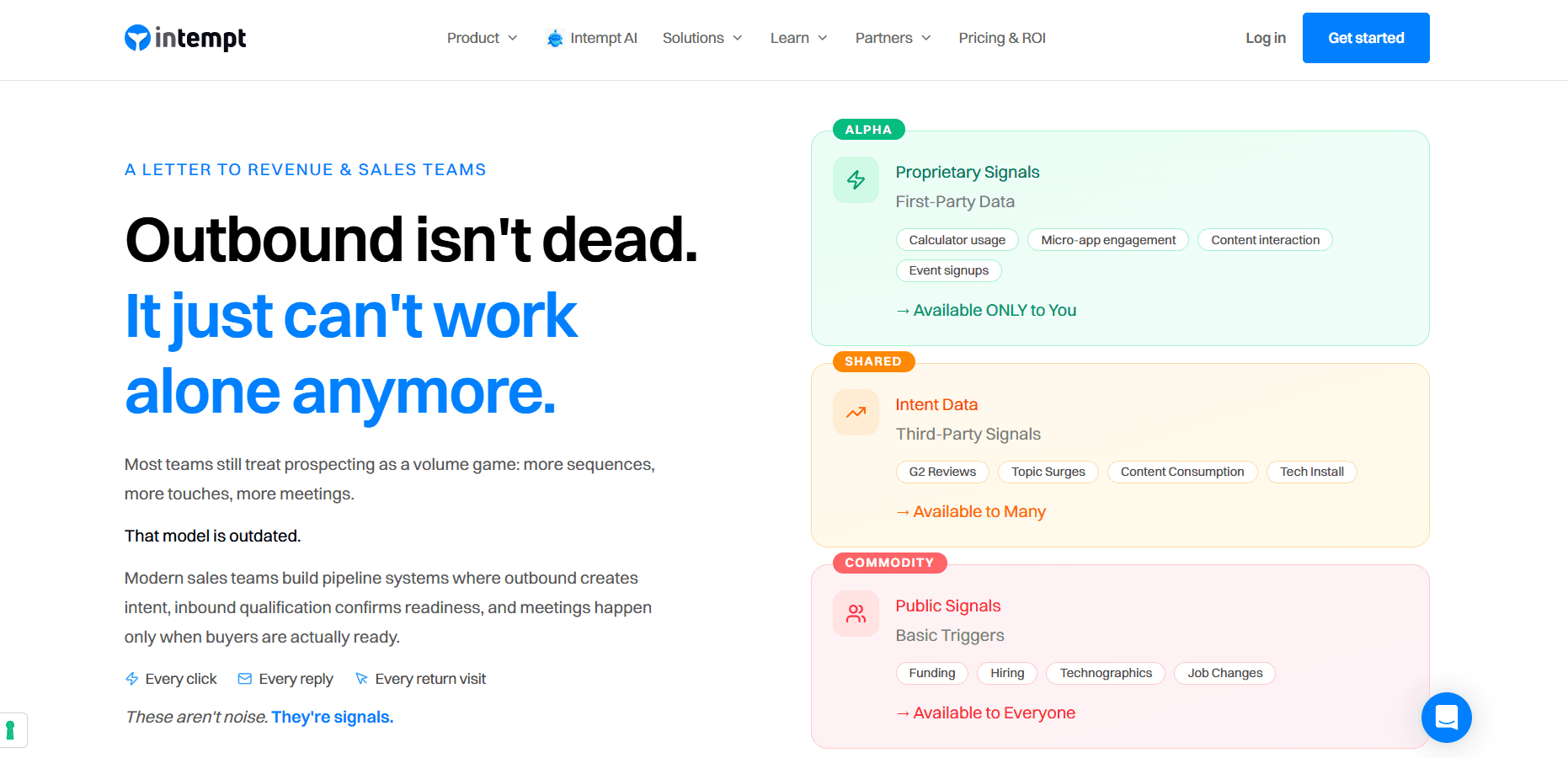
Intempt's AI-native platform combines outreach sequencing, AI meeting intelligence, a built-in CRM, and pipeline analytics into one workspace starting at $19/seat/month.
It's built for demand generation teams that spend too much time switching between a sequencing tool, a meeting tool, a notetaker, and a CRM, and want to run their entire pipeline-building workflow from a single place.
The Organization plan adds AI-generated outreach sequences, HubSpot CRM sync, and deal intelligence, which makes it particularly strong for teams that want AI to handle more of the writing, research, and pipeline visibility.
What You Get
- AI-Generated Outreach Sequences: Automatically generates multi-step email sequences tailored to your prospect and tone, cutting the time reps spend on cold email copywriting and sales pitch creation.
- Meeting Recording and AI Summaries: Records, transcribes, and summarizes every sales call with action items, topic detection, and key moment highlights so nothing slips after a discovery call.
- Pre-Meeting Research Briefs: Automatically pulls prospect and company intelligence before each meeting so reps show up prepared without spending 20 minutes on LinkedIn before every call.
- AI Inbox with Intent Signals: Categorizes incoming emails by intent (interested, objecting, out of office) and drafts replies in your tone so reps can respond faster without writing from scratch.
- Ask Blu (Live AI Assist): In-meeting AI assistant that surfaces relevant information, suggested responses, and context in real time during live sales conversations.
- Deal Insights and Pipeline Intelligence: Tracks deal progression, flags stalled opportunities, and surfaces AI coaching insights across your team's pipeline at the Organization plan level.
- Unlimited Sequences: No caps on active outreach sequences, so your team can run demand generation campaigns for multiple ICPs simultaneously.
- HubSpot CRM Sync: Two-way sync on the Organization plan, keeping contacts, deals, and activity logs current without manual updates.
Who Should Use It
Intempt is well-suited for demand generation teams, from solo reps to growing revenue teams, that want AI to handle the writing, note-taking, and follow-up coordination so they can focus on actual conversations. Particularly strong for teams that already have a contact list or lead source and need a smarter way to engage, follow up, and move pipeline without managing a stack of disconnected tools.
Teams that run a high volume of discovery calls and demos get the most out of the meeting intelligence and pre-meeting research features.
What to Watch For
Intempt has no built-in lead database, LinkedIn outreach, or call functionality. Pair it with Apollo or Clay for contact sourcing, and Reply.io if LinkedIn and phone are part of your outreach mix.
The free plan is also limited to 1 active sequence and 60 minutes of recording, so evaluate Pro from the start.
Pricing
Free: $0/seat/month, includes 1 active sequence, 60 minutes of recording, and $5 AI Pass balance. Professional: $19/seat/month (annual), includes unlimited meetings and sequences, 1,000 recording minutes/month, $24 AI Pass balance, advanced AI summaries, AI draft replies, and intent signal detection.
Organization: $39/seat/month (annual), includes $49 AI Pass balance, AI-generated sequences, HubSpot CRM sync, deal insights, pipeline intelligence, AI coaching, unlimited recording, and pre-meeting research briefs. Enterprise: $79/seat/month (annual). Replaces 5+ tools and saves teams over $100/month per seat.
2. Apollo.io
Apollo.io is a sales intelligence and engagement platform that combines a database of 210M+ contacts with built-in email sequencing, a dialer, intent data, and AI writing tools, all in one place. It's one of the most widely used AI tools for demand generation because it solves two problems at once: finding the right contacts and reaching out to them without switching platforms.
For teams on a tight budget who need both data and outreach automation, Apollo's pricing is hard to argue with, especially on the free and Basic tiers. The contact database alone, with 60+ filter options, gives smaller teams access to data intelligence that used to require an enterprise contract.
What You Get
- 210M+ Contact and Company Database: Search and filter by job title, industry, company size, technology used, funding stage, and 60+ other attributes to build targeted prospect lists.
- Email Sequencing: Multi-step automated campaigns with personalization variables, A/B testing, and conditional branching based on prospect behavior.
- Built-In Dialer: The Professional plan includes a US dialer with call recording and automatic CRM activity logging for multi-channel outreach.
- Intent Data: Tracks buying signals and website visitor activity to surface prospects actively researching solutions like yours right now.
- AI Email Writing: Generates personalized email copy and opening lines based on prospect data pulled directly from the Apollo database.
- CRM Integration: Bidirectional sync with Salesforce, HubSpot, and Pipedrive with activity logging for emails, calls, and meetings.
- Chrome Extension: Surfaces contact data and enrichment directly on LinkedIn profiles and company websites without leaving your browser.
Who Should Use It
Apollo is the strongest choice for early-to-mid-stage B2B sales teams (5 to 50 reps) that need both a contact database and sequencing in a single platform and don't want to manage separate subscriptions for each. Particularly compelling for outbound-focused teams on a budget that can't justify enterprise-level data tool pricing but still need verified emails and multi-step outreach. Best for teams where email and light phone outreach are the primary demand generation channels.
What to Watch For
Apollo's mobile number credits run out fast, and per-credit overages add up quickly for high-volume prospecting teams. Email deliverability has been a mixed point in user reviews, with some teams reporting that shared sending infrastructure can affect sender reputation over time. Data accuracy also varies by geography, with stronger coverage in North America than EMEA or APAC.
Pricing
As of March 2026: Free plan (limited credits, 5 mobile numbers/month, basic sequences). Basic at $49/user/month (contact database access, sequences, basic CRM sync). Professional at $99/user/month (adds dialer, advanced reporting, call recordings). Organization at $149/user/month. Annual billing discounts available across all tiers.
3. AiSDR
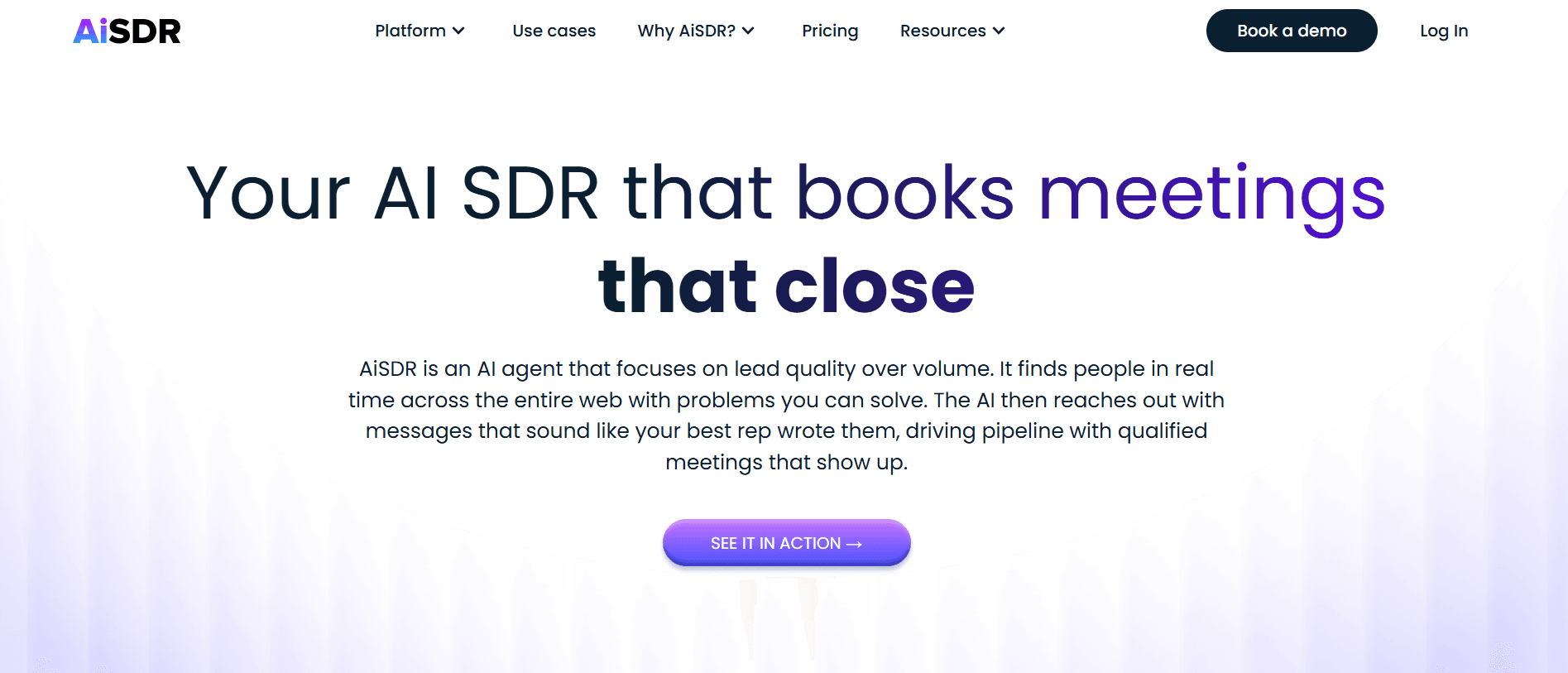
AiSDR is an AI-driven sales assistant designed to automate and enhance outbound sales processes. It handles the repetitive, time-heavy parts of the outbound cycle, prospecting, writing personalized outreach, and managing follow-up sequences, so reps can stay focused on live conversations and deal progression rather than admin work.
Unlike fully autonomous platforms that aim to replace SDR headcount entirely, AiSDR is built as an augmentation layer: AI handles the research, writing, and follow-up coordination while your reps stay in the loop for replies and relationship-building.
What You Get
- AI-Powered Prospecting: Identifies and surfaces qualified leads based on your ICP criteria, reducing the time reps spend manually building and verifying contact lists.
- Personalized Outreach Automation: Generates context-aware, personalized emails tailored to each prospect's role, company, and situation rather than generic templated sends.
- Automated Follow-Up Management: Tracks reply status and schedules follow-up messages based on prospect behavior, keeping sequences active without manual intervention from your team.
- Multi-Step Sequence Builder: Creates structured outreach flows across multiple touchpoints, ensuring consistent follow-through across your entire prospect list.
- Reply Handling and Intent Detection: Categorizes incoming responses by intent (interested, not now, unsubscribe) and routes them accordingly so reps focus on warm replies first.
- CRM Integration: Syncs contact records, outreach activity, and reply data with your CRM to keep pipeline data current without manual updates.
Who Should Use It
AiSDR is a strong fit for B2B sales teams that want AI to handle the time-consuming parts of outbound, prospect research, email writing, and follow-up coordination, while keeping reps involved in conversations that require judgment and relationship-building.
Well-suited for growing teams looking to increase outbound output without proportionally increasing SDR headcount. Best for teams running structured email-led outbound motions with a clearly defined ICP.
What to Watch For
AiSDR focuses on outbound automation and does not include a built-in multi-source data enrichment layer comparable to tools built specifically for data aggregation across dozens of providers.
Teams that need to pull from 50+ data sources simultaneously or build technically complex enrichment workflows will find dedicated enrichment tools more flexible for that specific use case. Evaluate pricing at your actual outreach volume before committing to a plan.
Pricing
As of March 2026: Starting at $900/month. Designed for teams looking to scale outbound output without adding SDR headcount. Contact sales for volume-based or enterprise pricing.
4. Artisan AI
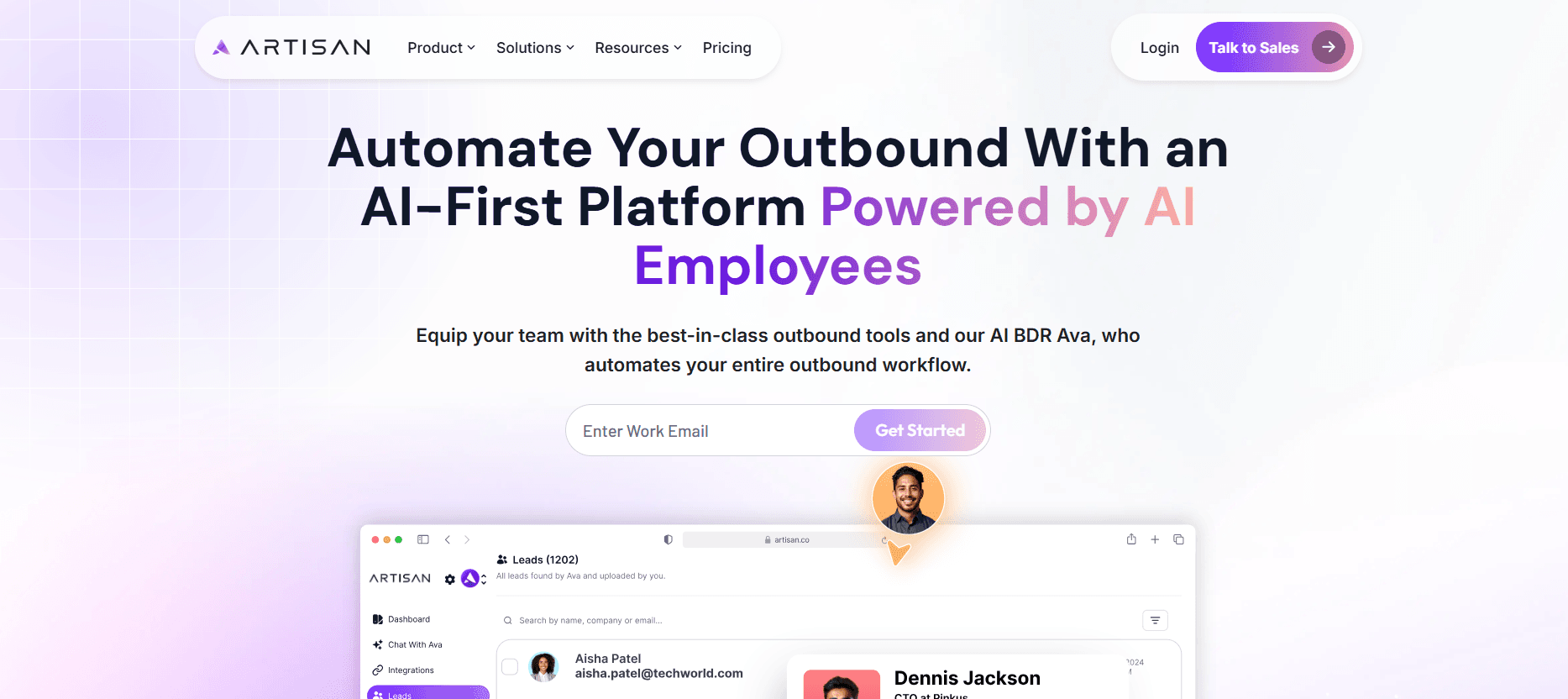
Artisan AI is a fully autonomous outbound sales platform built around Ava, an AI Business Development Representative that handles lead research, personalized email generation, follow-up sequencing, and meeting booking without human involvement. It's positioned for sales teams that want to run a high-volume outbound demand generation motion without hiring or managing additional SDR headcount.
Ava pulls from a proprietary database of 300M+ B2B contacts and learns from campaign performance to improve outreach quality over time. If you want AI to genuinely run your outbound pipeline generation motion while your reps focus on closing, Artisan is the most complete autonomous agent on this list.
What You Get
- Ava AI BDR Agent: A fully autonomous AI agent that researches prospects, writes personalized email sequences, manages follow-ups, and books meetings directly on your team's calendar.
- 300M+ B2B Contact Database: Ava sources leads from a proprietary database filtered by ICP criteria you define during onboarding, without requiring a separate data subscription.
- AI Personalization at Scale: Generates unique first lines and context for each prospect based on company news, LinkedIn activity, job changes, and real-time intent signals.
- Multi-Channel Outreach: Runs coordinated campaigns across email and LinkedIn in structured sequences, not isolated blasts.
- CRM Integration: Native integrations with HubSpot, Salesforce, and Pipedrive to sync contact records, activity logs, and booked meetings.
- Performance Learning: Ava analyzes response rates and meeting booking data to refine messaging over time, improving with each campaign cycle.
- Automated LinkedIn Outreach: Handles connection requests, follow-up messages, and LinkedIn touchpoints as part of a multi-channel outbound sequence.
Who Should Use It
Artisan works best for growth-stage and mid-market companies that want to scale outbound prospecting without proportionally scaling headcount. Particularly compelling for teams where the SDR role is primarily outbound email and LinkedIn, and where the team is comfortable with a 2 to 3 month configuration period before expecting consistent meeting volume. Less suitable for teams that rely heavily on phone calls or need results within the first 60 days.
What to Watch For
Ava requires meaningful setup time. Multiple user reviews report that 2 to 3 months of optimization are typical before the system produces consistent results, meaning you're paying long before you see ROI. Artisan uses annual contracts, so if the platform doesn't work for your ICP after three months, your exit options are limited. Personalization quality has also been a mixed point, with some teams finding Ava's output feels templated despite detailed ICP inputs during onboarding.
Pricing
As of March 2026: Contact sales for custom pricing. Pricing is based on lead volume with estimates ranging from $500 to $2,000/month. No free trial or self-serve signup option.
5. Qualified
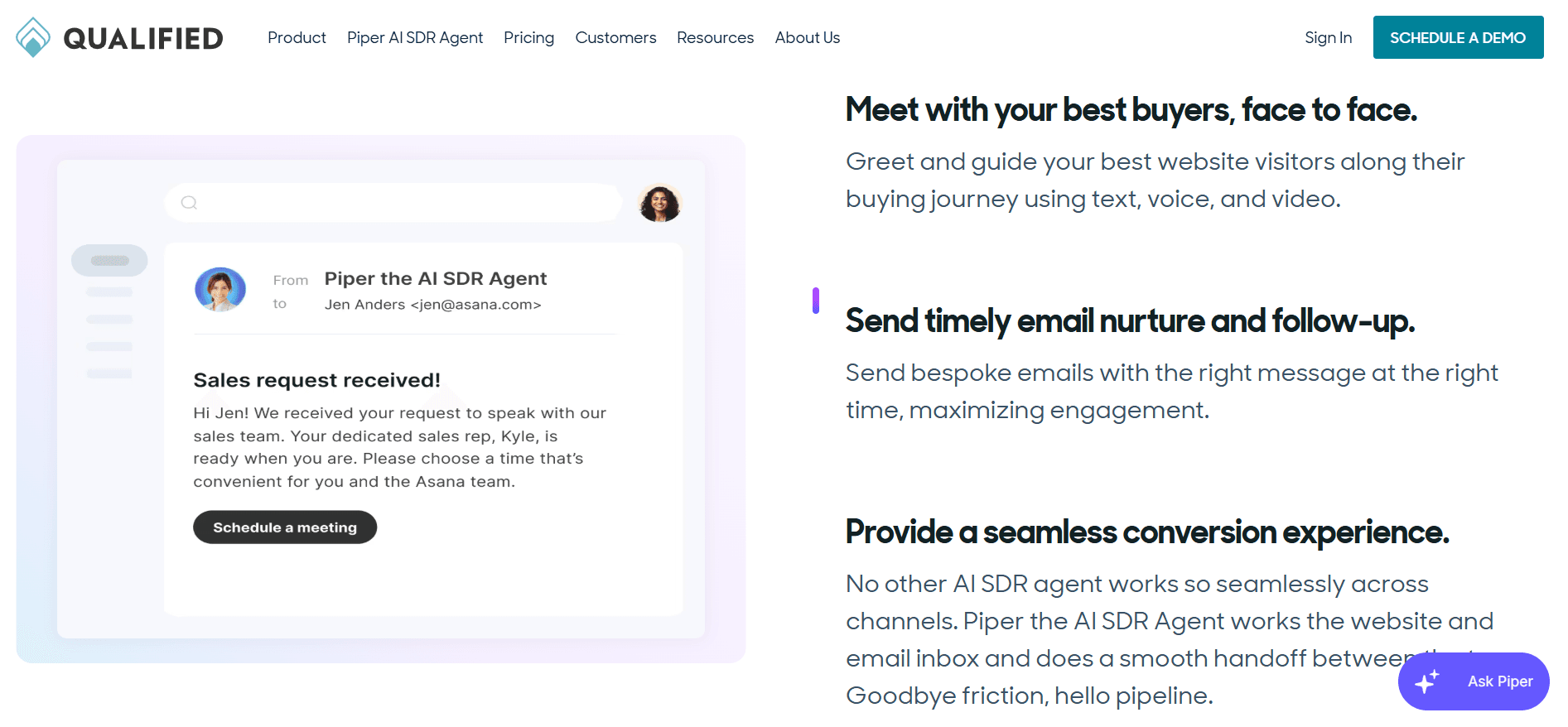
Qualified is an inbound pipeline generation platform built around Piper, an AI SDR agent that engages website visitors in real time, qualifies their intent, and books meetings directly onto rep calendars without a human in the loop. It is the most widely recognized purpose-built inbound AI SDR platform on the market, used by enterprise B2B teams that treat every website visit as an active sales opportunity.
The platform is Salesforce-native by design, which makes it exceptionally deep for teams already on that CRM but a hard non-starter for everyone else.
What You Get
- Piper AI SDR Agent: Holds real-time natural language conversations with website visitors 24/7, qualifies leads against your ICP, and books meetings onto the right rep's calendar without any human involvement.
- Personalized Greetings and Dynamic Offers: Serves each visitor a custom message, CTA, or offer based on their firmographic data, traffic source, and behavior on site, rather than a generic chatbot prompt.
- Instant Meeting Booking (No Forms): Converts qualified visitors directly to calendar bookings, removing the form-to-follow-up lag that costs most inbound teams meetings.
- Intelligent Lead Routing: Routes live conversations and booked meetings by territory, account ownership, and rep availability using Salesforce CRM data, with fallback rules for unassigned accounts.
- AI-Generated Follow-Up Emails: Piper sends personalized follow-up emails autonomously after conversations that do not immediately convert, continuing the nurture without rep involvement.
- Real-Time Rep Alerts: Notifies reps via Slack when a high-value account is active on the site so they can join the conversation live.
- Pipeline Attribution: Tracks conversations through to pipeline and revenue with full attribution reporting for marketing and sales teams.
Who Should Use It
Qualified is built for enterprise B2B companies with $50M+ in revenue, high-traffic websites, and Salesforce as their CRM. Best for SaaS and technology teams where inbound website traffic is a meaningful pipeline source and the cost of a visitor bouncing without converting is significant. Not suited for teams not on Salesforce, or for companies with limited website traffic where the per-visitor cost of the platform is hard to justify.
What to Watch For
Qualified is Salesforce-only, full stop. If your team is on HubSpot, Pipedrive, or anything else, there is no workaround. Salesforce has also signed a definitive agreement to acquire Qualified, which means the product roadmap will increasingly align with Agentforce and the standalone value proposition will shift.
Pricing
No published pricing. Premier plan estimated at $42,000 to $68,000/year. Enterprise and Ultimate tiers at custom pricing. 14-day free trial available. Note: Salesforce CRM is a hard requirement and adds $30,000 to $60,000/year in additional infrastructure cost for teams not already on it.
6. Reply.io
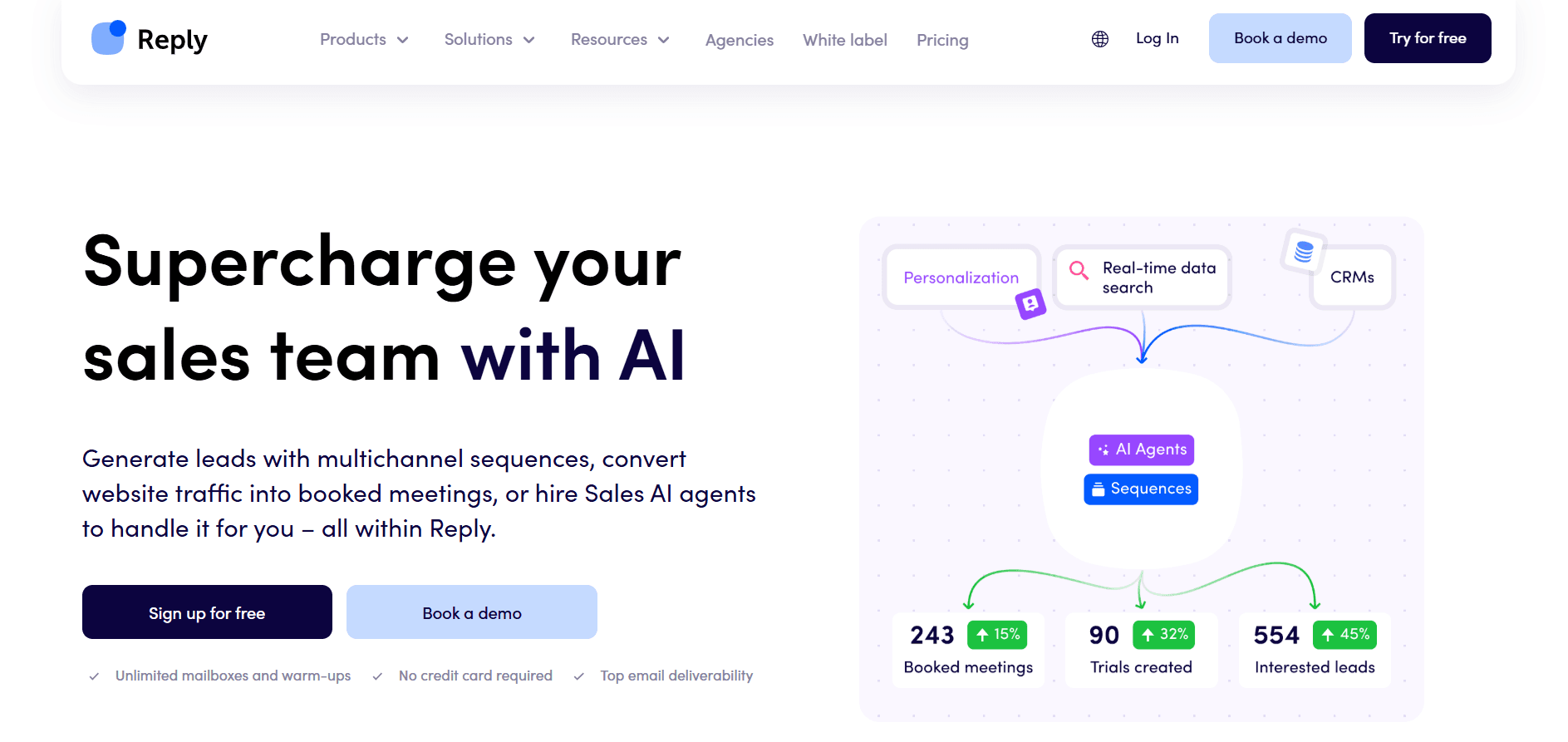
Reply.io is a multi-channel sales engagement platform that runs outreach sequences across email, LinkedIn, phone, WhatsApp, and SMS from one interface. It's one of the few tools on this list that covers all the channels your prospects live in, without forcing you to stitch together separate tools for each one.
The platform includes AI sequence generation, email validation, a built-in dialer, and a Jason AI agent that can autonomously handle initial outreach and reply management across channels.
What You Get
- Multi-Channel Sequences: Build automated outreach flows across email, LinkedIn, phone, WhatsApp, and SMS in a unified sequence builder.
- Jason AI Agent: An AI agent that handles initial outreach, manages replies, and books meetings autonomously across channels.
- Email Validation: Built-in email verification before sending to keep bounce rates low and protect sender reputation at scale.
- Built-In Dialer: Make and log calls directly from the platform with automatic activity tracking and call recording.
- AI Sequence Builder: Generates multi-step outreach sequences based on your ICP, product, and goal without writing from scratch.
- B2B Contact Database: Access to 140M+ verified business profiles for prospect list building within the platform.
- CRM Integration: Bidirectional sync with HubSpot, Salesforce, Pipedrive, and Copper with activity logging across all channels.
Who Should Use It
Reply.io fits mid-market sales teams (10 to 100 reps) that run multi-channel outbound sequences and want to manage everything from one platform. Particularly strong for teams doing meaningful LinkedIn and email outreach simultaneously and don't want to manage a separate cold email tool plus a LinkedIn tool plus a dialer. Teams that want an autonomous AI agent for initial contact, with humans taking over at the reply stage, will find Jason AI genuinely useful.
What to Watch For
The advanced AI features and Jason AI agent are locked behind higher-tier plans, which changes the pricing math significantly for smaller teams. The sequence builder also has a steeper learning curve than simpler tools like Instantly, and onboarding takes longer than you'd expect. Email deliverability, while managed, isn't as strong as platforms built exclusively for cold email infrastructure.
Pricing
As of March 2026: Starter at $49/user/month (email sequences, basic CRM sync, limited AI credits). Professional at $89/user/month (adds LinkedIn automation, calls, Jason AI, advanced reporting). Scale and Agency plans available via custom pricing. Free trial available.
7. 11x.ai
11x.ai is an autonomous AI SDR platform built around Alice, an AI agent that handles the entire outbound demand generation workflow end-to-end: prospecting from 21+ data sources, writing personalized multi-channel sequences, managing follow-ups, and booking meetings without any human in the loop.
The platform also includes Jordan, an AI phone agent that handles both inbound and outbound calls in 30+ languages.
Backed by $76M from a16z and Benchmark, 11x is the most heavily funded autonomous AI SDR platform on this list and positions its agents as direct headcount replacements rather than tools that assist existing reps.
What You Get
- Alice AI Outbound SDR: Fully autonomous agent that identifies ICP-fit buyers from 21+ third-party data sources, writes personalized email sequences, manages follow-ups, and books meetings directly onto rep calendars.
- Jordan AI Phone Agent: Handles inbound and outbound phone calls autonomously in 30+ languages, qualifies leads through natural two-way conversation, and syncs call outcomes to CRM in real time.
- Multi-Source Lead Sourcing: Alice cross-references 21+ verified data providers to build and enrich prospect lists without requiring a separate database subscription.
- Self-Improving Messaging: Alice analyzes response rates and meeting booking outcomes to refine messaging over time, adjusting approach based on what is actually working.
- Account-Based Outreach: Multi-threads across buying committee contacts at target accounts rather than sending single-contact sequences.
- Lead Re-Engagement: Automatically revives dormant or cold leads in your existing database with updated context and fresh outreach.
- CRM Integration: Bidirectional sync with Salesforce, HubSpot, and Pipedrive, including automatic activity logging and meeting booking updates.
Who Should Use It
11x is positioned for mid-market to enterprise B2B companies with large TAMs, clearly defined ICPs, and the budget for a premium annual contract. Best for teams where outbound SDR work is a defined function and the goal is to run that function at scale without proportionally growing headcount. Requires a meaningful ramp-up period before results are consistent, so it suits companies with existing sales infrastructure rather than those building their first outbound motion.
What to Watch For
11x requires a genuine commitment before you see results. The platform runs on annual contracts only with no monthly option, and most teams report a 2 to 3 month calibration period before Alice produces consistent meeting volume. Pricing is only available through a sales call, so budget conversations happen before you have had a chance to test the product. Jordan, the phone agent, also delivers inconsistent results in practice and is not yet at the same level as Alice for outbound email.
Pricing
No published pricing. Estimated at approximately $5,000/month (~$60,000/year) for a plan covering roughly 3,000 contacts with up to 5 email touchpoints each. Annual contracts only. No free tier and no self-serve trial. Heavily discounted introductory pricing has been reported, which normalizes upward at renewal.
How to Use AI SDR Tools Effectively?
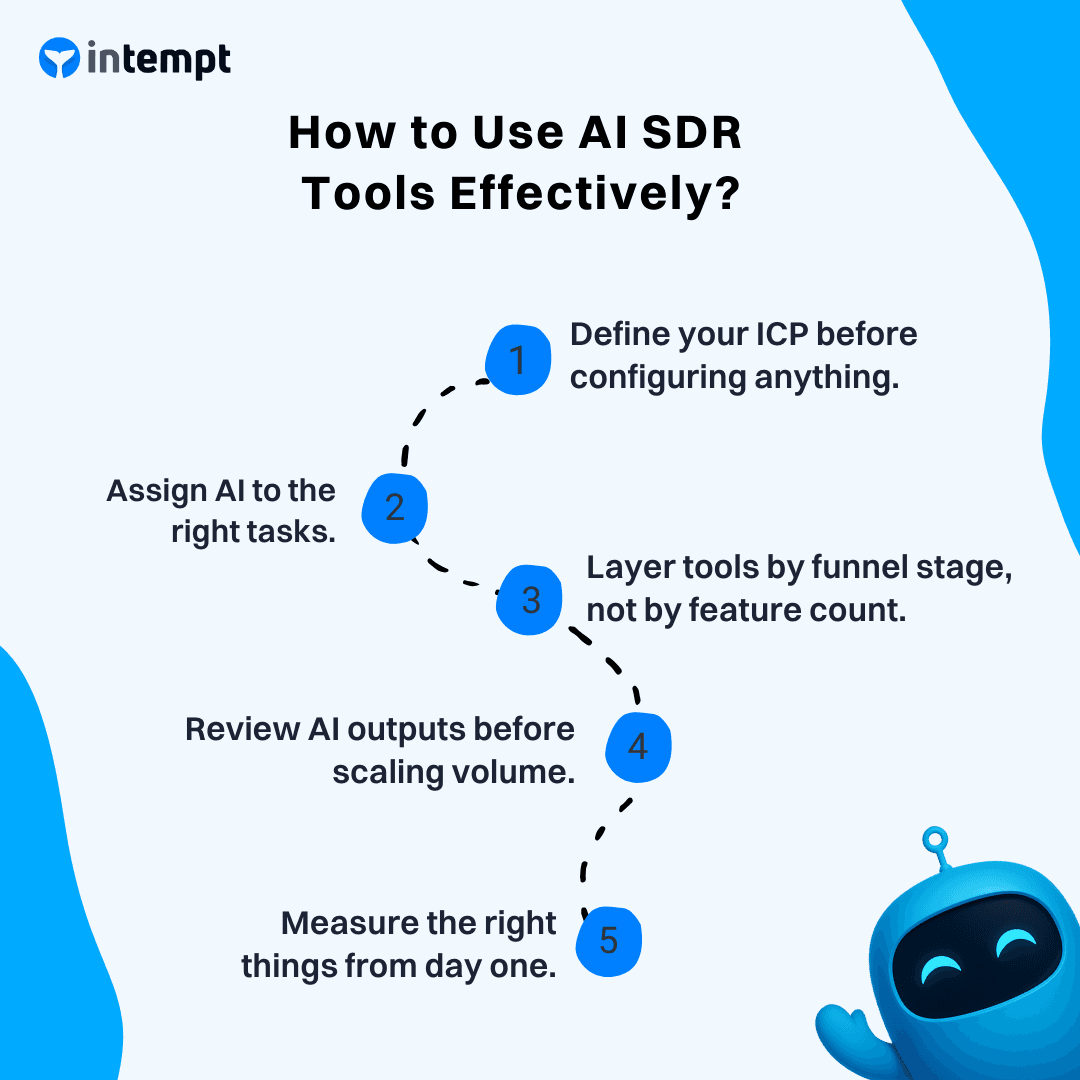
Buying the right AI SDR tool is step one. Getting value from it is a different problem entirely. Most teams underperform with these platforms, not because the tool is bad, but because they skip the setup work that makes AI actually useful.
1. Define your ICP before configuring anything.
AI tools generate output based on the targeting criteria you give them. If your ideal customer profile is vague, the sequences will be generic, the visitor routing will miss, and the meeting booking will pull in the wrong accounts. Spend the time before onboarding to nail down company size, industry, tech stack, and the specific signals that indicate buying intent.
2. Assign AI to the right tasks.
Use AI for writing first drafts, summarizing calls, identifying intent signals, and routing leads. Keep humans on the conversations that require judgment, empathy, and real-time adaptation. The teams that treat AI as a co-pilot rather than an autopilot get measurably better results.
3. Layer tools by funnel stage, not by feature count.
A common mistake is buying one platform that tries to do everything, then being disappointed it does not do any of it well. The stronger approach: use Qualified to capture inbound intent at the top, Apollo or Clay to enrich and source outbound contacts in the middle, and Intempt to run sequences, handle meeting intelligence, and track deals through to close. Each tool has a defined role.
4. Review AI outputs before scaling volume.
The first 30 days of any AI SDR deployment should be a calibration period. Review what the AI is writing, who it is targeting, and how it is routing leads. Fix the model before you scale the volume. Fixing errors at 10 sequences is easy. Fixing them at 500 is expensive.
5. Measure the right things from day one.
Open rates tell you if your subject lines work. Reply rates tell you if your message resonates. Meeting rates tell you if you are hitting the right ICP. Pipeline generated tells you if any of it actually matters. Set your success metrics before onboarding and track them weekly from the first week of deployment.
How to Choose?
| Platform | Choose If | Best For | Not Ideal If | Pricing / Notes |
|---|---|---|---|---|
| Intempt | You have a contact list and want one platform for outreach sequencing, meeting intelligence, deal tracking, and pipeline visibility | Demand gen teams (3–50 reps) running structured deal cycles with regular discovery calls and demos | You need to build a contact database from scratch | Professional: $19/seat/month, Organization: $39/seat/month. HubSpot sync replaces 5+ tools |
| Apollo.io | You need a verified B2B contact database plus outreach sequencing in one tool on a budget | Early to mid-stage teams (5–50 reps) focused on email and light phone outreach | Data accuracy in EMEA or APAC is critical | Free tier + affordable Basic plan for testing and scaling |
| AiSDR | You want deeply enriched, hyper-personalized prospect lists using multiple data sources | Technical GTM or RevOps teams with a growth engineer | You want a simple tool with minimal setup | Combines 10+ data providers without separate subscriptions |
| Artisan AI | You want AI to run outbound demand generation with minimal manual effort | Growth-stage and mid-market companies scaling outbound without hiring SDRs | You need results within 60 days or rely heavily on phone outreach | Requires ~2–3 month ramp-up for consistent results |
| Reply.io | You need multi-channel outbound (email, LinkedIn, phone, SMS) in one platform | Mid-market teams (10–100 reps) doing LinkedIn + email outreach together | You need highest cold email volume or advanced AI personalization | Strong all-in-one outbound execution tool |
| Qualified | You are an enterprise B2B company on Salesforce with high website traffic | Teams where inbound website pipeline is a major revenue driver | You are not on Salesforce or have low website traffic | Premium tool; sensitive to Salesforce ecosystem changes |
| 11x.ai | You want AI to fully run outbound SDR workflows autonomously | Mid-market to enterprise teams with defined ICP and long-term commitment | You need fast ROI, flexible contracts, or strong phone outreach | Annual contract (~12 months); positioned as SDR replacement |
Bottom Line
The best AI SDR tools for demand generation are not the ones with the most features. They are the ones that solve the specific bottleneck slowing your pipeline down. If your team cannot find good contacts, that is a data problem. If inbound visitors are bouncing without booking a meeting, that is a capture problem.
If reps spend hours prepping for every call, that is an intelligence problem. If follow-ups keep slipping post-meeting, that is a workflow problem. Each points to a different tool.
For teams that want one platform to cover outreach, meeting intelligence, deal tracking, and pipeline visibility, Intempt is the clearest fit. For teams that need a contact database plus sequencing without two subscriptions, Apollo is the most practical starting point.
For enterprise teams on Salesforce trying to convert inbound website traffic, Qualified is built exactly for that problem. For companies that want AI to run outbound as a full headcount replacement, 11x.ai has the ambition, though its track record warrants careful due diligence before signing an annual contract.
The smartest move is picking one tool that solves your biggest current bottleneck, testing it against real pipeline goals, and expanding from there. Most tools on this list offer free plans or trials. Start with the problem you are actually trying to fix, not the one with the best demo.
TL;DR
- Intempt ($19/seat/month Professional): Best for demand generation teams wanting outreach, meeting intelligence, deal tracking, and pipeline visibility in one AI-native platform. Pair with Apollo for contact sourcing.
- Apollo.io (Free / $49/user/month): Best for teams that need a B2B contact database and email sequencing without managing separate tools. Strong free tier for early-stage teams.
- AiSDR ($900/month): Best for sales teams wanting AI to automate outbound prospecting, personalized outreach, and follow-up management end-to-end. Strong for structured email-led outbound motions without adding SDR headcount.
- Artisan AI (Contact sales): Best for companies wanting a fully autonomous AI BDR to run outbound end-to-end. Requires budget, patience, and a clear ICP before onboarding.
- Qualified (~$42K-$68K/year): Best for enterprise B2B teams on Salesforce wanting an AI SDR agent to engage and qualify inbound website visitors 24/7. Salesforce-only.
- Reply.io ($49/user/month+): Best for multi-channel outbound teams running email, LinkedIn, phone, and SMS sequences from a single platform.
- 11x.ai (~$5,000/month, contact sales): Best for enterprise outbound teams wanting a fully autonomous AI SDR without adding headcount. Annual contracts only; do your due diligence before signing.
Frequently asked questions. Answered.
AI SDR tools for boosting demand generation are platforms that use artificial intelligence to automate prospecting, outreach, meeting preparation, and pipeline management so sales teams can generate more qualified pipeline with less manual effort. They range from contact databases with built-in sequencing to fully autonomous AI agents that handle the entire outbound workflow without human involvement.
Traditional sequencing platforms automate sending but still require your reps to write every email, research every prospect, and manage every follow-up manually. AI SDR tools go further by generating outreach automatically, scoring leads based on intent signals, and surfacing insights from meetings and pipeline data. If your reps spend more than two hours per day on tasks that aren't actual selling conversations, an AI SDR tool will close that gap faster than a traditional sequencer.
For many teams, yes. Intempt consolidates outreach sequencing, meeting recording and AI summaries, deal tracking, pipeline intelligence, and HubSpot CRM sync into one platform. Teams previously using separate tools for sequencing, notetaking, and CRM management typically replace three to five tools with Intempt's Enterprise plan at $79/seat/month, often at lower total cost than managing each separately.
Meeting intelligence tools record, transcribe, and analyze sales calls to surface action items, prospect objections, deal risks, and coaching opportunities automatically. Teams using AI meeting intelligence report fewer dropped follow-ups, faster rep onboarding, and better visibility into why deals stall. Intempt's meeting intelligence layer includes pre-meeting research briefs, in-meeting AI assistance via Blu, and deal insights that connect call outcomes directly to pipeline movement.
Apollo's free plan offers genuine value with basic sequencing functionality and limited contact credits, making it the strongest starting point for small teams. For teams of two to five reps that already have a contact list, Intempt's Professional plan at $19/seat/month is a cost-effective way to get AI-assisted outreach, meeting intelligence, and deal tracking in one platform without paying for five separate subscriptions.
The most important factors are: how well the tool addresses your specific bottleneck (data, outreach, meeting capture, or pipeline visibility), whether it integrates cleanly with your CRM, how pricing scales at your actual team size, and whether the AI features are genuinely workflow-changing or cosmetic. Always test the core use case on a free or trial plan before committing to an annual contract.

About the author
Hardik Sharma
Growth Marketer
Hardik researches and writes about marketing tools, sales technology, and customer engagement platforms. His work helps teams evaluate software with honest feature and pricing breakdowns.
LinkedIn
.png&w=3000&q=75)