.svg)


How to Reduce Churn with AI-Powered User Retention Strategies?
Your app is doing well, with users actively exploring features and making regular purchases. But then you start noticing subtle changes. A previously engaged user logs in less frequently. Their in-app purchases decrease. They interact with fewer features each week. Despite being a loyal subscriber for months, their engagement gradually fades until they finally cancel their subscription altogether. Sound familiar?


Expected Results
- Detect churn risk early by tracking micro-signals of disengagement.
- Build AI-driven likelihood models that predict churn before it happens.
- Launch real-time, personalized re-engagement journeys across channels (email, push, SMS, in-app).
- Personalize in-app experiences dynamically to restore engagement.
- Measure lift in retention rate, user lifetime value (LTV), and engagement frequency with clean A/B testing.
The Problem with Traditional Churn Prevention
Traditional approaches to user retention often feel like trying to catch a falling star - too little, too late. When companies wait until users have already disengaged to take action, they're fighting an uphill battle.
Let's look at what typically happens:
A user's engagement begins to decline. Weeks or months pass before the company notices. Finally, they send a generic "We miss you!" email with a discount code. By this point, the user has likely found an alternative solution or simply lost interest. The psychological disconnect is clear - you can't rebuild a relationship after weeks of silence with a templated message.
Why Users Disengage Before They Churn?
User churn rarely happens suddenly. It’s a slow fade marked by subtle behavioral shifts: fewer logins, shorter sessions, less feature interaction, and reduced spending.
Common Reasons For Disengagement:
- Loss of perceived value: Users stop seeing new benefits in your app.
- Friction or frustration: Bugs, crashes, or poor UX discourage continued use.
- Feature fatigue: Users overlook updates or underuse core functions.
- Lack of personalization: One-size-fits-all outreach fails to resonate.
Proactive retention strategies powered by AI can catch these signals in real-time and intervene before users churn.
What Churn Signals Actually Mean?
Think of churn risk signals as early warning signs. They’re small behavior changes that, when analyzed together, reveal a user’s likelihood of leaving.
Examples of churn indicators include:
- Decline in session length or frequency.
- Reduced interaction with previously loved features.
- Drop in in-app purchases or engagement events.
- Skipping new updates or ignoring push notifications.
AI models aggregate these signals to assign a “churn likelihood score,” helping you target interventions at the right moment - not after the user is gone.
Transitioning to a Proactive, AI-Powered Strategy
Proactive engagement is all about identifying signs of disengagement as they happen, not after a user has already left. Rather than sending a “come back” email when it’s too late, a proactive strategy uses real-time data to detect early indicators of churn. This can include a subtle decline in app sessions, reduced interaction with critical features, or a drop in in-app purchases.
For instance, if a user’s session length decreases or if they stop engaging with a key feature they once loved, the system can flag them as at risk. By using Likelihood models, AI transforms raw data into actionable insights, allowing you to intervene before the user slips away.
Instead of a one-size-fits-all discount coupon sent too late, companies can trigger a custom in-app message that speaks directly to a user’s recent activity. This might be a helpful prompt reminding them of a feature they’ve stopped using or an offer tailored to their usage patterns. The result? Users feel seen and valued, increasing the likelihood that they’ll continue to engage.
.png)
How to Implement AI-Powered Retention with Intempt?
Step 1: Create a Qualification to Predict Churn
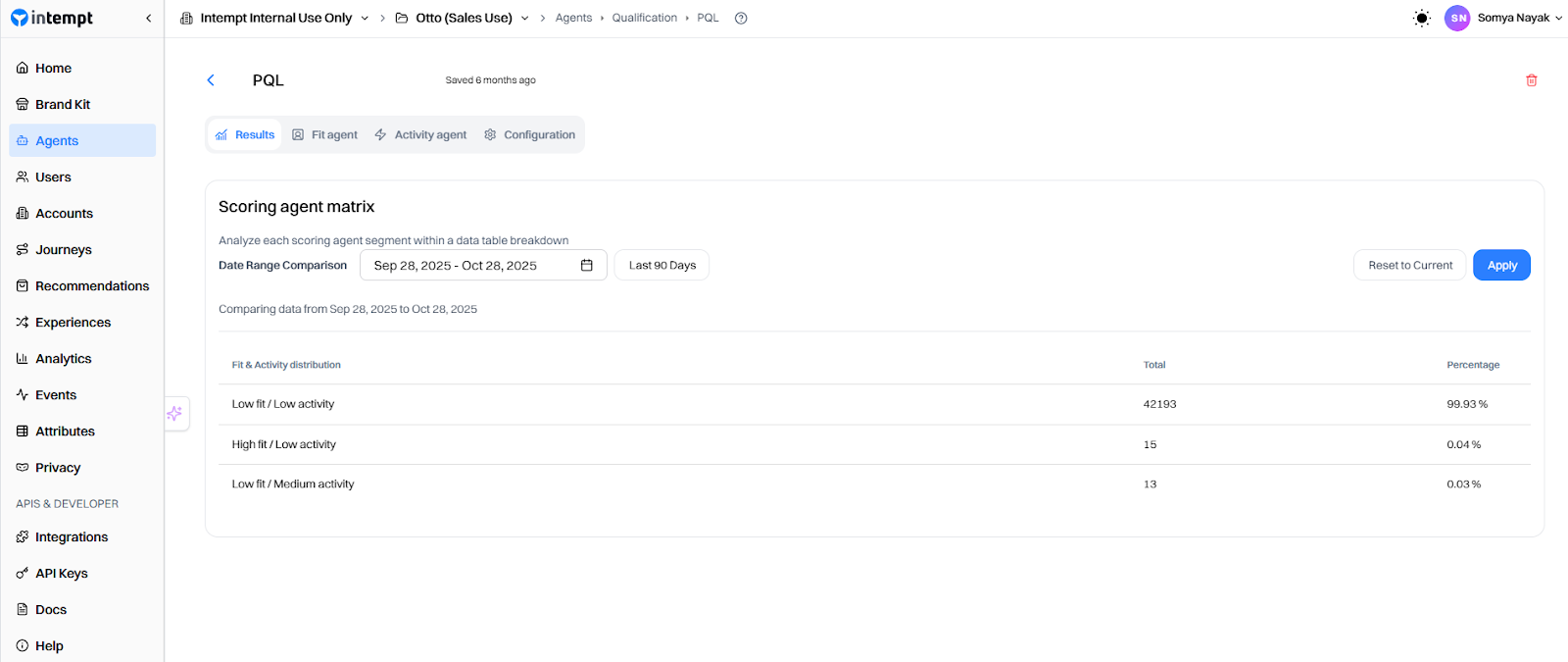
Build an AI-based Qualification agent that learns from historical user behavior (cancellations, feature use, session drop-offs). Platforms like Intempt’s GrowthOS integrate directly with CRMs (e.g., HubSpot) to connect data sources and automatically assign churn risk scores.
Step 2: Create Targeted Segments
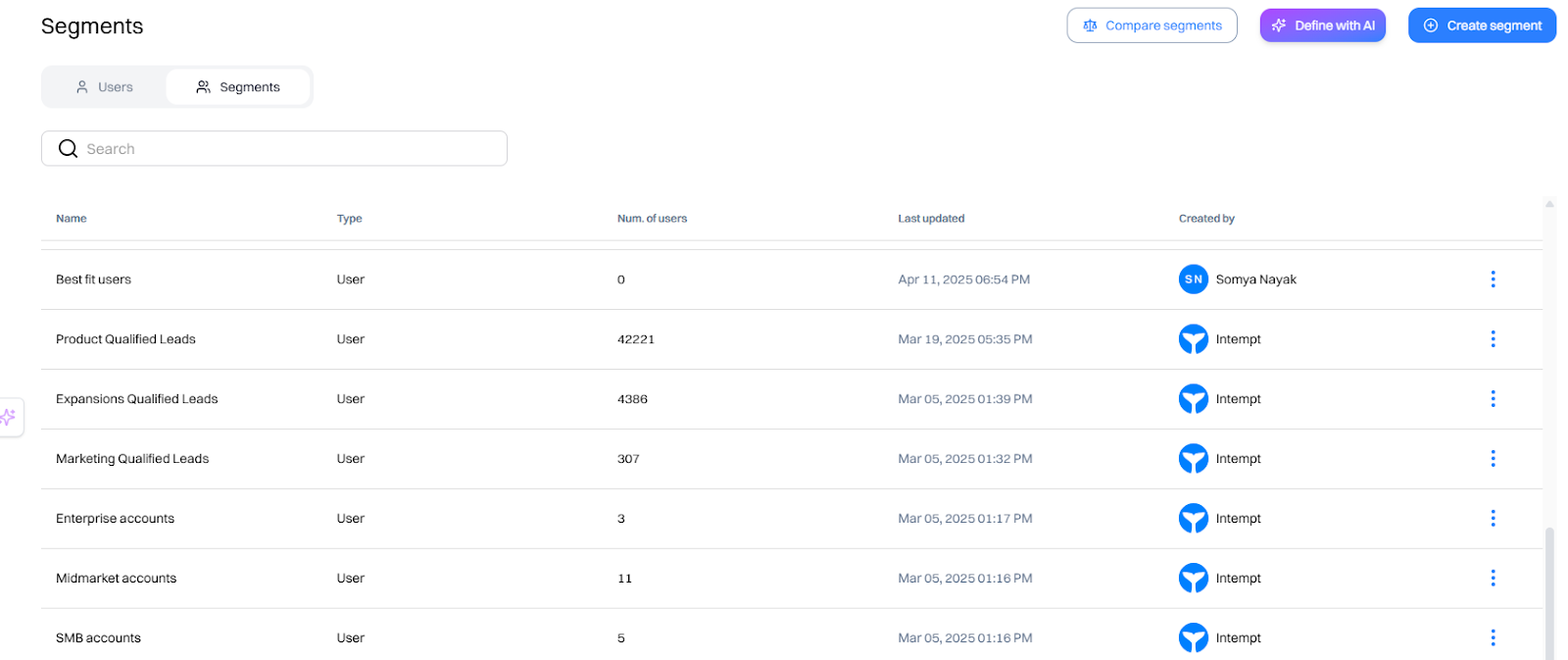
Segment users into high, medium, and low churn risk tiers. Use these segments to tailor engagement campaigns - relevant content for each user type, timed to their behavior.
Step 3: Launch Re-Engagement Journeys
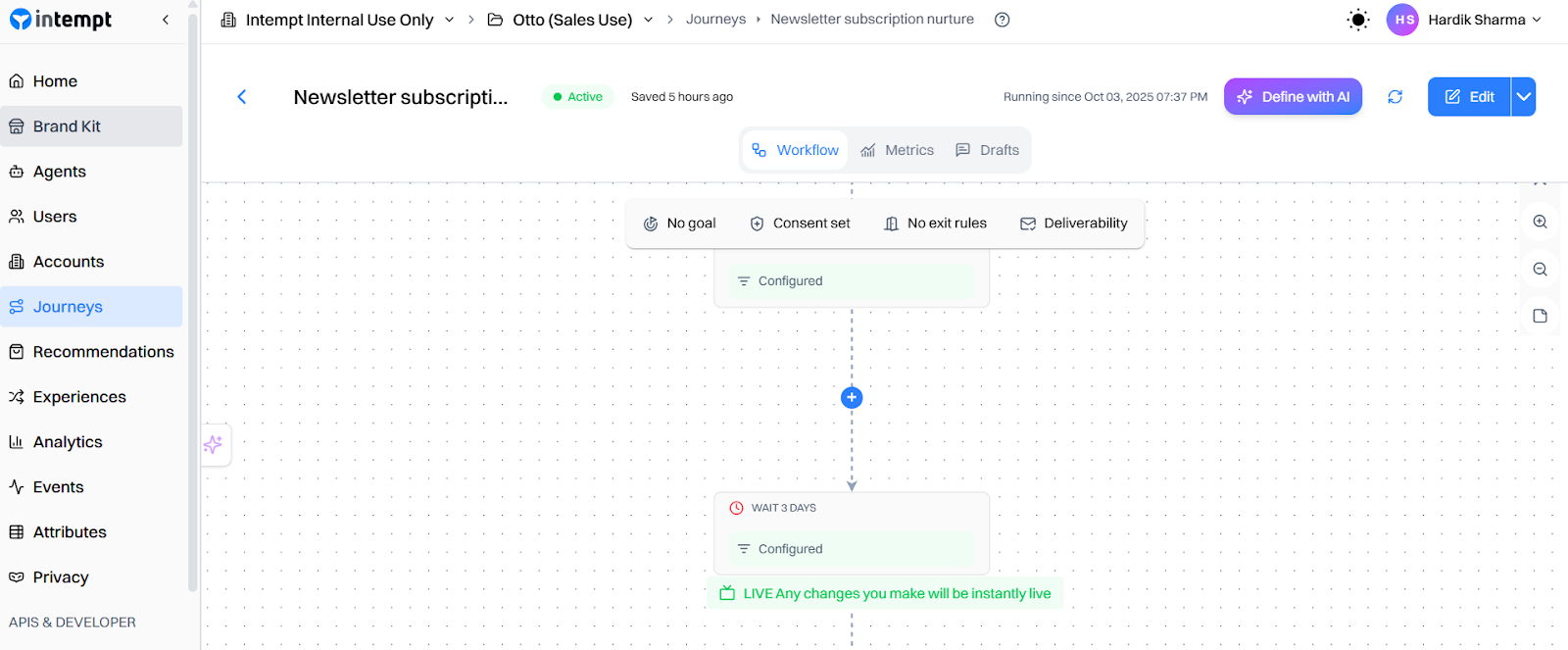
Once AI identifies high-churn users, it’s time to start engaging them. Re-engagement strategies should include:
Personalized Re-Engagement Campaigns
Use detailed user data to craft personalized messages that align with each user's preferences and behaviors. The more relevant the communication, the higher the chance of reigniting their interest. For instance, if a user is particularly interested in a specific feature (e.g., a meditation series or a game level), send them an email highlighting new updates.
Examples: “Hi [Name], we noticed you enjoyed [Feature X]. We’ve just added new content that you’re going to love!” Or, if a user frequently uses a budget tracking feature, “Hi [Name], we’ve added a new goal-setting option to help you save even better!” These messages should make users feel remembered and understood, not just another face in the crowd.
Advanced Personalization: Leverage dynamic content that changes based on real-time user data. For example, send personalized rewards, such as a discount for their favorite in-app purchase, to encourage immediate action.
Multi-Channel Outreach
Engage users through a combination of push notifications, SMS, and emails. Multi-channel outreach ensures you meet users on their preferred platform, which is key for maintaining engagement.
Examples: If a user isn’t responding to emails, switch to push notifications with a time-limited incentive like, “Don’t miss out on this 24-hour special!” Use in-app messages while they’re actively using the app to offer immediate rewards for continued use. By keeping your outreach consistent across channels but customized for each platform, you can ensure your re-engagement efforts feel coordinated and effective.
Cross-Channel Consistency: Ensure messages align across all channels. If a user receives a push notification, the content should be reflected in their in-app message inbox so they feel continuity in their interactions with your brand.
Turning Pain Points into Engagement Opportunities
Use analytics to identify common pain points and frustrations that drive users away. Address these issues head-on by showing users that you’re listening and taking action.
Examples: If analytics show that users frequently experience crashes in a particular section, prioritize fixing that issue and communicate it clearly. Send follow-up messages like, “We heard your feedback! The [issue] has been fixed-experience the improved [Feature Y] today!” This proactive approach lets users know their voice matters, making them more likely to return.
Real-Time Troubleshooting: Use in-app messaging to offer troubleshooting tips while users are facing difficulties. If a user encounters an error, guide them through a solution with an in-app message that says, “Looks like something didn’t work right-here’s how to fix it.”
Timely Guidance and Interactive Walkthroughs
Not all disengagement is caused by frustration; sometimes users simply don’t understand the full value of your app. Provide timely guides to help users make the most of core features.
Examples: Identify users who aren’t utilizing core features effectively and offer brief tutorials or guides. For instance, “Want to get the most out of [Feature X]? Here’s a quick guide to help you unlock all its benefits!” Deliver these guides through in-app prompts or emails to make accessing the information easy and immediate.
Interactive Walkthroughs: Use interactive, step-by-step walkthroughs to introduce new features. If a user skips a feature introduction, prompt them later with a message like, “Ready to get started with [Feature X]? Let’s do it together!” and provide a button to initiate an interactive guide.
Spark Social Connections
Foster a sense of community by encouraging users to engage socially. Creating a community where users interact with one another can help them build an emotional connection to your app, which keeps them coming back.
Social Challenges and Milestones: Introduce social challenges or milestones that users can share. For example, “Join our 7-day wellness challenge and share your journey!” Offer incentives for joining challenges, such as unlocking badges or earning points. Community-driven prompts encourage participation and a feeling of camaraderie.
Spotlight User Contributions: Recognize user contributions and celebrate successes. For instance, “Congratulations to [User Name] for completing [Challenge X]! You’re an inspiration to the community!” Highlighting individual successes makes other users aspire to reach the same milestones.
Step 4: Deploy Real-Time In-App Personalization
So, we created journeys to tackle churn. What’s next? To maximize your churn prevention strategy, you must go a step further and create personalized in-app experiences targeting users' specific needs, motivations, and pain points using AI. Here are some actionable strategies to effectively personalize the in-app experience and prevent churn:
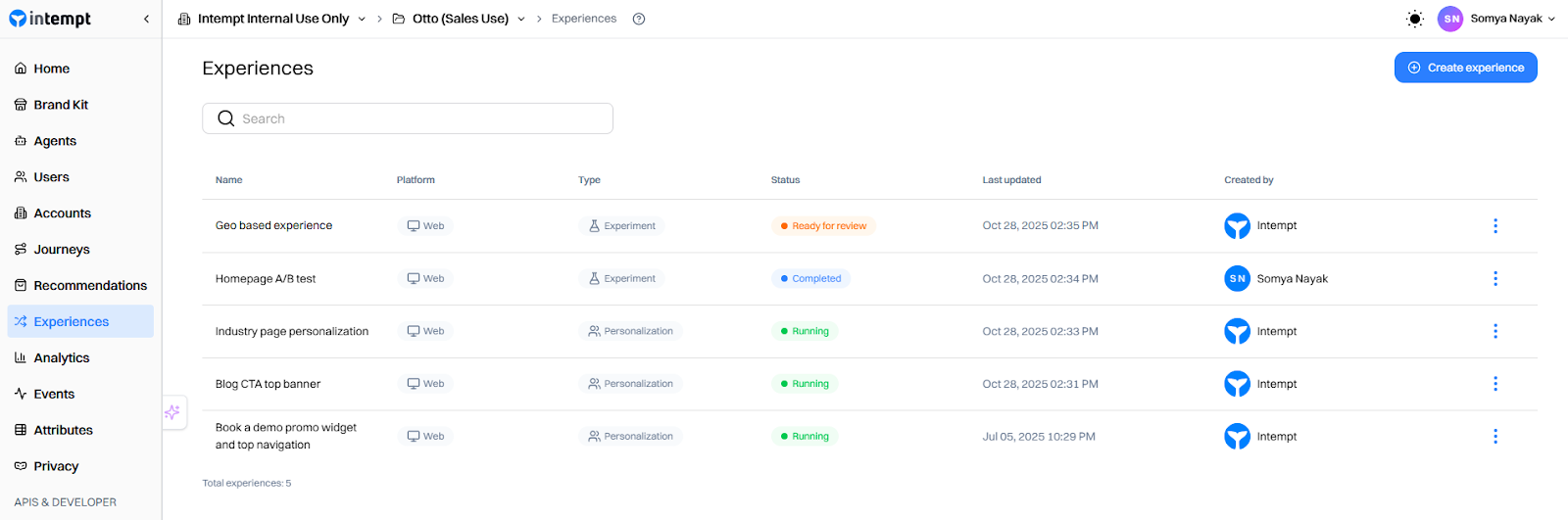
Dynamic Personalized Content for Immediate Value
- Custom Feature Reminders: Highlight features that the user has previously enjoyed but not used recently. For instance, if the user is often engaged with a fitness feature like guided running workouts but hasn't used it for some time, create a pop-up or banner that suggests, "Ready for your next run? We've added new workouts just for you!"
- Promote Recently Updated Content: Users often churn when they feel like they've exhausted an app's utility. Combat this by dynamically promoting new content. For example, "Hey [Name], check out the latest meditation series we just launched-tailored to help you de-stress after work!" This reminds users of the fresh and evolving value that the app offers.
Behavior-Based Rewards to Encourage Re-Engagement
- Reward System for Returning: If a user is identified as likely to churn, incentivize their continued engagement by offering personalized rewards. For instance, upon logging in after a period of inactivity, display "Welcome back! You've unlocked a loyalty bonus: 200 points to get you started again!" This gives an immediate sense of achievement and a reason to continue engaging.
- Encourage In-Feature Engagement: If a user showed interest in a feature but hasn’t completed an action-for example, they started a workout program but didn’t finish-trigger a reward. "Complete your next workout and earn 300 bonus points!" This type of messaging encourages users to complete actions that they’ve abandoned, keeping them engaged with core features.
Personalized Guidance and Tutorials
- Interactive Tutorials for Key Features: Sometimes users churn because they do not understand how to use certain features. If AI identifies a user is disengaging, offer an interactive tutorial based on the features they have not yet explored. For instance, "We noticed you haven’t used our budgeting feature. Here’s a quick guide to help you save more effectively!" Tutorials that are brief, interactive, and catered to the user's needs can greatly enhance perceived value.
- Real-Time Assistance Prompts: If a user appears confused or is repeatedly interacting with a feature but not completing the expected flow, provide real-time prompts like "Need help understanding this feature? Tap here for a quick guide!" This not only aids in navigating the app but also reassures users that the app is designed with their journey in mind.
Time-Sensitive Offers to Drive Engagement
- FOMO (Fear of Missing Out) Promotions: Use time-limited offers to create urgency. For example, "Exclusive offer: Unlock premium content for 50% valid for the next 24 hours only!" Including a countdown timer can significantly boost the sense of urgency. This approach is particularly effective for users flagged by AI as being at a medium risk of churn-those who might need a nudge to stay engaged.
- Special Loyalty Offers: Tailor offers that make users feel special and valued. For example, "As one of our valued subscribers, enjoy a free upgrade to premium for the next 7 days!" This type of messaging shows users that their loyalty is appreciated and provides them with a reason to continue exploring the app.
Adaptive In-App Layout Adjustments
- Highlight Most-Used Features: Rearrange the app's home screen layout dynamically to bring the user's most-loved features to the forefront. If the AI indicates a declining engagement in key areas, prioritize displaying the features they’ve used most frequently in the past. For instance, if a user often uses a "Sleep Stories" feature, make it the first thing they see when they open the app, with a message like, "Ready for a good night's sleep?"
- Showcase Newly Added Features in Context: Introduce new features by integrating them seamlessly into the user’s journey. If a user is engaging with exercise-related content, recommend a new tracking feature with a prompt like, "Track your progress with our new personalized dashboard-designed to keep you motivated!" By ensuring new features are contextually relevant, users are more likely to feel their experience is continually improving.
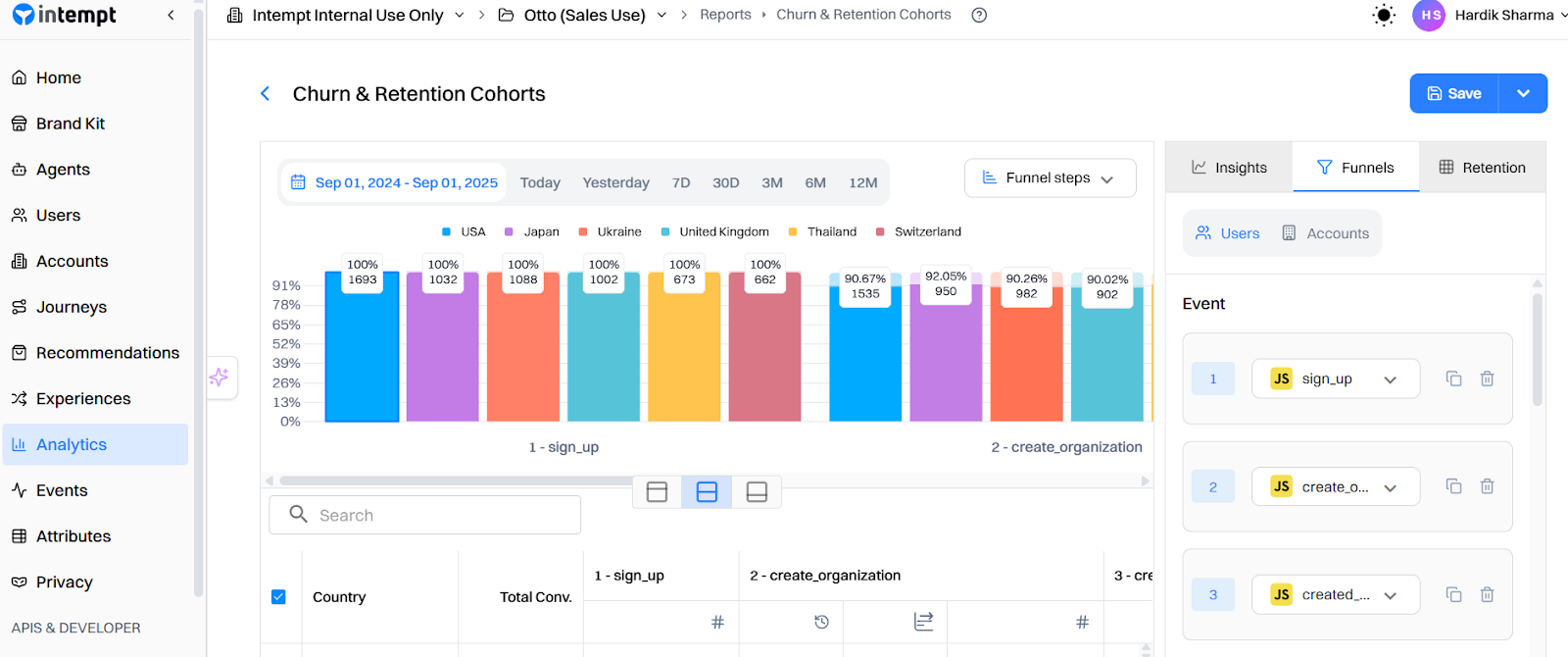
Step 5: Continuous Testing & Optimization
Monitor your campaigns, measure impact, and iterate based on data.
Refine thresholds for churn risk and personalize interventions more accurately over time.
Benefits of a Proactive AI Retention Strategy
Switching to a proactive, AI-powered strategy can have a transformative impact on your business:
- Reduced Churn and Improved Retention Rates- By engaging users before they decide to leave, AI-driven retention strategies can significantly lower churn rates. This means more users stay active, leading to sustained engagement and revenue.
- Increased Customer Lifetime Value and Engagement- Timely, personalized interventions not only prevent churn but also enhance overall user satisfaction. When users feel understood, they’re more likely to invest in your app long-term, boosting their lifetime value.
- Enhanced User Experience and Brand Loyalty- Proactive engagement creates a more dynamic and responsive user experience. By addressing user needs in real-time, you build trust and loyalty, turning casual users into devoted brand advocates.
Better ROI Compared to Traditional Methods- Investing in proactive AI retention is more cost-effective than chasing users with generic re-engagement emails. Studies show that retaining an existing customer is much cheaper than acquiring a new one (source). This means your proactive strategies can yield a significantly higher return on investment.
Challenges and Best Practices
Data Privacy and Integration
- Handle user data with the highest level of responsibility and transparency.
- Ensure all data collection, storage, and AI-driven interventions fully comply with relevant privacy and data protection regulations (e.g., GDPR, CCPA).
- Prioritize seamless integration across your CRM, app, and other data systems to enable a unified, accurate view of user behavior and engagement.
Setting Effective Thresholds for Intervention
- Carefully define the moments that trigger automated or manual interventions.
- Triggering too early can frustrate users, while acting too late can result in missed engagement opportunities.
- Regularly analyze behavioral data to fine-tune these thresholds and optimize the balance between relevance and timing.
Continuous Monitoring and Iteration
- Treat your retention strategy as a living system that evolves with user behavior and market trends.
- Leverage analytics to continuously track performance, identify friction points, and refine your approach.
- Fostering a culture of experimentation and learning-regular iteration ensures your retention tactics remain effective over time.
Looking Ahead
The future of user retention lies in proactive, AI-powered strategies that treat each user as an individual. By leveraging tools like Intempt that integrate with your existing systems, you can transform your retention approach from reactive to proactive, from generic to personal, and from guesswork to data-driven decisions.
Now is the time to rethink your churn prevention strategy. Instead of waiting until users are gone to try and win them back, leverage AI to keep them engaged from the start. Evaluate your current retention methods, identify early indicators of churn, and start experimenting with personalized, real-time interventions. Your users deserve an experience that makes them feel valued
TL;DR
- Detect churn risk early with AI likelihood models.
- Segment users by churn probability (high, medium, low).
- Launch multi-channel re-engagement journeys personalized to each user.
- Personalize in-app content dynamically using behavior signals.
- Test, measure, and iterate for continuous improvement.
FAQs
1) How early should I intervene when a user shows signs of churn?
You should act as soon as you detect meaningful drops in usage like login frequency, feature engagement, or spending.
2) What signals matter most when building a churn prediction model?
Look for declining session length/frequency, reduction in key feature use, support tickets increasing, and missed renewals.“Most churn happens because of poor onboarding… by the time someone’s decided to cancel, it’s usually too late.”
3) What are common blockers to implementing retention tools?
Among many friction points and roadblocks, “Time, technical lift, and poor onboarding are frequent blockers.
4) Should I ask churned users why they left, and how useful is the feedback?
Yes, reaching out helps, but expect low response rates and bias toward dissatisfied users. Another approach can be to ask the users who stay why they stay instead of worrying about those who immediately churn.
5) Is there a one-size-fits-all solution to churn prevention?
To be really honest - No. You’ll need to tailor based on user type, product complexity, and lifecycle stage.
6) How should I prioritise which users to engage (because I can’t target everyone)?
Use risk scoring plus value-based segmentation. For example, target high-risk users and high-lifetime-value users first, since saving them has the most impact. Industry guidance recommends this for efficiency.
FAQs
Can I trial Webflow before paying?

Sure! You can test out Webflow on our free plan where you can experiment with 2 projects. Your unhosted projects will have a two-page limit, but you can purchase a site plan on a per-project basis to unlock up to 100 static pages and additional CMS pages.
What is a project?
A project is a website that you build in Webflow. You can publish projects to a webflow.io staging subdomain for free, export the code on a paid plan, or add a site plan to connect your custom domain and unlock hosting features.
What can I white label?
Pro accounts can add their own logo to Client Billing forms and the Editor. Pro accounts can also remove references to Webflow in the source code and form submission emails, and hide the Webflow badge from their staging sites.
How much traffic can the hosting handle?
Webflow hosting scales automatically to handle millions of concurrent visits. All site plans serve sites through our Amazon's Cloudfront CDN and accelerated using Fastly, loading sites in milliseconds.
What kind of support does Webflow provide?
We offer fast email support to paid accounts and prioritized help for team accounts. Community support (forum.webflow.com) is available to free accounts.
How long does it take to learn Webflow?
If you're new to building websites, our video tutorials will get up and running quickly. If you already know concepts behind CSS and the box model, you will feel at home in Webflow.
Check out Growth Play Library ➡️
Get started free on GrowthOS ➡️
Book a growth call ➡️
.svg)
Sid Chaudhary
Founder & CEO


Looking for ways to grow faster?
Discover marketing workspace where you turn audiences into revenue.
Learn about IntemptReceive Monthly Insights
Get expert insights & news on the latest promotion trends in our monthly newsletter.
Sid Chaudhary
CEO & Founder

Lifecycle automation tips
Industry tips
Case Studies
You might also like...
%20In-Depth%20Comparison.png)
Intempt v/s Klaviyo (2025): In-Depth Comparison
Marketers want seamless customer journeys, not a maze of rules and manual triggers. If the system feels like work, it’s not automation, it’s stress in a shiny UI. Klaviyo has long been the go-to for e-commerce platforms, powering email, SMS, and now even WhatsApp automation. But 2025 teams want more than AI that writes better subject lines; they want an AI comarketer that thinks ahead. In this comparison, we’ll explore Intempt v/s Klaviyo with a sharp focus on their Journeys to help you find out which one delivers true AI-powered orchestration rather than just automated messaging.

%20In-Depth%20Comparison.png)
Intempt vs VWO (2025): In-Depth Comparison
Marketers don’t just want to test ideas; they want to turn those ideas into real customer experiences. Simple A/B tests and standard conversion lifts were once the gold standard, but now they have become the ghost of the past, because in 2025, growth teams demand more. They want to personalize in real time, orchestrate intelligently, and connect experiment results to revenue outcomes.
%20In-Depth%20Comparison.png)
Intempt vs Mixpanel (2025): In-Depth Comparison
Marketers and product teams thrive on data, and let’s be honest, they hate it when it’s scattered across 2-3 different tools, buried in dashboards, and takes a ton of their time just to get a half-answer. Mixpanel has long been the gold standard for analytics, but 2025 teams want more than charts and funnels; they want action. They want orchestration, personalization, and a clear line from insight to revenue. In this comparison, we’re putting Intempt vs. Mixpanel under the microscope, feature by feature, insight by insight, to help you find the smarter and more future-ready analytics partner for your team.
Subscribe to The Full Stack Marketer 📈
Zero theory or mindset discussions here; just actionable marketing tactics that will grow revenue today.

Web A/B testing
Use front-end A/B and multi-page experimentation product built for any business size. Run multiple experiments on the same page.

Targeting & personalization
Deliver targeted messaging, personalized offers and recommend the most relevant content for your users.

Visual editor
Empower your team to collaborate with an easy-to-use visual editor without using developer time to get things up and running.

Analytics
Gain insight into the impact of your experiments with statistically valid results. No complex statistical analysis required.

Server & client-side testing
Go beyond client-side testing and deploy experiments on the server-side. Test and optimize content changes and even complete re-brands.

Flexible goal selection
Select the right goal for each personalization and experimentation campaign to ensure you’re optimizing towards the right objectives.
.svg)

.svg)


.svg)
.svg)