.svg)


Intempt vs VWO (2025): In-Depth Comparison
Marketers don’t just want to test ideas; they want to turn those ideas into real customer experiences. Simple A/B tests and standard conversion lifts were once the gold standard, but now they have become the ghost of the past, because in 2025, growth teams demand more. They want to personalize in real time, orchestrate intelligently, and connect experiment results to revenue outcomes.
%20In-Depth%20Comparison.png)


Why Compare Intempt and VWO?
Think of today’s experience platforms as the control centers of customer growth. VWO and Intempt both help teams understand and improve user experiences, but they take radically different approaches.
VWO is built around testing, helping marketers optimize conversions and validate design hypotheses.
Intempt, on the other hand, is built around orchestration, helping teams understand user intent, run personalized experiments, and automate the next best experience across the lifecycle.
So why does this comparison matter?
Because modern growth teams are asking new questions:
- Which tool helps me move from testing to taking action on the results?
- Which connects experience optimization directly to revenue outcomes?
- Which platform empowers my team to run experiments, automate personalization, and measure business impact - all in one place?
That’s why this comparison matters. In 2025, the experience landscape isn’t just about running A/B tests; it’s about building systems that predict, personalize, and decide what should happen next. Teams need platforms that bridge testing and action, hypotheses and outcomes, experiences and revenue.
Speaking of revenue, pricing is also a key part of this comparison. Intempt follows a Monthly Tracked Users (MTU) model starting at $52.6 per 1,000 users, making it predictable, scalable, and aligned with lifecycle teams who want to personalize experiences across the entire funnel (Web, App, Hubspot, Stripe, Shopify).
VWO, on the other hand, prices based on traffic and testing volume. It works well for CRO and experimentation teams focused on web optimization, but costs can climb quickly as site traffic and test frequency increase.
How Is Intempt Different Than VWO?
At first glance, both Intempt and VWO help you improve user experiences and conversions. But they’re built on two very different visions of what growth looks like.
Intempt
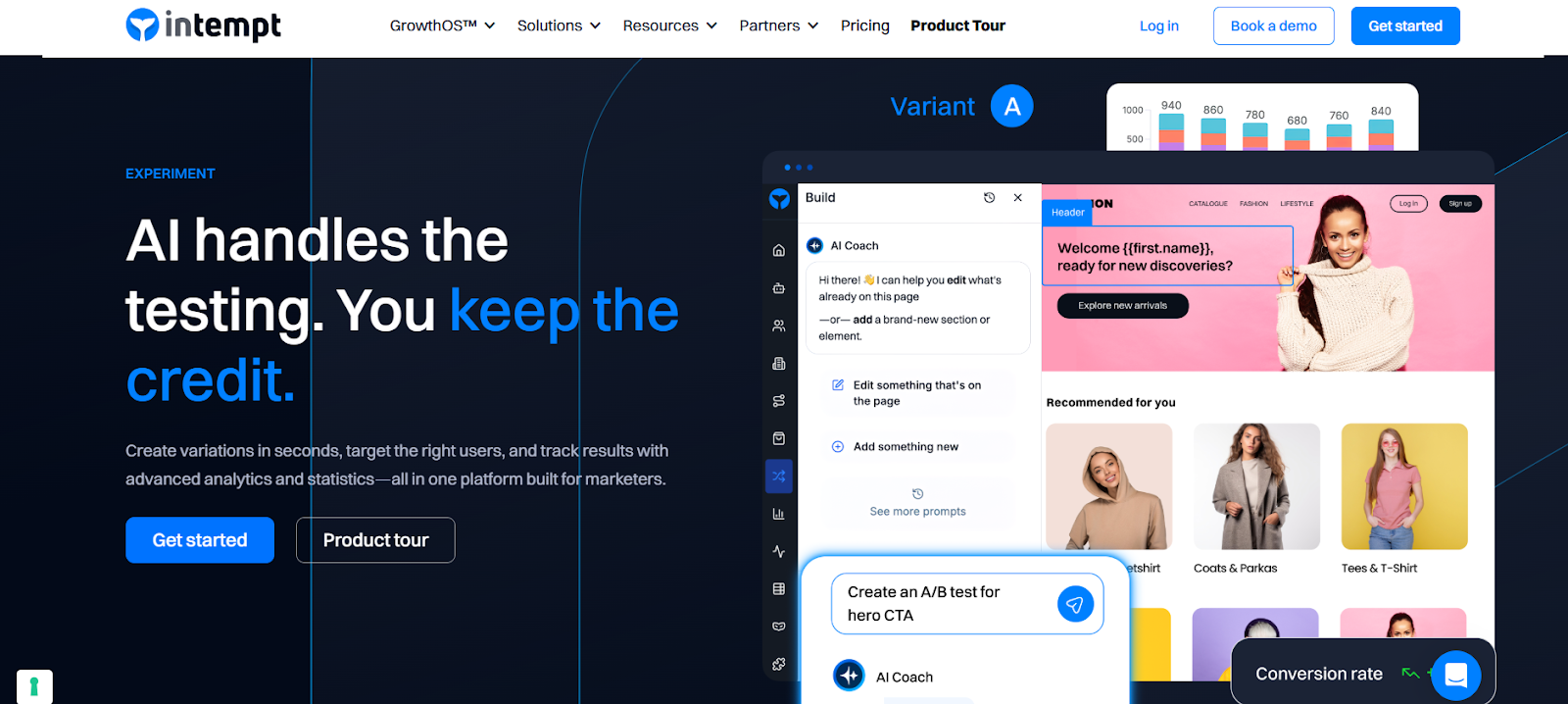
Intempt is designed for teams that want to move from static A/B testing to AI-powered orchestration. It’s built to understand behavior, predict intent, and automatically adapt experiences across channels, empowering cross-channel growth.
With Intempt’s GrowthOS, teams can run experiments, personalize user journeys, and track revenue impact, all from one unified place. The platform connects analytics, personalization, and CRM data to ensure every experiment leads to measurable growth.
Intempt’s experimentation tools allow you to run quick UI changes or deep logic tests, combine AI targeting, traffic control, and multi-page experiments, and drill into your experiment outcomes by applying filters or segment breakdowns, all in one place. It then helps you to create personalized experiences in web and app, adapt them for every user, and measure real impact, all without complexity or guesswork, using AI. It does all of this magic with no dev queue and no tool-switching, just experiments and personalization, you control end-to-end.
Intempt’s AI doesn’t just measure outcomes; it guides the next orchestration, ensuring every user sees the most relevant message, product, or offer in real time.
VWO
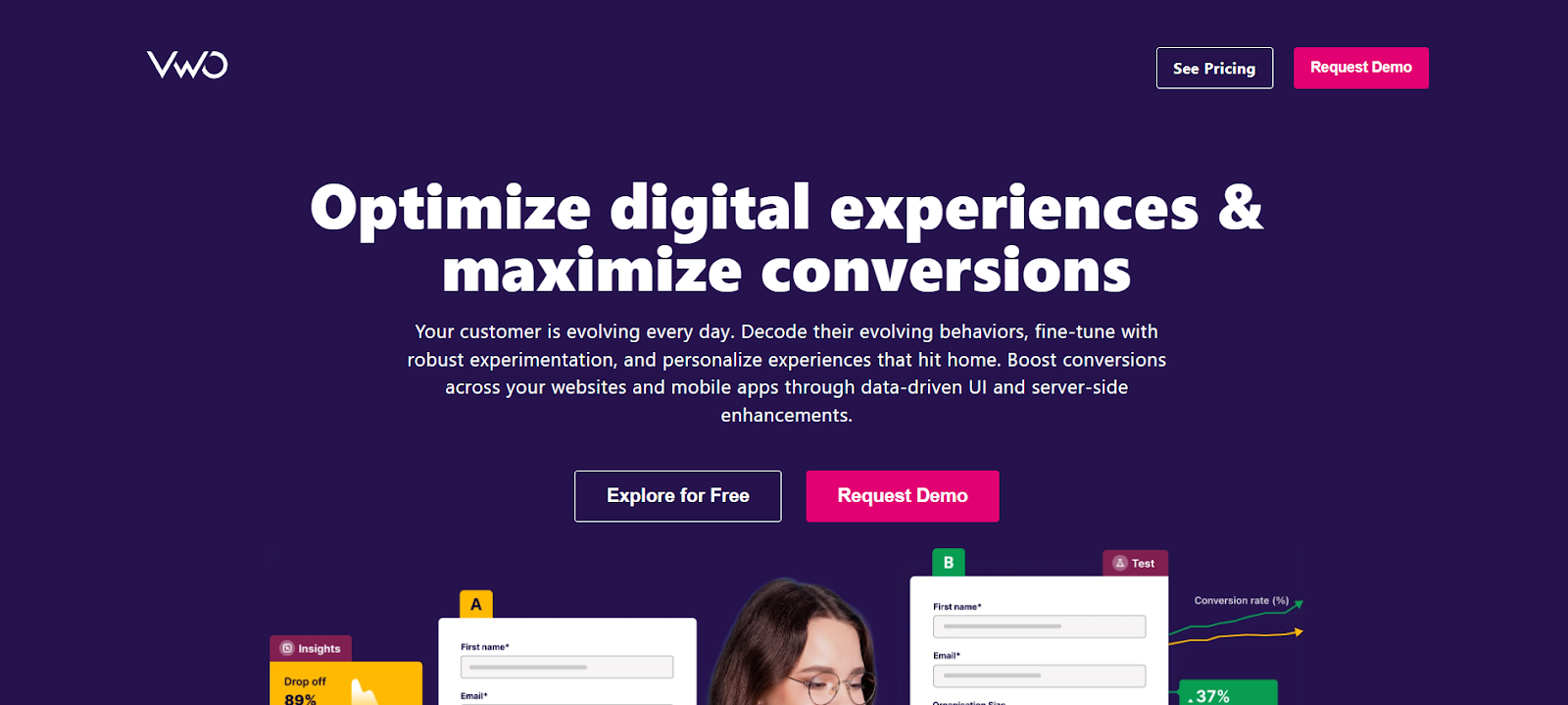
VWO (Visual Website Optimizer) is one of the most established experimentation platforms on the market. It offers robust A/B testing, multivariate testing, and split URL testing, with a visual editor that makes test setup simple for marketers.
Over time, VWO has expanded into personalization, heatmaps, and CRO insights, helping teams test and optimize websites without developer dependencies.
However, while VWO excels at experimentation, it’s primarily focused on “on-site optimization”. It doesn’t unify behavioral data across channels, nor does it natively connect experiments to revenue or CRM systems.
In-Depth Comparison: Intempt vs VWO
Intempt isn’t just an alternative to VWO; it’s a step-up from experimentation to orchestration. Modern growth teams don’t just need to test different variations; they need connected, intelligent systems that turn insights into adaptive experiences.
Experiments alone don’t drive growth unless you take action on the experiment results, make different campaigns to test and personalize according to the winner. That’s where the comparison between Intempt GrowthOS and VWO becomes crucial.
Both platforms help you optimize user experiences, but the way they handle experimentation depth, personalization intelligence, and orchestration scalability differs significantly.
Below, we have compared both platforms feature by feature across experimentation, personalization, orchestration, experience insights, integrations, pricing, and more.
Experiences (Experiment + Personalization)

Experimentation
Both Intempt and VWO help teams test and optimize experiences, but the way they do it defines their philosophy.
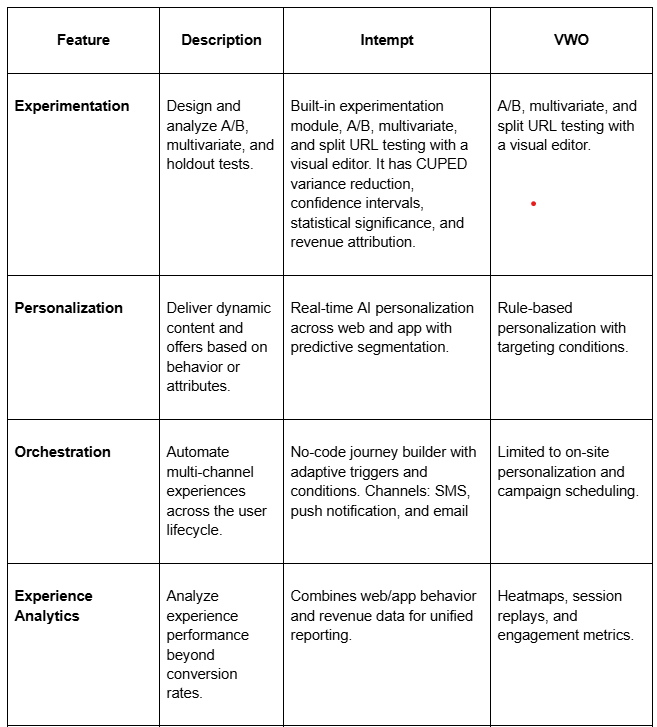
Intempt integrates experimentation natively into its GrowthOS. Teams can create variations in seconds, target the right users, and track results with advanced analytics and statistics, all in one platform built for marketers. Intempt makes it easier for marketers to manage all tests in one place, run quick client-side tests with no code drag and drop freedom, and complete customization.
By combining AI-driven targeting, intelligent traffic control, and multi-page experimentation, marketers can pinpoint which changes truly fuel growth, leading to sharper insights and smarter, more impactful reporting.
VWO has long been one of the most trusted experimentation platforms in the CRO space. Its visual editor allows non-technical teams to create and launch A/B and multivariate tests, while its split URL and full-stack testing enable deeper experimentation for developers.
VWO’s heatmaps, click maps, and session recordings provide clear visibility into how users interact with on-site elements. However, tests are typically limited to website-level optimization, and connecting experiment data to downstream metrics like CRM performance or revenue requires manual configuration or third-party integrations.
Personalization
Intempt
Personalization is one of Intempt’s strongest pillars. Using AI-driven behavioral segmentation, the platform continuously learns from user actions to deliver real-time, context-aware content across web, app, and email.
Marketers can create personalized blocks or offers without code, and the system automatically adjusts based on predicted user intent or lifecycle stage, all without complexity or guesswork using AI.. Every personalization instance connects back to activation triggers, ensuring that no experience operates in isolation. From individual elements to entire experiences, Blu (AI Coach) generates and customizes personalized experiences instantly that help to reach the right audience every single time.
VWO
VWO Personalize allows marketers to tailor on-site content and experiences using rule-based targeting. Teams can define conditions like geography, browser type, referral source, or previous behavior to display different variants.
It also supports integration with data platforms for broader segmentation, making it great for on-site A/B personalization. However, personalization rules remain static; changes in user behavior don’t automatically adjust segments or messaging in real time, limiting dynamic adaptability compared to Intempt’s AI models.
Orchestration
Intempt
This is where Intempt truly stands apart. Its no-code orchestration builder connects multiple channels - web, email, CRM, app, into adaptive, real-time journeys.
Using triggers and AI-based conditions, Intempt automatically calculates the best path for each user as their behavior or intent evolves. This turns traditional automation into intelligent orchestration, where every experiment, personalization, and message contributes to one cohesive user experience.
VWO
VWO offers campaign scheduling and limited workflow management within its web personalization tools, allowing you to time tests and run parallel campaigns.
However, it doesn’t provide multi-channel orchestration or cross-platform journey building. Campaigns operate independently on the website, without linking outcomes to email, CRM, or app experiences. For end-to-end lifecycle orchestration, additional tools (like HubSpot or Customer.io) are required.
Experience Analytics
Intempt
Intempt merges product, marketing, and revenue data into unified dashboards that show not only how experiences perform but why. Teams can measure how each experiment or personalization affects retention, conversion, and lifetime value in real time and refine their hypothesis.
As analytics are directly connected to orchestration triggers, Intempt’s real-time dashboards double as control centers, where marketers can act immediately on insights instead of waiting for reports.
VWO
VWO provides comprehensive UX analytics tools like heatmaps, scroll maps, and session recordings to visualize user interactions. Its goal tracking and funnel analysis reveal conversion drop-offs and on-page friction points, helping CRO teams refine their hypotheses.
However, these insights remain isolated to the website layer, without native integration to CRM or revenue systems. Teams often need BI or analytics tools to correlate user behavior with business outcomes.
User Insights
Intempt
Intempt’s AI-powered insights engine predicts behavior trends, conversion likelihood, churn probability, and engagement patterns, helping marketers focus efforts where they’ll drive the most value. It continuously learns from behavior and revenue data, surfacing high-intent users, weak touchpoints, and missed opportunities, turning passive analysis into active orchestration.
VWO
VWO’s insights center focuses on qualitative and quantitative data, offering behavior trends, survey responses, and session feedback to guide UX decisions.
These insights are valuable for improving web usability and conversion rate optimization, but they don’t extend into predictive modeling or AI-driven forecasting. VWO helps you understand what users did; Intempt helps you anticipate what they’ll do next.
Targeting & Segmentation
Intempt
Intempt offers dynamic, AI-based segmentation that updates automatically as new behavior data flows in. Audiences are scored based on predicted intent, engagement, and revenue potential, ensuring personalization always targets the right users at the right moment with real-time adaptability and live experiences.
This real-time adaptability makes segmentation not just reactive, but proactive, continuously adjusting campaigns as user patterns shift.
VWO
VWO provides flexible manual audience segmentation, allowing teams to target users based on traffic source, behavior, geography, or custom attributes.
It’s highly useful for controlled A/B tests but lacks real-time adaptability. Audiences remain static until manually edited, making large-scale personalization more time-consuming for growing teams.
Recommendations
Intempt
Intempt’s AI recommendation engine predicts the next best product, content, or offer for each user based on behavioral and transactional data. These recommendations are directly embedded into personalization flows, journeys, or pages, optimizing engagement without manual configuration. It means the users are recommended products according to their personal preferences and behavior. It helps to reduce churn and increases the probability of lead conversion.
VWO
VWO offers product recommendations through its VWO Personalize module, primarily used by e-commerce brands to cross-sell or upsell on-site. These are rule-based recommendations, triggered by static conditions like product category or browsing history. While effective for merchandising, they lack the predictive and cross-channel intelligence that Intempt’s AI models deliver.
CDP (Customer Data Platform)
Intempt includes a fully native CDP at its heart. It unifies behavioral data, CRM records, ecommerce events, product usage, and revenue signals into real-time customer profiles. Identity resolution keeps data consistent across web, app, backend, and third-party systems, and every trait or intent score becomes instantly usable for targeting, personalization, experiments, and journeys. Because the CDP is built in, marketers can activate data immediately, no external pipelines or engineering work needed.
VWO offers CDP functionality through VWO Data360, which consolidates on-site behavior, session data, and identifiers into unified profiles. This enhances experiment targeting and personalization within the web layer. However, Data360 is primarily optimized for website and experimentation data, and activating this data across the broader lifecycle - email, CRM, mobile, or revenue reporting requires third-party integrations or additional tools.
Integrations and Pricing
Both platforms integrate into broader marketing and analytics stacks—but they differ in focus.
Integrations
Intempt functions as the command center of your growth ecosystem.
It connects natively to HubSpot, Shopify, and Stripe, creating a unified customer profile that combines behavior, transactions, and engagement. It offers SDKs for web, iOS, Android, and backend environments. With bi-directional data flows, Intempt ensures every system stays updated in real time, turning analytics into action automatically.
VWO integrates with popular analytics and CMS tools like Google Analytics, Segment, and WordPress. These connections allow marketers to import audiences and export experiment data, but do not support orchestration or predictive insights across systems.
Pricing
Intempt’s pricing starts at $52.6 per 1,000 Monthly Tracked Users (MTU). You pay based on the number of users you track and personalize for, not events or experiments. This makes it predictable and scalable for growing teams.
VWO’s pricing follows a tiered model, typically based on the number of monthly tested users or the volume of experiments. Plans start with enterprise features, including personalization, insights, and full-stack testing, which are available at higher custom tiers. As test volume and traffic scale, so do costs.
Beyond Experiences: The Core Capabilities That Make Intempt More Than a Testing Tool
Where VWO helps you test what works, Intempt helps you create what’s next. Beyond individual experiments, Intempt unifies experimentation, personalization, activation, and AI into one intelligent system that evolves with every user interaction.
Journeys
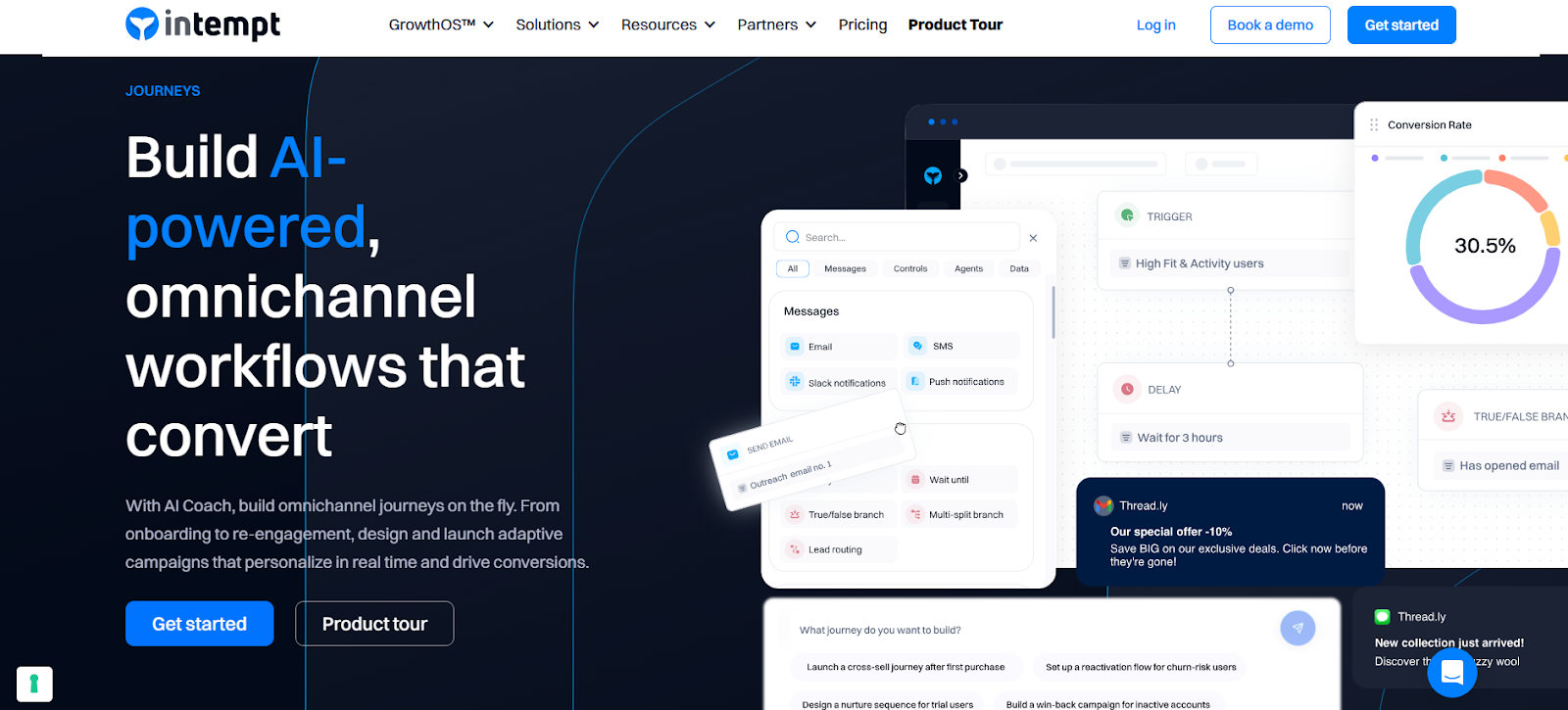
Intempt’s no-code journey builder lets teams design automated, multi-channel workflows visually.
From onboarding to retention and reactivation, marketers can orchestrate entire lifecycle campaigns using drag-and-drop experiences with triggers and conditions.
Journeys adapt dynamically; if user behavior changes, Intempt’s AI recalculates the best path in real time.
This ensures users always receive the most relevant message or experience, across email, web, app, and CRM.
With Intempt, build workflows with full control over triggers, branching, and logic. Control timing, logic, and sales routing with precision.
It’s not just automation, it’s activation powered by intelligence, where each journey learns, optimizes, and improves with every interaction.
Analytics
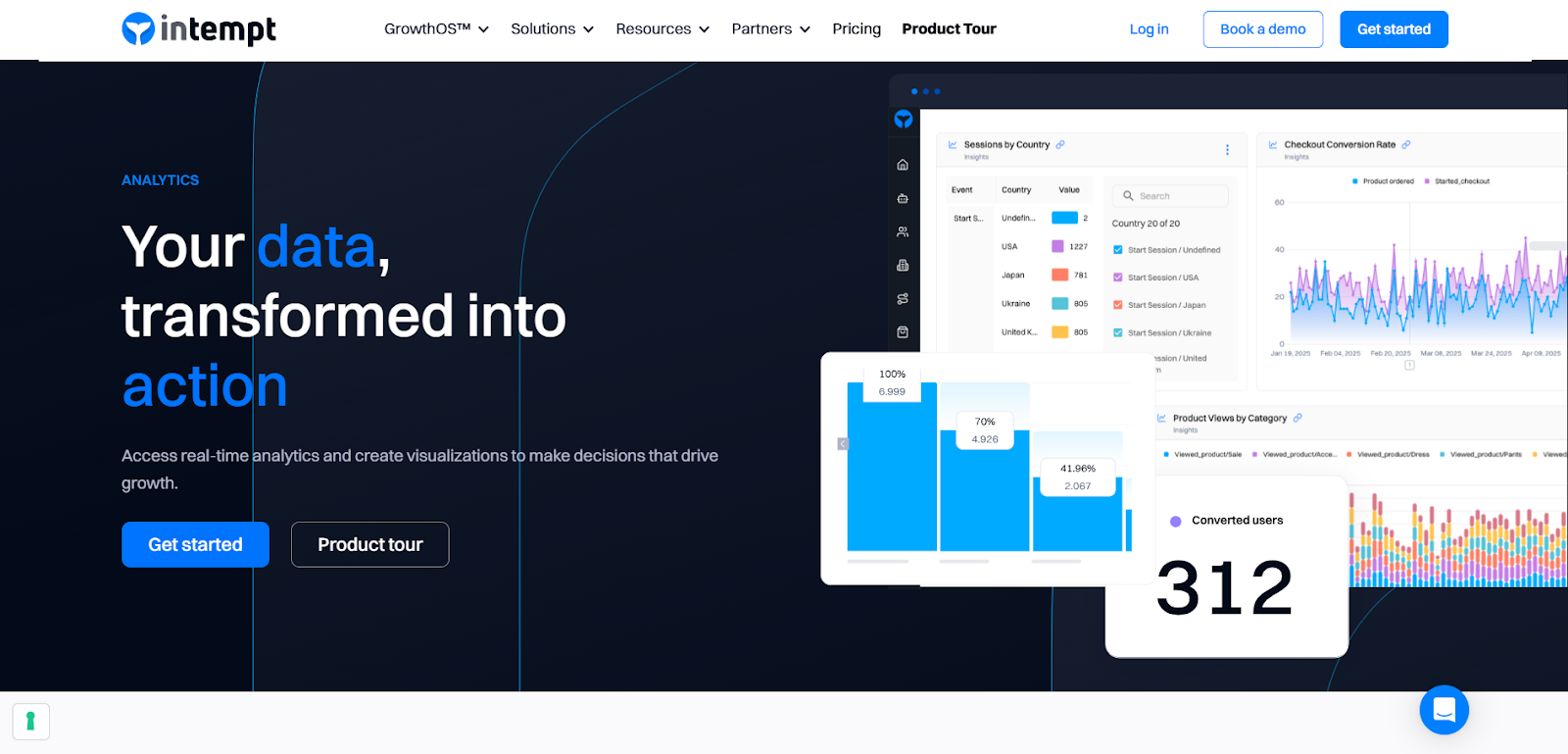
Intempt’s analytics engine goes beyond dashboards; it’s the intelligence layer powering every experience. Its AI-powered auto-event capture automatically detects and labels key actions across web, mobile, SDKs, and third-party tools, linking all activity to unified customer profiles with zero developer setup.
Its session analytics track and group every interaction into meaningful sessions, revealing behavior patterns without manual tagging. Real-time dashboards combine behavioral, product, and revenue data in one place, giving teams instant clarity on performance across journeys, campaigns, and experiments.
With native revenue attribution, Intempt maps every conversion back to its source, whether it’s a feature, campaign, or experiment, helping teams understand which experiences truly drive growth.
It’s not just analytics, it’s adaptive intelligence that fuels personalization, experiments, and orchestration, turning every insight into action.
When to Choose What?
Choosing between Intempt and VWO doesn’t have to feel like you’re stuck in an endless CRO vs Growth debate on LinkedIn. Let’s simplify it. Here’s the marketer-friendly breakdown of which platform wins for which type of team, use case, and growth model.
Choose VWO When…
You’re laser-focused on website optimization and want a strong experimentation engine without going deep into cross-channel orchestration or AI-driven personalization. VWO is built for teams who live and breathe landing pages, UX tweaks, and controlled A/B testing environments.
Pick VWO if:
- Your primary optimization happens on your website, and you don’t need multi-surface personalization across web, app, email, and CRM.
- You want a dedicated experimentation tool with heatmaps, session replays, and CRO-focused insights.
- You prefer manual segmentation and rule-based targeting over AI-driven intent models.
- You run high-traffic testing programs where visual editing and quick page-level experiments are your bread and butter.
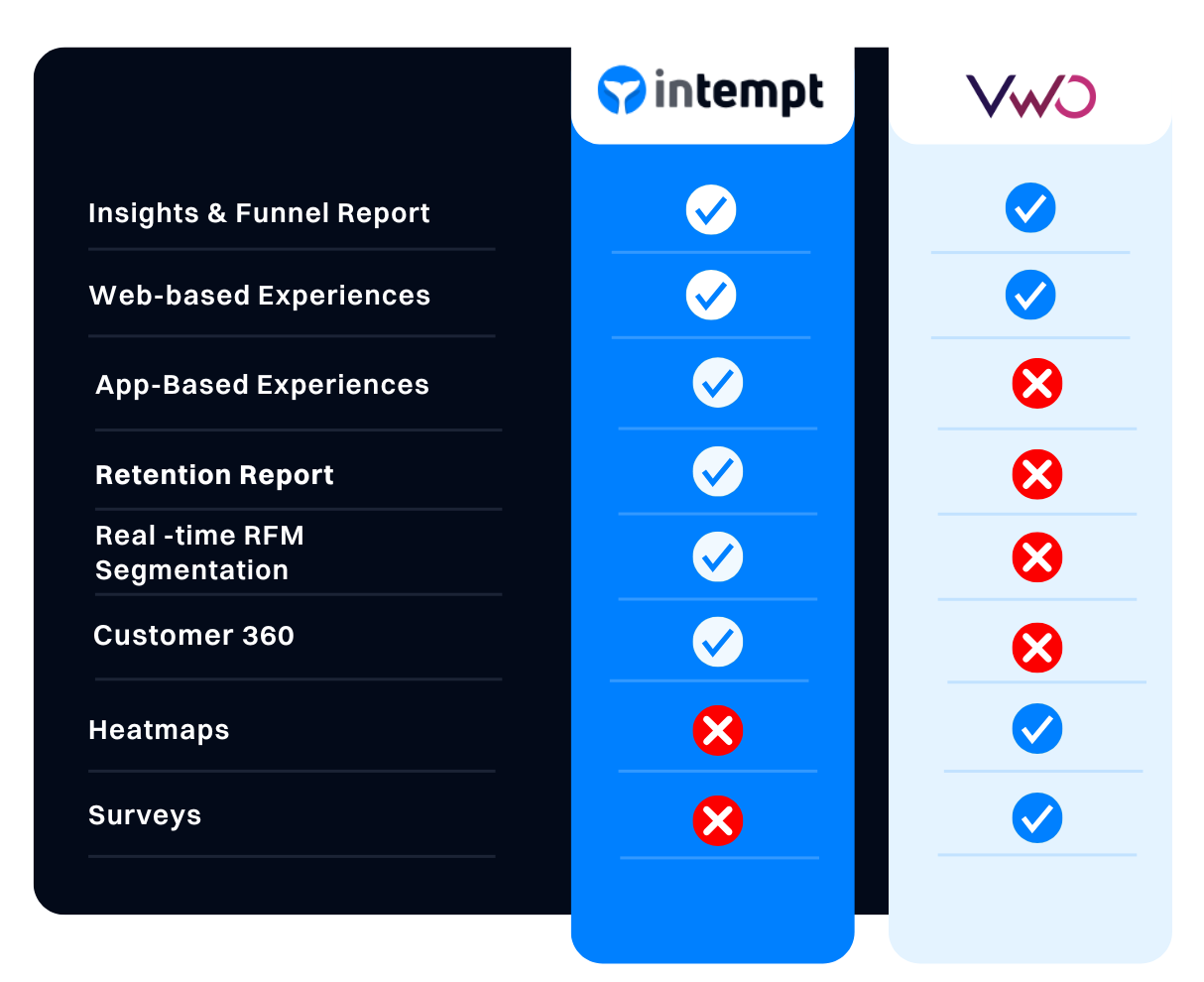
- You don’t need unified analytics + revenue attribution across the lifecycle. VWO provides Insights and Funnel reports but fails to provide with Retention Report.
- You already use other tools for email, mobile, CRM, or lifecycle orchestration and don’t expect your experimentation tool to double as a co-marketer.
VWO: a powerful experimentation engine built for CRO teams who want precise, controlled tests and website-level optimization.
Choose Intempt When…
You’re orchestrating customer experiences across multiple surfaces and want an AI co-marketer who not only helps you test, but predicts, adapts, and drives growth automatically. Intempt is built for modern lifecycle teams who need experimentation, personalization, and orchestration to work as one self-learning system.
Pick Intempt if:
- You operate across web, app, email, push, and CRM, not just the website layer.
- You want unified analytics with funnels, retention, journeys, and revenue attribution directly tied to experiments and personalization.
- You want real-time, AI-driven segmentation that updates based on user intent, behavior, and product usage.
- You want to run personalized experiments across web and mobile, not just UI tweaks on landing pages.
- You want an AI co-marketer that acts as your Qualification, Lifecycle, and Research agent, doing the thinking, predicting next-best actions, and optimizing journeys automatically.
- Your growth depends on lifecycle triggers, product signals, or multi-touch engagement, not just page-level conversions.
- You need native personalization blocks, in-app messages, push notifications, and multi-channel journey orchestration, all in one place.
- You want a platform that scales with your actual customer base rather than message volume, making it significantly more cost-efficient as you grow and engage users across multiple channels.
Intempt: intelligent orchestration for teams that want adaptive growth loops, not just optimized button colors. If your growth model relies on real-time behavior, continuous experimentation, multi-surface engagement, and AI-driven lifecycle automation, Intempt is the smarter choice.
TL;DR
- Experiences vs. Experiments: VWO optimizes tests; Intempt’s GrowthOS orchestrates real-time, adaptive experiences that evolve with every user action.
- Testing Focus: VWO excels at structured A/B and multivariate testing; Intempt extends beyond testing with AI-powered personalization across web and app.
- Learning Loop: VWO shows what worked; Intempt learns why it worked and automates the next best action through predictive cohorts and connected experiments.
- Integrations: VWO integrates well with analytics and CMS tools; Intempt integrates deeply with CRM, ecommerce, and marketing systems for instant experience activation.
- Pricing: VWO scales with traffic and experiment volume; Intempt’s MTU-based pricing starts at ~$52.6 per 1,000 users and remains predictable as you grow.
- Platform Scope: VWO improves individual tests; Intempt unifies experiments, personalization, and recommendations into a single AI-driven GrowthOS.
FAQs
1) What is the main difference between Intempt and VWO?
VWO focuses on experimentation and CRO. Intempt combines experimentation with activation, personalization, and revenue attribution, offering a unified view of user experiences and business outcomes.
2) Does Intempt replace VWO completely?
Yes, Intempt covers all core testing and personalization capabilities of VWO while extending into AI-driven journeys, CRM integration, and predictive insights.
3) Can Intempt replace Google Optimize or similar experimentation tools?
Absolutely. With Google Optimize sunsetting, many teams have moved to tools like VWO for experimentation. Intempt offers everything those tools provide and more. Beyond A/B and multivariate testing, Intempt integrates experiments directly into journeys, combines behavioral data with CRM and revenue insights, and enables AI targeting to identify high-intent users automatically.
4) Which is more cost-effective: Intempt or VWO?
Intempt is simply a cost-effective platform. Intempt’s pricing starts at $52.6 per 1,000 Monthly Tracked Users, making it predictable and scalable. VWO’s pricing on the other hand, grows with tested user volume or traffic, which can increase significantly as experiments scale.
5) Can I migrate my data from VWO to Intempt?
Yes. Intempt supports data migration via API or CSV, syncing experiments, user data, and segments into its unified model, so you can build upon existing insights without starting from scratch.
6) What’s included in Intempt’s free trial?
Intempt’s free trial gives you full access to its GrowthOS. You can explore real-time analytics, predictive cohorts, funnel analysis, and AI-powered personalization with live data tracking for your website or app. It also includes integrations with major tools like HubSpot, Shopify, and Stripe, so you can see how unified analytics and orchestration work together in practice. During the trial, you’ll also get onboarding support from Intempt’s growth team, helping you migrate data, set up auto-event capture, and launch your first AI-powered experiment.
FAQs
Can I trial Webflow before paying?

Sure! You can test out Webflow on our free plan where you can experiment with 2 projects. Your unhosted projects will have a two-page limit, but you can purchase a site plan on a per-project basis to unlock up to 100 static pages and additional CMS pages.
What is a project?
A project is a website that you build in Webflow. You can publish projects to a webflow.io staging subdomain for free, export the code on a paid plan, or add a site plan to connect your custom domain and unlock hosting features.
What can I white label?
Pro accounts can add their own logo to Client Billing forms and the Editor. Pro accounts can also remove references to Webflow in the source code and form submission emails, and hide the Webflow badge from their staging sites.
How much traffic can the hosting handle?
Webflow hosting scales automatically to handle millions of concurrent visits. All site plans serve sites through our Amazon's Cloudfront CDN and accelerated using Fastly, loading sites in milliseconds.
What kind of support does Webflow provide?
We offer fast email support to paid accounts and prioritized help for team accounts. Community support (forum.webflow.com) is available to free accounts.
How long does it take to learn Webflow?
If you're new to building websites, our video tutorials will get up and running quickly. If you already know concepts behind CSS and the box model, you will feel at home in Webflow.
Check out Growth Play Library ➡️
Get started free on GrowthOS ➡️
Book a growth call ➡️
.svg)
Sid Chaudhary
Founder & CEO


Looking for ways to grow faster?
Discover marketing workspace where you turn audiences into revenue.
Learn about IntemptReceive Monthly Insights
Get expert insights & news on the latest promotion trends in our monthly newsletter.
Sid Chaudhary
CEO & Founder

Lifecycle automation tips
Industry tips
Case Studies
You might also like...
%20In-Depth%20Comparison.png)
Intempt v/s Klaviyo (2025): In-Depth Comparison
Marketers want seamless customer journeys, not a maze of rules and manual triggers. If the system feels like work, it’s not automation, it’s stress in a shiny UI. Klaviyo has long been the go-to for e-commerce platforms, powering email, SMS, and now even WhatsApp automation. But 2025 teams want more than AI that writes better subject lines; they want an AI comarketer that thinks ahead. In this comparison, we’ll explore Intempt v/s Klaviyo with a sharp focus on their Journeys to help you find out which one delivers true AI-powered orchestration rather than just automated messaging.

%20In-Depth%20Comparison.png)
Intempt vs Mixpanel (2025): In-Depth Comparison
Marketers and product teams thrive on data, and let’s be honest, they hate it when it’s scattered across 2-3 different tools, buried in dashboards, and takes a ton of their time just to get a half-answer. Mixpanel has long been the gold standard for analytics, but 2025 teams want more than charts and funnels; they want action. They want orchestration, personalization, and a clear line from insight to revenue. In this comparison, we’re putting Intempt vs. Mixpanel under the microscope, feature by feature, insight by insight, to help you find the smarter and more future-ready analytics partner for your team.
Subscribe to The Full Stack Marketer 📈
Zero theory or mindset discussions here; just actionable marketing tactics that will grow revenue today.

Web A/B testing
Use front-end A/B and multi-page experimentation product built for any business size. Run multiple experiments on the same page.

Targeting & personalization
Deliver targeted messaging, personalized offers and recommend the most relevant content for your users.

Visual editor
Empower your team to collaborate with an easy-to-use visual editor without using developer time to get things up and running.

Analytics
Gain insight into the impact of your experiments with statistically valid results. No complex statistical analysis required.

Server & client-side testing
Go beyond client-side testing and deploy experiments on the server-side. Test and optimize content changes and even complete re-brands.

Flexible goal selection
Select the right goal for each personalization and experimentation campaign to ensure you’re optimizing towards the right objectives.
.svg)

.svg)


.svg)
.svg)