.svg)


Intempt v/s Klaviyo (2025): In-Depth Comparison
Marketers want seamless customer journeys, not a maze of rules and manual triggers. If the system feels like work, it’s not automation, it’s stress in a shiny UI. Klaviyo has long been the go-to for e-commerce platforms, powering email, SMS, and now even WhatsApp automation. But 2025 teams want more than AI that writes better subject lines; they want an AI comarketer that thinks ahead. In this comparison, we’ll explore Intempt v/s Klaviyo with a sharp focus on their Journeys to help you find out which one delivers true AI-powered orchestration rather than just automated messaging.
%20In-Depth%20Comparison.png)


Why Compare Intempt and Klaviyo?
Both platforms promise smarter, faster customer journeys. Klaviyo helps e-commerce teams automate messaging across channels like email, SMS, and WhatsApp with growing AI muscle.
Intempt, on the other hand, orchestrates entire customer lifecycles, connecting analytics, personalization, experiments, and recommendations into one adaptive AI-driven system with a superior UI that makes orchestration less complex and more intuitive.
In 2025, choosing the right tool means asking:
- Which one does more than just automate messages?
- Which has more impact on the full customer journey?
- Which one adapts in real time instead of relying on static flow logic?
- Which one ties orchestration directly to analytics + AI-driven decision making?
- Which one offers a user interface and user experience that empowers marketers faster, with fewer clicks and less complexity?
That’s what makes this comparison important. Because the future of marketing isn’t automated, it’s intelligent and easy to use.
How Is Intempt Different Than Klaviyo?
At first glance, both Intempt and Klaviyo let you create automated journeys. But beneath the surface, they’re powered by very different philosophies of marketing automation and different levels of UI/UX refinement.
Intempt
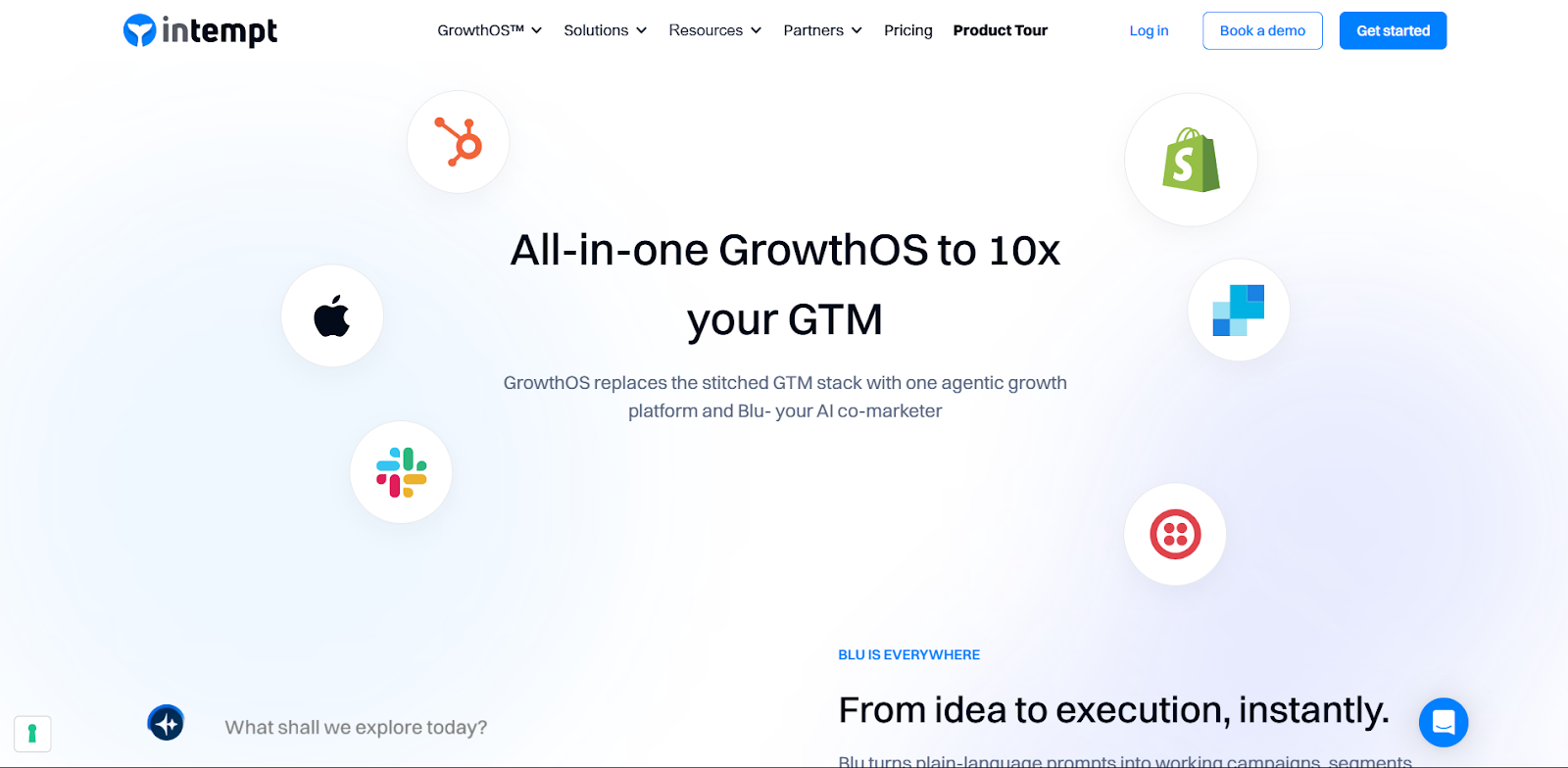
Intempt is built for growth teams that want their automation to think, not just execute, and for marketers who prefer a streamlined, intuitive interface. It’s your AI co-marketer that understands intent, predicts what users will do next, and orchestrates personalized experiences automatically. The UI is designed to make building, visualizing, and tweaking journeys easy: fewer nested menus, easier experimentation setup, and clearer revenue attribution dashboards.
The Journeys feature inside Intempt goes beyond flowcharts. It combines behavioral analytics, CRM data, intent-scoring, and predictive modeling to dynamically recalibrate each user’s path.
With Blu (AI Coach), you can build omnichannel journeys on the fly. From onboarding to re-engagement, design and launch adaptive campaigns that personalize in real time and drive conversions.
For example:
If a user shows high purchase intent but doesn’t convert, Intempt’s AI will instantly trigger a personalized experiment testing a discount email vs. an in-app recommendation and automatically learn which drives the best outcome. You only need to set up the campaign once, and whenever the situation arises, Intempt handles the rest automatically.
It’s not “set it and forget it” automation. It’s “set it and let AI + your interface work together to learn and adapt.”
Klaviyo
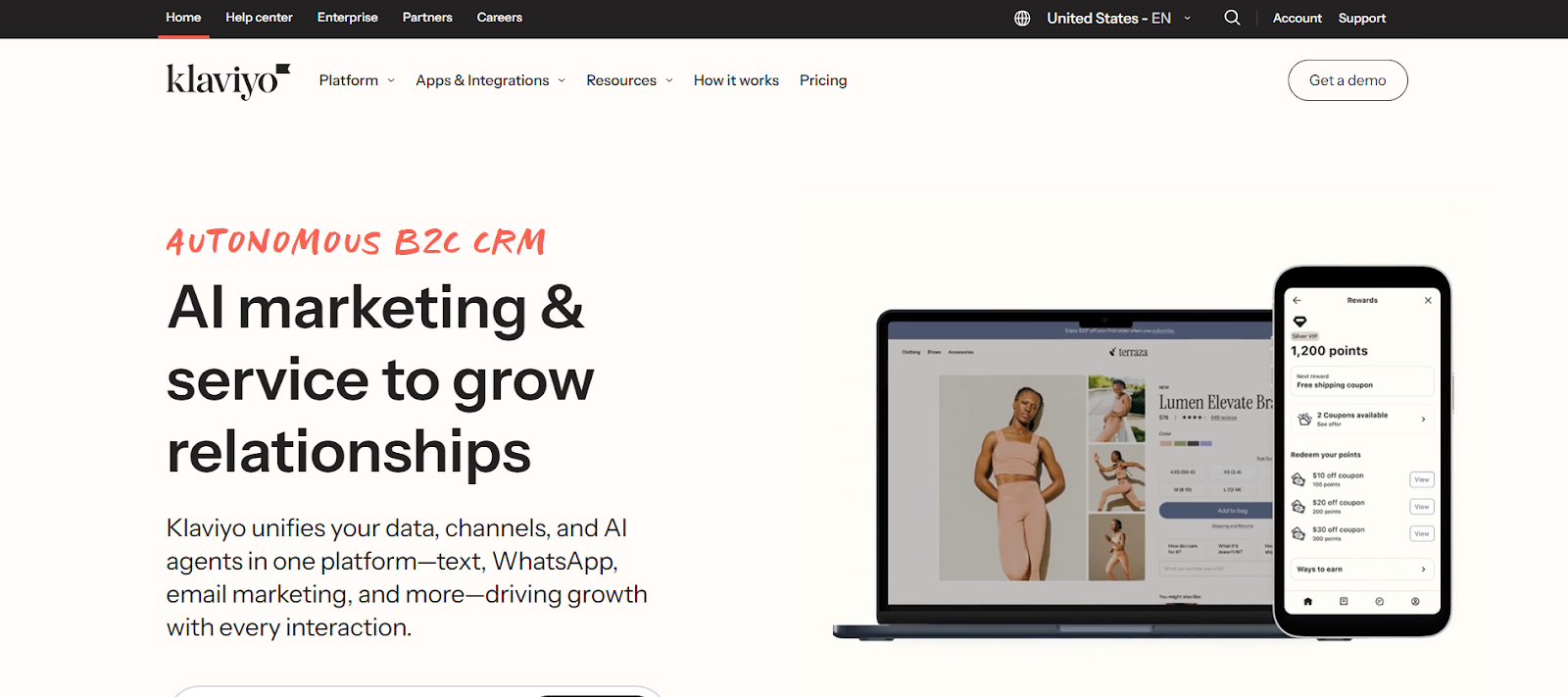
Klaviyo has evolved from being an email automation platform to a powerful AI-assisted omnichannel engine. It provides features like AI content generation for email, SMS, and WhatsApp, predictive analytics, and flows.
Journeys in Klaviyo (called Flows) are rule-based: you define the triggers, time delays, and logic branches manually. The AI helps create content and timing inside those branches, but it doesn’t rewrite or optimize the journey logic itself in a fully autonomous way. Also, while its UI is robust, many marketers still report steeper learning curves for advanced journey orchestration.
In-Depth Comparison: Intempt vs Klaviyo
As an all-in-one GrowthOS, Intempt isn’t just an alternative to Klaviyo; it’s a step-up from campaign automation to intelligent journey orchestration. Modern growth teams don’t just need tools that send messages; they need connected, AI-driven systems that understand intent, adapt in real time, and turn every customer path into a personalized growth loop.
Automation alone doesn’t build loyalty unless it connects to personalization, analytics, and orchestration. That’s where the comparison between Intempt and Klaviyo becomes crucial.
Both platforms empower marketers to engage customers across channels, but the way they handle journey intelligence, personalization depth, orchestration flexibility, and UI/UX simplicity differs significantly.
Below, we’ve compared both platforms feature-by-feature across journeys, personalization, orchestration, AI capabilities, analytics, integrations, pricing, and more.
Journeys
Both Intempt and Klaviyo help teams automate customer journeys, but the way they do it defines how far your marketing can really scale.
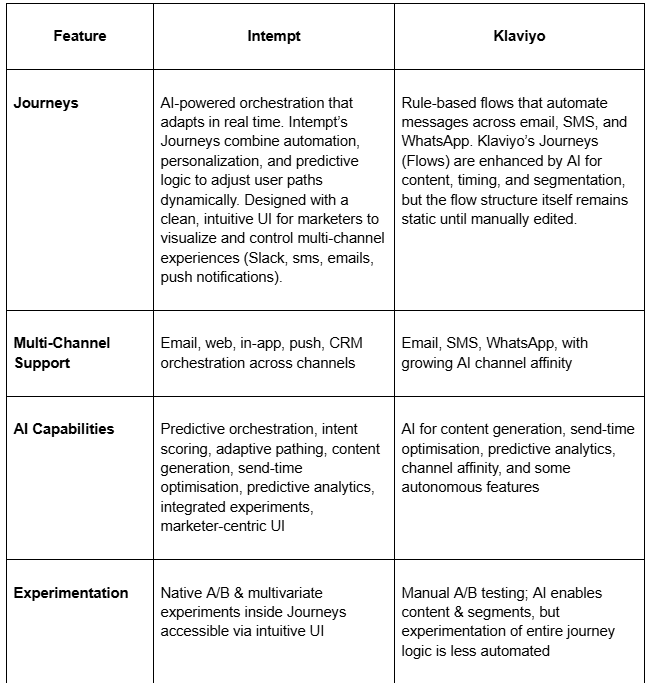
Intempt takes a predictive, AI-driven approach to orchestration. Its Journeys aren’t static flows; they’re living systems that adapt in real time. Powered by behavioral data and AI intent models, each path recalculates dynamically based on what a user does, not just what’s been pre-set. If engagement drops, Intempt’s co-marketer triggers a new route, maybe a retargeting experiment, a personalized offer, or an in-app nudge.
Marketers can start flows based on behaviors, attributes, or agent signals, including agent-triggered enrichment blocks and research workflows. With the help of predictive branching, marketers can go beyond static Yes/No splits with AI that routes users based on likelihood to convert, upgrade, or churn, and let AI detect churn risk, purchase intent, or lifecycle stage and auto-start journeys at the right moment.
Klaviyo, in contrast, uses Flows, which are rule-based sequences built around pre-defined triggers and timing. They’re powerful for e-commerce campaigns like welcome sequences, abandoned cart reminders, or post-purchase follow-ups. AI layer adds automation for content generation, segmentation, and send-time optimization.
However, its capabilities are more limited in terms of multi-channel real-time event triggers and cross-device behaviour. The journey logic itself doesn’t evolve automatically. To change how a customer moves through a flow, marketers need to manually edit branches and triggers.
In short, Klaviyo automates journeys, but Intempt orchestrates them intelligently, dynamically, and across every channel.
Multi-Channel Support
Both platforms connect multiple communication channels, but differ in how deeply they orchestrate them.
Intempt was designed from the ground up for omnichannel orchestration. Marketers can build a single journey that spans web, app, email, push notifications, and CRM. The system automatically syncs user data across all channels and adapts messages in real time, ensuring consistency and personalization wherever users engage.
Marketers can use AI snippets and real-time variables, enriched with Research Agent fields and updated CRM data, and combine channels to build consistent, cross-platform journeys that adapt dynamically using enrichment and deliverability intelligence.
Klaviyo has evolved into a strong multichannel marketing platform, expanding beyond email and SMS to include WhatsApp and push notifications. Its AI layer helps choose the optimal channel for each user and predicts when they’re most likely to respond.
That said, orchestration remains more message-based than experience-based channels are managed individually rather than holistically. Real-time coordination across platforms often requires additional setup or third-party tools.
In essence, Intempt connects every channel into one adaptive journey, while Klaviyo optimizes communication within each channel.
AI Capabilities
Both Intempt and Klaviyo have strong AI foundations, but they apply them differently: one for orchestration, the other for optimization.
Intempt uses AI as the core driver of orchestration. Its predictive models score user intent, forecast conversion likelihood, and automatically adjust journeys based on real-time behavior. The AI analyzes engagement patterns, identifies drop-offs, and recommends (or even executes) next-best actions across channels. AI detects churn risk, purchase intent, or lifecycle stage and auto-start journeys at the right moment. It doesn’t just optimize campaigns; it builds self-learning customer journeys.
Klaviyo leverages AI primarily within its messaging layer. Its AI assistant can write emails, generate SMS and WhatsApp content, optimize send times, and predict metrics like CLTV, churn risk, or next purchase date.
The AI enhances marketer productivity and message quality but doesn’t autonomously manage or re-orchestrate entire customer journeys.
Simply put, Klaviyo’s AI helps you send smarter, while Intempt’s AI helps your journeys think smarter, constantly analyzing, adapting, and improving outcomes without manual input.
Experimentation
Both Intempt and Klaviyo allow marketers to test and optimize campaigns, but their experimentation philosophies diverge sharply.
Intempt embeds experimentation natively within its GrowthOS. Marketers can run A/B and multivariate tests inside journeys, adjust targeting parameters, and monitor results with advanced analytics - all in one unified interface.
By combining AI-driven audience targeting, intelligent traffic distribution, and multi-page experimentation, Intempt helps marketers quickly see which variations drive meaningful growth. No code, no exports, and most importantly, no tool-hopping; everything is built for marketers to iterate fast and act on insights instantly.
Klaviyo supports A/B testing primarily within its email and SMS flows. Marketers can test subject lines, message timing, or offer variants, and its reporting highlights the best-performing versions.
However, experimentation is limited to content-level optimization, not end-to-end journey testing or multi-channel experiments. Running deeper behavioral tests or connecting outcomes to larger orchestration strategies typically requires additional setup or integrations.
If Klaviyo helps you test better messages, Intempt helps you test better experiences, combining analytics, personalization, and orchestration in one AI-driven system.
Segmentation & Personalization
Both platforms excel at segmentation and personalization, but they differ in automation and adaptability.
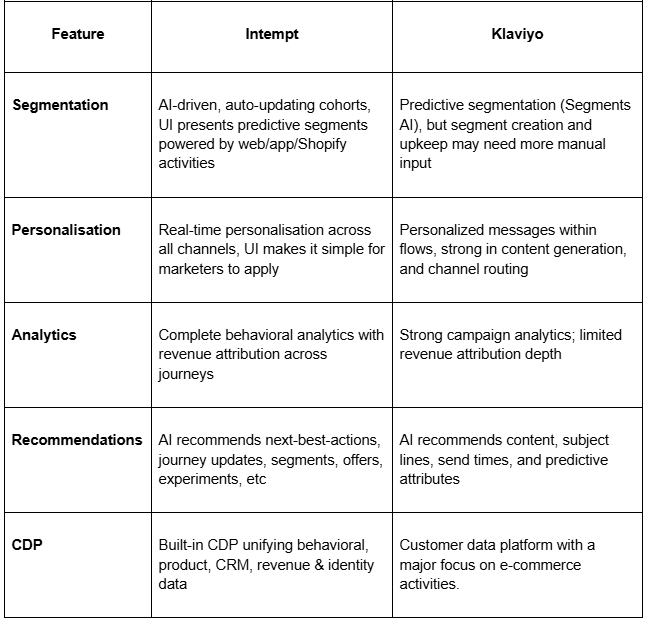
Intempt offers predictive, auto-updating segmentation. AI dynamically groups users based on behavior, intent scores, and engagement signals, ensuring campaigns and journeys always use real-time data.
Personalization extends beyond messages: content blocks, offers, and even journey paths adapt automatically for each user. Marketers can visually build and deploy these dynamic segments without code, and Intempt’s AI continuously refines them to improve targeting precision over time.
Intempt allows you to set up a “Lifecycle agent” where you can define how users are bucketed based on selected conversion events within specified timeframes. For eg, (“Champion”, “Loyal”, “Regulars”, “At Risk”, etc).
Klaviyo delivers one of the best predictive segmentation systems in the e-commerce world. Using its customer data platform (CDP), marketers can build segments based on activity, purchase history, and predictive metrics like churn or CLTV. Its personalization features are robust for message-level customization, from product recommendations to dynamic content generation using AI.
However, updates to segments depend on defined rules, and personalization is primarily focused within messages rather than journey logic.
To summarize: Klaviyo personalizes communication, but Intempt personalizes the entire customer experience, from the first impression to conversion and beyond.
Analytics
Intempt integrates behavioral analytics directly into its orchestration engine. Instead of dashboards you occasionally check, analytics are woven into how journeys run. Marketers can track user funnels, cohort performance, feature usage, conversions, churn risk, and revenue, all tied back to journey logic and orchestration decisions.
Revenue attribution isn’t an add-on; it’s the backbone. You see exactly how each journey, message, or experiment impacts revenue, retention, and user progression. Intempt acts like a co-marketer who continuously studies your data and adjusts strategies based on what truly moves the needle.
Klaviyo provides clean, highly actionable analytics for e-commerce: open rates, click rates, revenue per recipient, flow performance, and campaign attribution windows. Its predictive analytics (like churn risk and expected CLTV) are powerful for e-commerce targeting and personalization.
However, its analytics remain message-first, not journey-first. Connecting data to larger lifecycle performance often requires additional integrations or manual interpretation. Klaviyo doesn’t provide deep analytics. It’s excellent for communication metrics, but not as strong for understanding full customer lifecycle health or how journeys impact revenue holistically.
Recommendations
Intempt uses AI to recommend activation decisions. It identifies high-impact segments, predicts churn or purchase intent, recommends journey branches, and even proposes which experiments to run to maximize revenue.
These recommendations tie back to behavioral analytics, product usage, and revenue signals, which means the AI doesn't just tell you what content to send, but also what journey logic should change.
It’s like having a strategist who whispers: “This cohort is heating up, shift them into this branch,” or “Users in Step 4 are dropping; test this variation.”
Klaviyo focuses its AI recommendations on content and timing. It suggests subject lines, SMS copy, product recommendations, send-time optimization, and predictive segments (like likely to churn or likely to purchase).
For e-commerce teams, these are incredibly useful tools for launching high-performing campaigns fast. But its recommendations don’t extend into journey-level decision-making; you still need to manually decide how the flow should run or change.
Customer Data Platform (CDP)
Intempt functions as a full CDP, centralizing behavioral events, product usage, CRM activity, attributes, revenue, and identity resolution in one place. It captures events from Shopify, Stripe, and HubSpot, combining them with email, web, in-app, and push notifications. This data doesn’t just sit in profiles; it powers AI orchestration, predictive segments, experimentation, and personalization across channels. Because analytics, orchestration, and experiments are built on top of the CDP, Intempt offers a true end-to-end GrowthOS: capture data → understand behavior → orchestrate journeys → test → measure → adapt.
Klaviyo includes a customer data layer designed primarily for e-commerce activity. It captures events from Shopify, WooCommerce, and similar systems, combining them with email/SMS/WhatsApp interactions. Its CDP strengths lie in ecommerce-focused attributes like predicted CLTV, purchase history, channel engagement, and product-level behaviors.
While powerful for e-commerce messaging, it doesn’t operate as a full-funnel CDP powering multi-touch web/app orchestration the way Intempt does.
Integrations and Pricing
Integrations
Intempt
- Connects directly with major systems (Shopify, HubSpot, Stripe, Segment, Meta) using clean setup flows and marketer-friendly UI.
- Real-time, two-way syncs feed data into orchestration and UI surfaces insights clearly.
- The UI prioritizes clarity, featuring fewer nested rules, improved visualization of journeys, and more drag-and-drop or no-code builders, making it easier for non-technical marketers to manage orchestration.
Klaviyo
- It provides e-commerce integrations (Shopify, WooCommerce, BigCommerce) and has expanded into omnichannel (WhatsApp).
- UI is powerful, but with scale and multiple channels, users report complexity and steeper learning curves for advanced journey logic. Reddit+1
- AI features are well-integrated (content generation, channel affinity, segments), but the UI for orchestrating complex, multi-channel, multi-step journeys is less streamlined compared to what Intempt offers.
Pricing
Intempt
- Based on Monthly Tracked Users (MTUs), starting at around $52.6 per 1,000 users.
- With its intuitive UI/UX, you’ll spend less time managing tools and more time growing.
Klaviyo
- Pricing based on the number of contacts + volume of messages across channels.
- For Email, the pricing starts from $45 per month for 15,000 emails.
- As your contact list and message volume grow, you may see steep cost increases. And with UI complexity, you may also incur extra setup/maintenance costs in time.
Beyond Journeys: Why Intempt Is More Than Just a Journey Orchestration Platform
Intempt isn’t just an AI-powered journey orchestrator; Intempt GrowthOS provides a complete suite of AI-driven capabilities that connect every part of your growth engine, from sales to retention. Each feature is designed to help marketers and product teams move from understanding users to acting intelligently on every insight.
Personalization
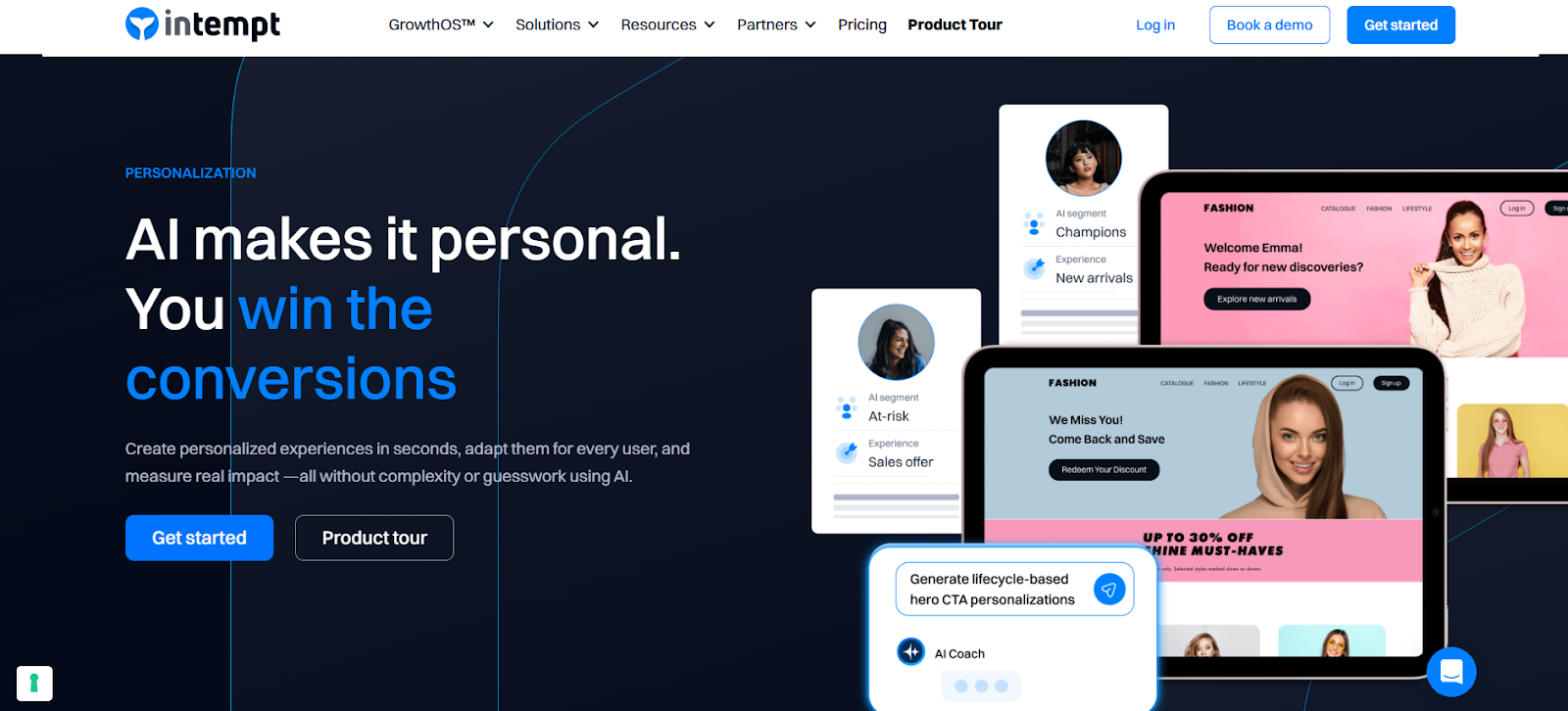
The AI-based personalization engine inside Intempt continuously adapts user experiences across email, web, and product interfaces. Using real-time behavioral tracking and predictive segmentation, it understands what users are likely to do next and serves them the right message or offer automatically.
Content blocks, product recommendations, and CTAs change dynamically based on user intent. Marketers can build these experiences visually, without code, and link them to experiments or campaigns instantly. This significantly reduces the dependency of marketers on developers for various activities. Personalization in Intempt transforms from static audience targeting into an autonomous co-marketer that optimizes every touchpoint. In short, create and manage every personalized flow in one place, build with AI without code, run campaigns with precision, and reach the right audience, every time.
Experiment
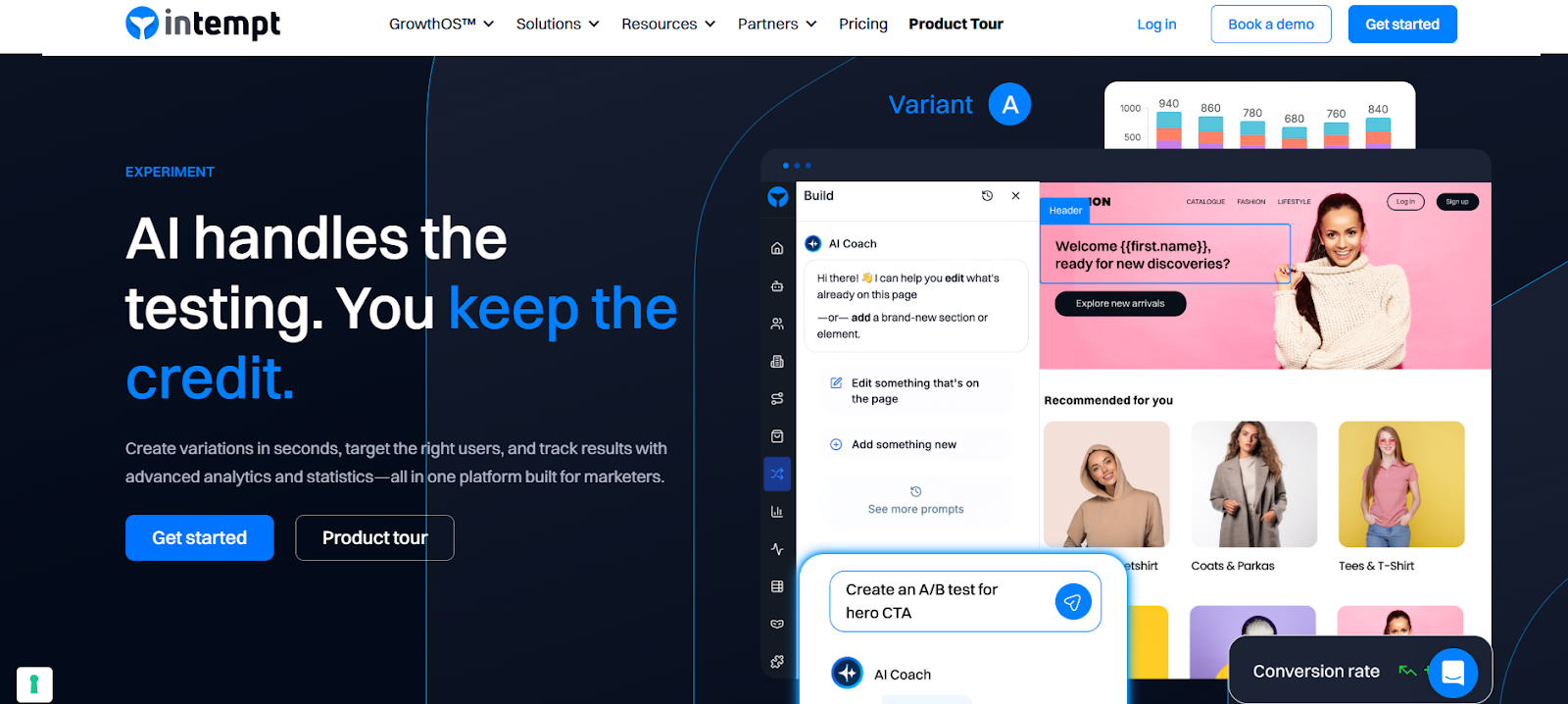
Experimentation is built directly into Intempt’s GrowthOS; no integrations or extra tools required.
Teams can design, deploy, and analyze A/B, multivariate, and holdout experiments directly inside journeys.
Experiments are tied to revenue attribution, so marketers can see not just which variant performs better, but which one drives actual revenue growth. Marketers can run quick UI changes or deep logic tests in one place, no dev queue, no tool-switching, just experiments you control end-to-end. It allows you to combine AI targeting, traffic control, and multi-page experiments to see which changes drive real growth.
It helps you to cut through the noise; the CUPED variance reduction taps into your historical data to smooth out randomness. Tests run shorter, insights arrive quicker, and you get to results that actually mean something. This seamless integration allows teams to continuously test and learn without disrupting live campaigns or waiting for analyst reports.
Recommendations
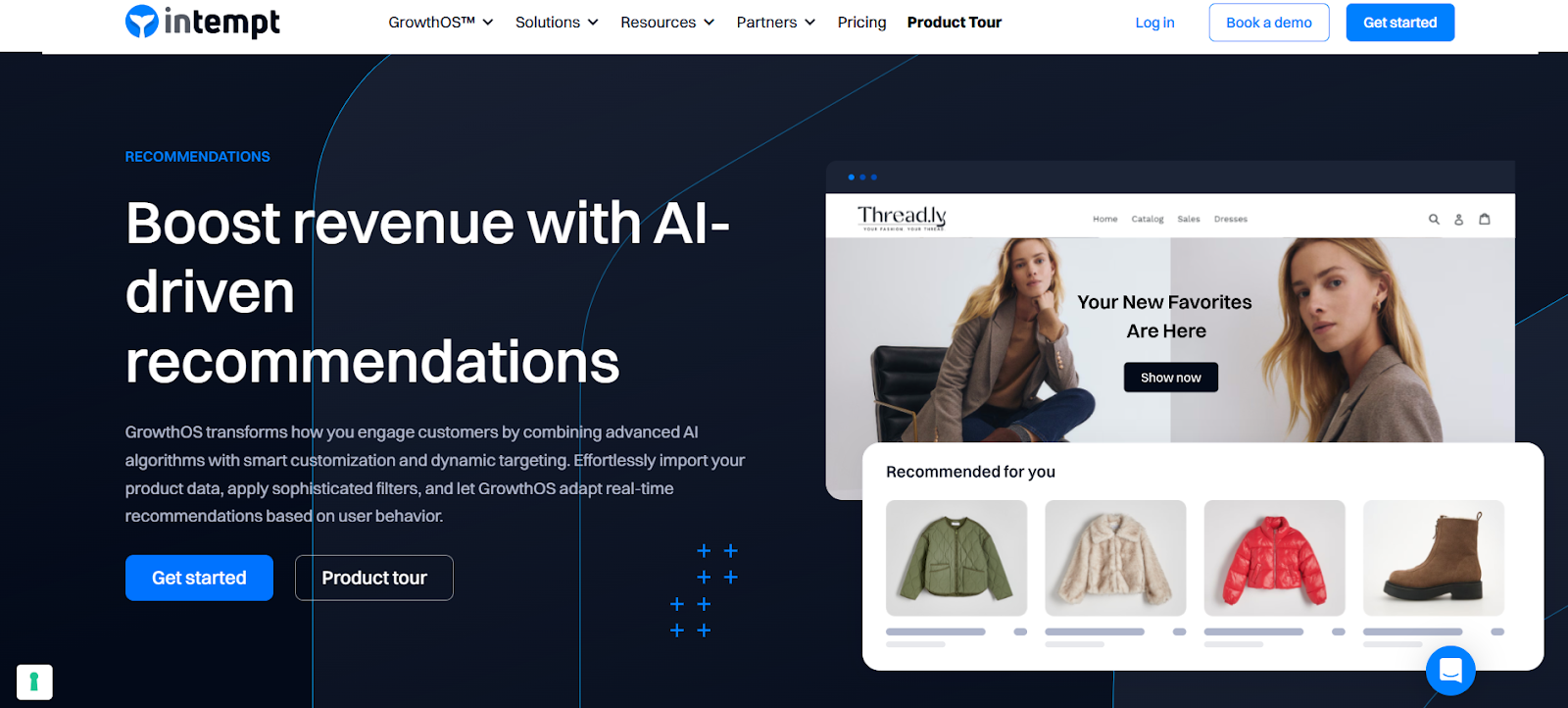
Intempt’s AI recommendation system predicts and delivers the next best content, offer, or product for every user. It draws on real-time behavioral, purchase, and engagement data to surface personalized suggestions, whether it’s the right plan to upgrade to, a blog to read, or a product to purchase.
Recommendations integrate directly into journeys, campaigns, and web pages, ensuring every user interaction feels individually tailored.
Intempt GrowthOS transforms how you engage customers by combining advanced AI algorithms with smart customization and dynamic targeting. Effortlessly import your product data, apply sophisticated filters, and let GrowthOS adapt real-time recommendations based on user behavior.
Over time, the model learns which patterns drive conversion, refining itself automatically to improve performance and relevance.
When to Choose What?
Choosing between Intempt and Klaviyo doesn’t have to be complicated. Let’s break it down in plain marketer language, so you instantly know which platform fits which type of team, use case, and growth model.
Choose Klaviyo When…
You’re running an e-commerce-focused brand, and the majority of your engagement happens through messaging. Klaviyo shines brightest when your growth strategy is built around storefront conversions and repeat purchases.
Pick Klaviyo if:
- You run a pure e-commerce brand and your primary touchpoints are email, SMS, and WhatsApp.
- You want a fast path to revenue through plug-and-play flows like abandoned cart, browse abandonment, win-back, and post-purchase.
- You prefer AI that helps generate content rather than orchestrating decisions.
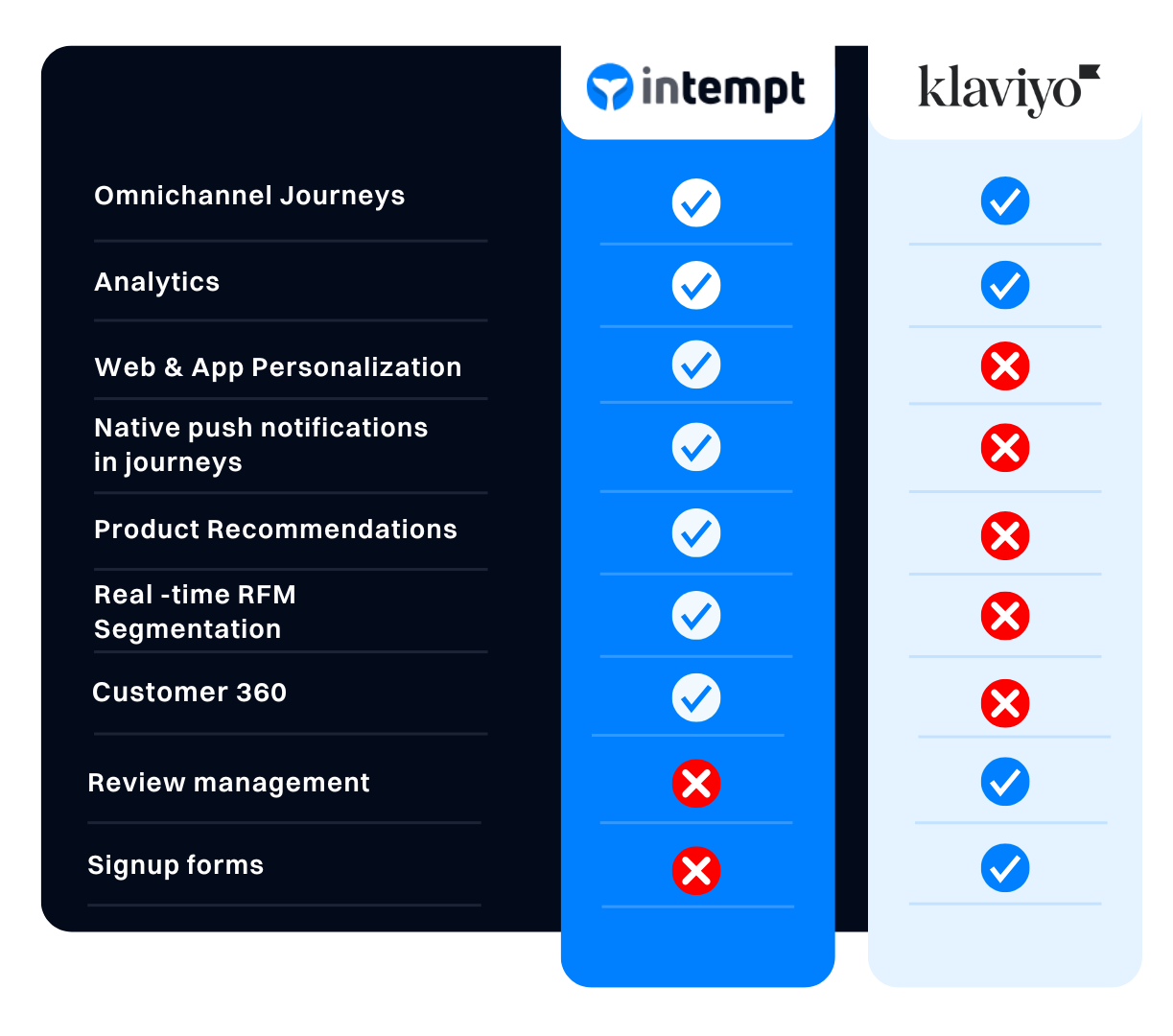
- You don’t need push notifications, in-app messages, or multi-touch journey orchestration.
- Your lifecycle isn’t heavily driven by product usage (like SaaS or mobile apps).
- You prioritize e-commerce storefront automation over holistic cross-channel experiences.
Klaviyo: a messaging engine built for ecommerce-heavy brands that want powerful, channel-first automation.
Choose Intempt When…
You’re managing customer lifecycles across multiple surfaces: web, app, email, push, CRM, and you want an AI co-marketer that doesn’t just assist, but actually thinks, predicts, adapts, and orchestrates growth for you.
Pick Intempt if:
- You operate across multiple platforms: web, app, email, and push, not just messaging.
- You need deep unified analytics with Insights, Funnel, and Retention reports with powerful segmentation + revenue attribution tied to behavior across every channel.
- You want AI-driven RFM segmentation that connects with your events and updates based on user behavior and intent.
- You want to test entire personalized experiments across web and mobile, not just message-level A/B tests.
- You want an AI co-marketer to act as a Qualification, Lifecycle, or Research agent that does your research for you, predicts next-best actions, and optimizes user journeys automatically.
- Your growth depends on product usage signals, behavioral triggers, or lifecycle stage shifts.
- You want native push notifications, in-app personalization, and cross-channel orchestration in a unified place.
- You want a platform that scales with your actual customer base rather than message volume, making it significantly more cost-efficient as you grow and engage users across multiple channels.
Intempt: intelligent orchestration for brands that want adaptive growth loops, not just better messages. If your growth model goes beyond simple messaging and relies on real-time behavior, multi-surface engagement, and continuous lifecycle optimization, Intempt is the smarter choice.
TL;DR
● Journeys that Think, Not Just Run:
Both Intempt and Klaviyo help automate customer journeys, but Intempt’s AI takes it further, continuously adapting paths based on user behavior and intent.
● True Omnichannel Orchestration:
Klaviyo connects email, SMS, and WhatsApp beautifully, but Intempt ties together every touchpoint, web, app, CRM, and push notifications into one AI-orchestrated journey.
● Analytics That Tell the Whole Story:
Klaviyo gives clean campaign metrics; Intempt gives deep unified analytics with Insights, Funnel, and Retention reports tied to revenue attribution.
● CDP That Powers Everything, Not Just Messaging:
Klaviyo has a strong e-commerce data layer. Intempt includes a full CDP that unifies behavioral, product, CRM, and revenue data, unlocking AI orchestration, predictive segments, experiments, and personalization across every channel.
● Smarter Recommendations That Fuel Growth:
Klaviyo recommends content and timing; it usually updates in batch, which is powerful, but not in real-time; Intempt provides recommendations in real-time based on behavioral + revenue signals.
● AI That Orchestrates vs. AI That Optimizes:
Klaviyo’s AI makes writing, timing, and targeting easier. Intempt’s AI makes marketing smarter, predicting next-best actions, optimizing paths dynamically, and turning journeys into self-learning growth engines.
● Experimentation Beyond Messages:
Klaviyo lets you A/B test content and timing; Intempt lets you test entire experiences across web and mobile.
● Lifecycle Agent for RFM:
Klaviyo gives you built-in RFM reporting, predefined groups updated nightly. Intempt allows you to set up a “Lifecycle agent” where you can define how users are bucketed based on selected conversion events within specified timeframes. For eg, (“Champion”, “Loyal”, “Regulars”, “At Risk”, etc)
● Designed for Marketers, Built for Growth:
Intempt’s UI and UX are cleaner, faster, and built for how marketers actually work with no steep learning curve, no buried menus. Klaviyo’s interface is powerful but more complex to manage as campaigns scale.
FAQs
1) What’s the main difference between Intempt and Klaviyo?
Klaviyo focuses on AI-assisted campaign automation, helping marketers send smarter messages across email, SMS, and WhatsApp.
Intempt goes beyond messaging. It’s an AI-driven GrowthOS built for journey orchestration, connecting analytics, personalization, and experimentation so every user path adapts in real time.
2) Does Intempt replace Klaviyo completely?
Yes. Intempt covers everything Klaviyo does (email, segmentation, personalization) while adding AI journey orchestration, multi-channel experimentation, and deep analytics. It’s not just a messaging platform; it’s a full growth system that learns and optimizes continuously.
3) How are Intempt’s Journeys different from Klaviyo’s Flows?
Klaviyo’s Flows are rule-based automations: you set triggers, define branches, and the system runs them as designed.
Intempt’s Journeys are AI-powered. They don’t just run, they think. If user behavior changes, the AI recalibrates the journey instantly, suggesting next-best actions and adapting content across channels without manual input.
4) What kind of AI does each platform use?
Klaviyo’s K:AI helps generate content, optimize send times, and predict engagement or churn. It’s great for messaging automation.
Intempt’s AI (Blu) acts as a co-marketer, analyzing intent signals, running adaptive experiments, predicting user actions, and orchestrating entire journeys end-to-end.
In short: Klaviyo’s AI helps you send better; Intempt’s AI helps your marketing think better.
6) Which tool offers a better UI and UX?
Marketers often find Intempt’s interface cleaner and faster to navigate. Its visual journey builder, drag-and-drop orchestration, and simplified dashboards make managing complex experiences effortless.
Klaviyo’s UI is powerful and familiar to ecommerce teams, but it can feel heavier as campaigns scale across multiple channels. Overall, Intempt is more marketer-friendly and easier to use.
FAQs
Can I trial Webflow before paying?

Sure! You can test out Webflow on our free plan where you can experiment with 2 projects. Your unhosted projects will have a two-page limit, but you can purchase a site plan on a per-project basis to unlock up to 100 static pages and additional CMS pages.
What is a project?
A project is a website that you build in Webflow. You can publish projects to a webflow.io staging subdomain for free, export the code on a paid plan, or add a site plan to connect your custom domain and unlock hosting features.
What can I white label?
Pro accounts can add their own logo to Client Billing forms and the Editor. Pro accounts can also remove references to Webflow in the source code and form submission emails, and hide the Webflow badge from their staging sites.
How much traffic can the hosting handle?
Webflow hosting scales automatically to handle millions of concurrent visits. All site plans serve sites through our Amazon's Cloudfront CDN and accelerated using Fastly, loading sites in milliseconds.
What kind of support does Webflow provide?
We offer fast email support to paid accounts and prioritized help for team accounts. Community support (forum.webflow.com) is available to free accounts.
How long does it take to learn Webflow?
If you're new to building websites, our video tutorials will get up and running quickly. If you already know concepts behind CSS and the box model, you will feel at home in Webflow.
Check out Growth Play Library ➡️
Get started free on GrowthOS ➡️
Book a growth call ➡️
.svg)
Sid Chaudhary
Founder & CEO


Looking for ways to grow faster?
Discover marketing workspace where you turn audiences into revenue.
Learn about IntemptReceive Monthly Insights
Get expert insights & news on the latest promotion trends in our monthly newsletter.
Sid Chaudhary
CEO & Founder

Lifecycle automation tips
Industry tips
Case Studies
You might also like...
%20In-Depth%20Comparison.png)
Intempt vs VWO (2025): In-Depth Comparison
Marketers don’t just want to test ideas; they want to turn those ideas into real customer experiences. Simple A/B tests and standard conversion lifts were once the gold standard, but now they have become the ghost of the past, because in 2025, growth teams demand more. They want to personalize in real time, orchestrate intelligently, and connect experiment results to revenue outcomes.

%20In-Depth%20Comparison.png)
Intempt vs Mixpanel (2025): In-Depth Comparison
Marketers and product teams thrive on data, and let’s be honest, they hate it when it’s scattered across 2-3 different tools, buried in dashboards, and takes a ton of their time just to get a half-answer. Mixpanel has long been the gold standard for analytics, but 2025 teams want more than charts and funnels; they want action. They want orchestration, personalization, and a clear line from insight to revenue. In this comparison, we’re putting Intempt vs. Mixpanel under the microscope, feature by feature, insight by insight, to help you find the smarter and more future-ready analytics partner for your team.
Subscribe to The Full Stack Marketer 📈
Zero theory or mindset discussions here; just actionable marketing tactics that will grow revenue today.

Web A/B testing
Use front-end A/B and multi-page experimentation product built for any business size. Run multiple experiments on the same page.

Targeting & personalization
Deliver targeted messaging, personalized offers and recommend the most relevant content for your users.

Visual editor
Empower your team to collaborate with an easy-to-use visual editor without using developer time to get things up and running.

Analytics
Gain insight into the impact of your experiments with statistically valid results. No complex statistical analysis required.

Server & client-side testing
Go beyond client-side testing and deploy experiments on the server-side. Test and optimize content changes and even complete re-brands.

Flexible goal selection
Select the right goal for each personalization and experimentation campaign to ensure you’re optimizing towards the right objectives.
.svg)

.svg)


.svg)
.svg)