.svg)


Intempt vs Mixpanel (2025): In-Depth Comparison
Marketers and product teams thrive on data, and let’s be honest, they hate it when it’s scattered across 2-3 different tools, buried in dashboards, and takes a ton of their time just to get a half-answer. Mixpanel has long been the gold standard for analytics, but 2025 teams want more than charts and funnels; they want action. They want orchestration, personalization, and a clear line from insight to revenue. In this comparison, we’re putting Intempt vs. Mixpanel under the microscope, feature by feature, insight by insight, to help you find the smarter and more future-ready analytics partner for your team.
%20In-Depth%20Comparison.png)


Why Compare Intempt and Mixpanel?
Think of AI-powered analytics and revenue attribution platforms as the GPS for modern product and marketing teams. Just like your navigation app reroutes you around traffic and finds the fastest route to your destination, these tools help marketers avoid unnecessary experiments, uncover the best-performing campaigns, and make sure every orchestration leads to measurable revenue.
But here’s the thing: when every tool claims to be “data-driven” or “AI-powered,” choosing the right one can feel like navigating in the dark. The lines between analytics, orchestration, and personalization are blurring fast, and growth teams are left asking:
- Which tool helps me understand user behavior versus influence it?
- Which one ties analytics directly to revenue outcomes?
- Which actually empowers my team to experiment and optimize without endless setup?
That’s why this comparison matters. In 2025, the analytics landscape isn’t just about tracking what happened; it’s about predicting, orchestrating, and personalizing what should happen next. Teams need platforms that bridge data and action, insight and impact, dashboards and dollars.
Speaking of dollars, pricing is also a very important reason for this comparison. In terms of pricing, Intempt’s pricing follows a Monthly Tracked Users (MTU) model, starting at $52.6 per 1,000 users. It makes it easy to predict and sustainable as you only pay for the users you track. Mixpanel, on the other hand, offers a free plan for up to 1 million events per month, which is good for small-scale startups or small teams. The paid plan starts from $140/month for 1.5 million events.
So, comparing Intempt and Mixpanel isn’t just about features; it’s about deciding which philosophy of growth you believe in: one rooted only in reporting, or one by reporting and taking actions from the dashboards.
How Is Intempt Different Than Mixpanel?
At first glance, both Intempt and Mixpanel promise to help you understand your users and make smarter growth decisions. But peel back the layers, and you’ll see they’re built on two very different visions of what modern growth should look like.
Intempt
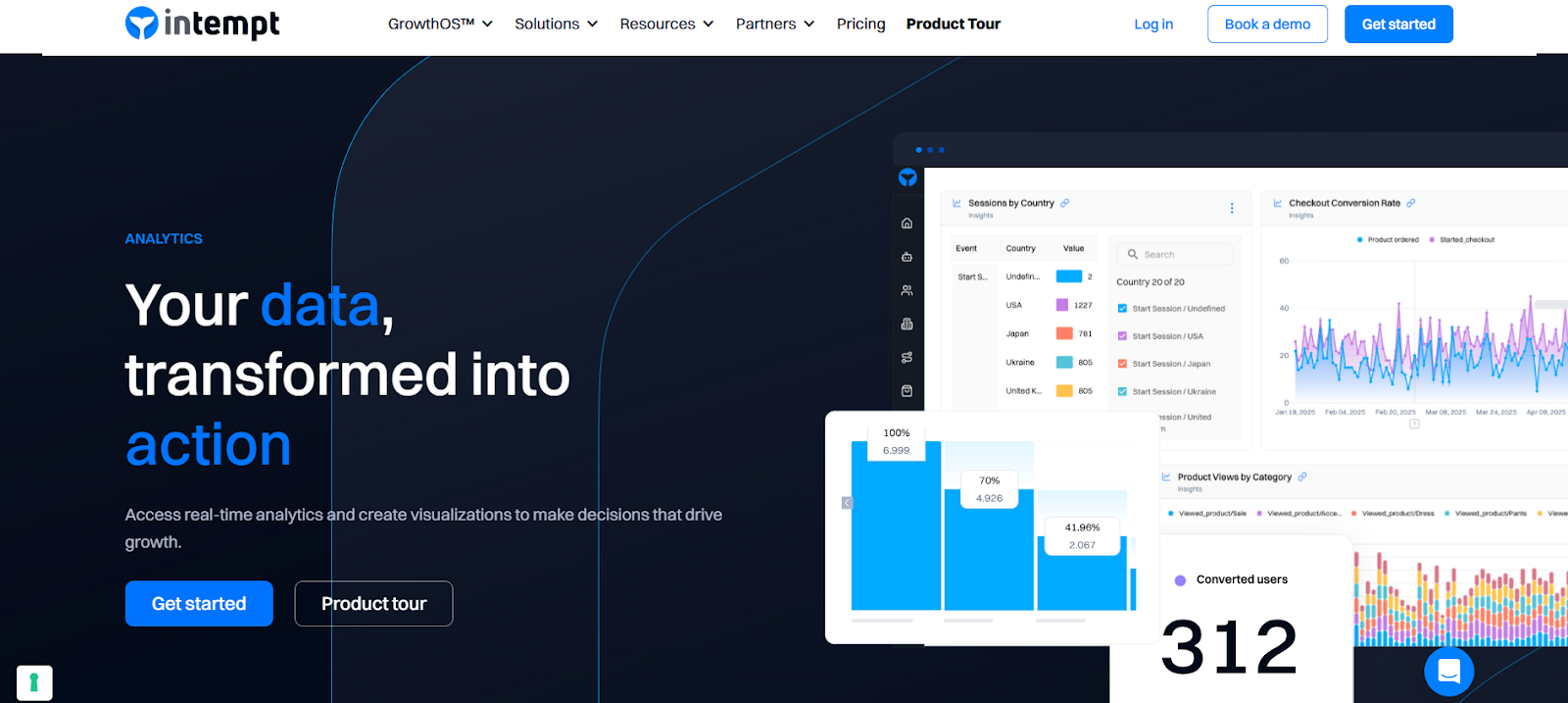
Intempt is built for teams that want to do more than just analyze data. It’s designed for marketers who wish to have an AI co-marketer by their side, someone that doesn’t just tell you what happened, but what to do next.
Intempt is designed for marketers, growth teams, and product operators who want a unified system that blends analytics, activation, and experimentation. It serves teams that need to understand user behavior, personalize journeys, run experiments, and tie everything directly to revenue without switching tools. It’s ideal for SaaS, PLG, lifecycle marketing, and teams that want an AI co-marketer guiding decisions instead of managing multiple disconnected platforms.
Instead of static reports, Intempt’s AI surfaces anomalies, highlights opportunities, and guides your next action. It’s not just analytics, it’s analytics that thinks with you.
Mixpanel
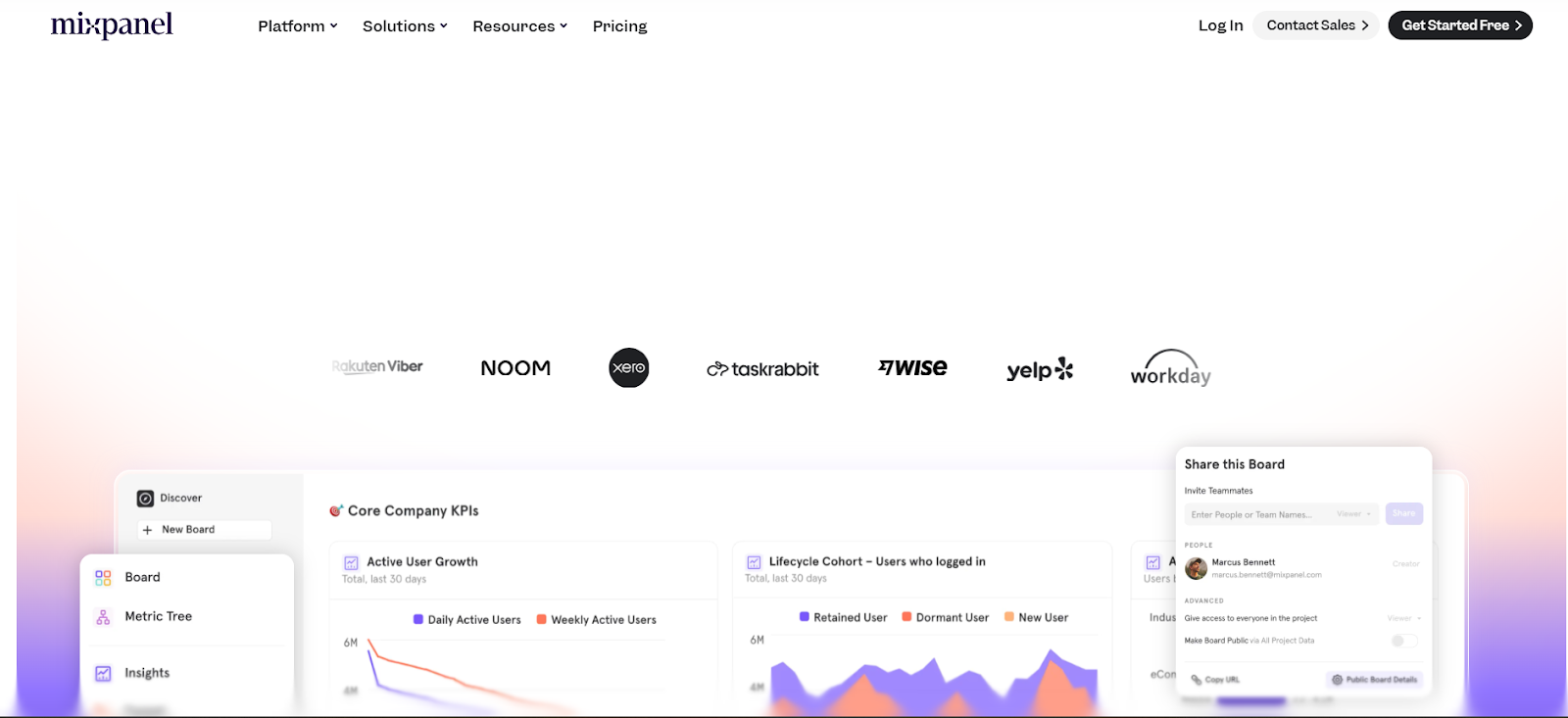
Mixpanel, meanwhile, has long been the go-to name for product and user behavior analytics. It excels at helping teams understand what users do inside their apps, offering powerful funnel, retention, and cohort reports, alongside clean, visual dashboards.
Its real-time analytics make it easy to spot trends, track feature adoption, and measure engagement over time. Mixpanel also added revenue analytics and AI-assisted querying, providing marketing and product teams with faster answers without the need for SQL.
Mixpanel is a good analytics engine, but you’ll still need other tools to turn those insights into orchestrated, revenue-driving actions.
In-depth Comparison: Intempt vs Mixpanel
As an all-in-one GrowthOS, Intempt isn’t just an alternative to Mixpanel; Modern teams don’t just need visibility, they need connected intelligence. Analytics alone doesn’t drive growth unless it connects to activation, personalization, and revenue. That’s where the comparison between Intempt GrowthOS and Mixpanel becomes crucial.
Both platforms help you understand user behavior, but the way they handle data integration, analytics depth, and pricing predictability differs significantly.
Below, we have compared both platforms feature by feature across analytics, orchestration, experiments, data integrations, pricing, and more.
Analytics
Both Intempt and Mixpanel help analyze user behavior, but Intempt gives you detailed revenue attribution that connects engagement data to business outcomes. This means marketers don’t just see what users did, they understand why it drove revenue.

Event Tracking
Both platforms capture user behavior across web and mobile and third-party tools, but the way they do it couldn’t be more different.
Intempt uses auto-event capture powered by AI, automatically detecting and labeling key actions without developer setup. It connects events across web and mobile, SDKs and third-party tools, linking them to unified customer profiles and CRM data. This ensures that even marketing and sales interactions become part of a single behavioral stream.
Mixpanel, in contrast, relies on manual event setup. Every tracked event must be instrumented through code or SDKs, which gives data teams control but slows down marketing agility. For fast-moving growth teams, Intempt’s automatic tracking removes friction and reduces technical dependency.
Funnel Analysis
Both tools visualize user drop-offs between key actions, but they serve different outcomes.
Intempt delivers real-time funnel analysis with revenue context, meaning you don’t just see where users drop off, but also how those drop-offs impact revenue. This connects funnel health directly to monetization and retention.
Mixpanel offers clean and intuitive funnel charts, but its focus is primarily on behavioral visualization. It doesn’t link those funnels to attribution data or downstream orchestration. In short, Mixpanel tells you where users leave, but falls short in informing you of its impact on your bottom line and what to do next.
Retention Analysis
Intempt tracks retention in terms of lifetime value and engagement frequency, offering predictive retention scoring that identifies which segments are most likely to stay or churn. This allows teams to act early by triggering personalized reactivation campaigns. It allows you to compare your data from the current to the previous days/months and track your users effectively and efficiently with ease.
Mixpanel, while strong in traditional retention reporting, focuses on static cohort comparisons, which are useful for analysis, but without predictive indicators or automated retention actions. Basically, it tells you what’s going on, but fails to help you with what you can do next!
Cohort Analysis
Intempt’s AI-driven cohorting groups users automatically based on shared behaviors, predicted value, and likelihood to convert. Segments update in real time as new actions occur, keeping campaigns and personalization current without manual work.
Mixpanel supports manual cohort creation, giving you flexibility, but it is very time-intensive. Data analysts can slice segments by event or property, and must update them regularly. Although it gives you flexibility, ironically, it kills away your efficiency as you have to do things manually instead of simply automating them.
Attribution Modeling
This is one of the biggest differences.
Intempt includes native revenue attribution modeling, mapping every conversion back to its source, whether it’s a campaign, product feature, or experiment. With integrations like Shopify, Stripe, and HubSpot, it shows not just what users did, but what drove actual revenue.
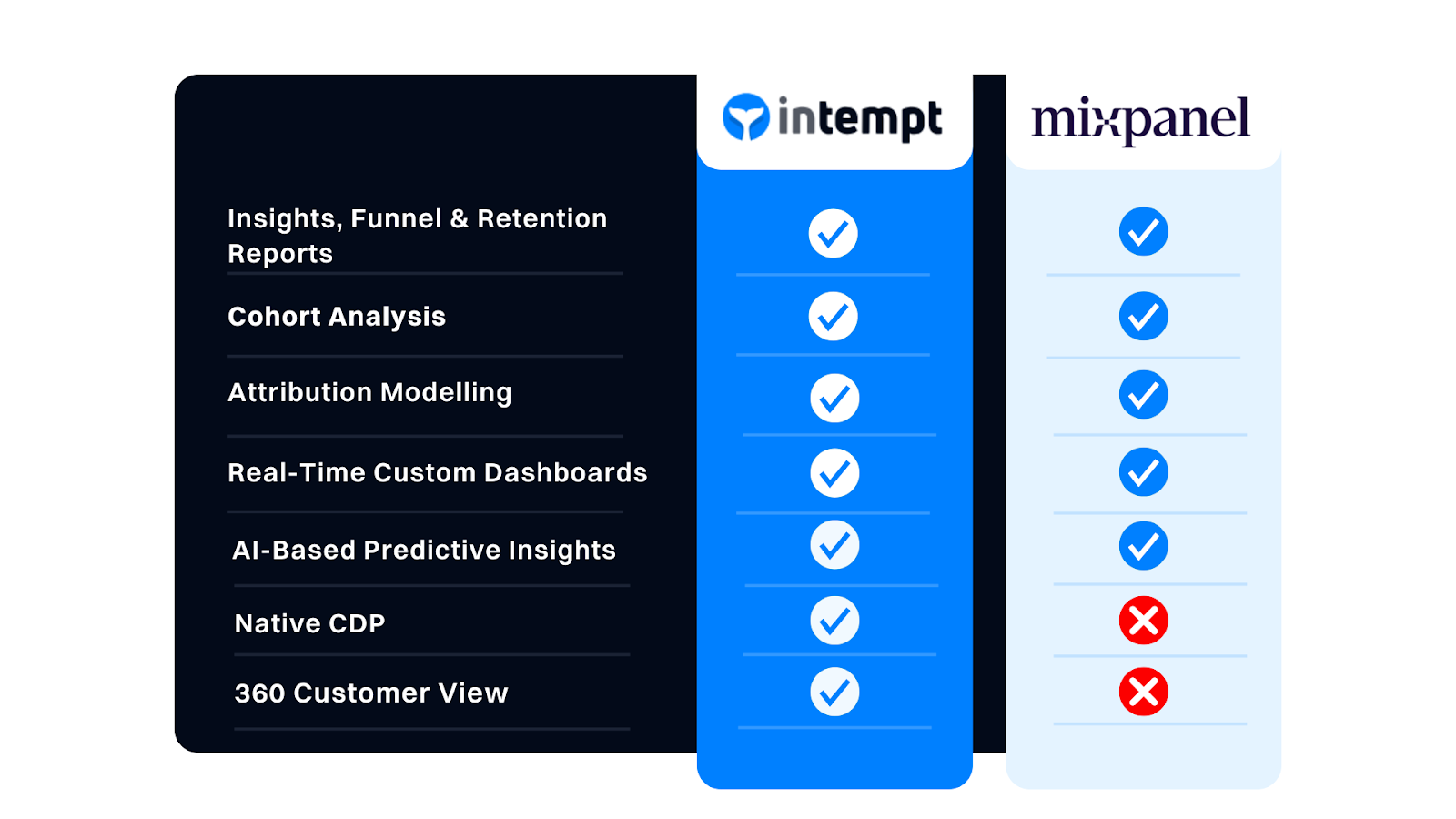
Mixpanel does not include attribution modeling natively. It can track events but not link them directly to payments or CRM data without third-party tools. For teams seeking a unified analytics-to-revenue view, Intempt holds a clear advantage, as Mixpanel does not have a native attribution modeling feature, which might be an issue for many growth teams.
Predictive Insights
Intempt leverages AI-driven forecasting to predict user churn, conversion, and engagement probability. Its models continuously learn from live data, adjusting campaigns and personalization strategies automatically.
Mixpanel provides trend-based AI-powered insights that surface historical patterns in engagement and conversion data. Teams can observe usage trends, feature adoption, or retention decay, and apply those insights to optimize product design or marketing messaging.
Real-Time Custom Dashboards
Intempt offers real-time dashboards combining behavioral, CRM, and financial data. Teams can monitor product analytics, campaign performance, and revenue attribution all in one view. Pre-built templates make setup easy, and each metric is tied directly to orchestration triggers, turning dashboards into command centers for growth teams.
Mixpanel features highly customizable dashboards that allow users to build detailed visualizations and reports. These dashboards are flexible and interactive, ideal for data analysts who need precise control over KPIs and visualization formats. They focus on behavioral metrics and performance trends.
Session Analytics
Intempt’s session analytics track every user interaction across web and mobile, automatically grouping them into meaningful sessions without the need for manual tagging.
Each session connects behavioral data with CRM and revenue context. Its AI can segment sessions by engagement depth, time on site, or journey stage, allowing teams to identify high-intent behaviors and trigger personalized experiments immediately. In short, session analytics in Intempt turn passive data into intent signals your co-marketer can act on in real time.
Mixpanel offers session tracking as part of its behavioral analytics suite, enabling teams to analyze user navigation flows and time-based engagement within an app or site. It’s great for measuring engagement duration, drop-off points, and frequency of sessions, but it focuses on user behavior within a single product channel. While detailed, Mixpanel’s session data isn’t natively connected to CRM or revenue events, requiring manual configuration or third-party tools for full funnel context.
CDP (Customer Data Platform).
Intempt functions as a fully integrated CDP, unifying behavioral, demographic, and event-level data into a single customer profile with identity resolution. This allows marketers to run real-time orchestration, build precise audiences, and activate data across channels instantly. Every touchpoint feeds into one place, meaning segmentation, personalization, and experiments all operate on the same unified profile.
Mixpanel, by contrast, is not a CDP. It relies on data sent from external CDPs like Segment or RudderStack and stores behavioral events for analysis only. There’s no identity resolution layer, no native activation, and no way to manage cross-channel user profiles. In short, Mixpanel lets you analyze user data, but not truly unify or activate it.
Data Warehouse
Intempt integrates directly with data warehouses like Web, App, Hubspot, Stripe, Shopify, supporting both inbound sync (bringing warehouse data into Intempt) and reverse ETL (sending enriched Intempt data back to your warehouse). This bi-directional flow means teams maintain a single source of truth, run orchestrations using warehouse-powered attributes, and ensure analytics, experiments, and personalization stay aligned across systems.
Mixpanel, on the other hand, here doesnot provide any data warehouse facilities. So, for teams that want direct and native integrations, this might be a setback.
Integrations and Pricing
Both Intempt and Mixpanel connect to broader data ecosystems, but they do it with very different philosophies.
Where Mixpanel focuses on plugging into existing analytics pipelines, Intempt GrowthOS is built to unify those pipelines into an AI-driven orchestration engine that personalizes actions directly from integrated data.
Mixpanel’s event-based billing scales with data volume, while Intempt’s user-based pricing scales predictably with active customers.
Integrations
Intempt:
Intempt functions as the command center of your growth stack. It integrates directly with CRM, ecommerce, marketing, and data warehouse systems to unify first-party data across the customer lifecycle.
Native connectors for HubSpot, Shopify, and Stripe make data syncing instantaneous. Intempt also supports real-time bidirectional flows, so insights can travel both ways between systems.
For example, a user’s intent score generated in Intempt can automatically update their CRM record, trigger an email journey, or adjust ad targeting in Meta, all without manual exports. It offers SDKs for web, iOS, Android, and backend environments.
Essentially, integrations in Intempt are not passive data pipes; they’re orchestration layers. Each connected platform contributes to orchestration, personalization, and revenue tracking.
Mixpanel:
Mixpanel integrates with a wide variety of tools across analytics, data warehouses, and marketing platforms.
It also offers SDKs for web, iOS, Android, and backend environments, and integrations through partners like Segment, RudderStack, Fivetran, and Hightouch. These integrations allow teams to import event data from other systems and export Mixpanel analytics into dashboards or BI tools like Tableau or Looker.
While Mixpanel’s integration depth is impressive, its focus is analytical rather than operational, meaning it primarily serves to collect and visualize data, not act on it. For teams with established data infrastructure, Mixpanel fits neatly into an analytics ecosystem, but requires additional orchestration or marketing automation tools to close the loop.
Pricing
Intempt:
Intempt’s pricing follows a Monthly Tracked Users (MTU) model, starting at $52.6 per 1,000 users.
This means you’re billed only for the number of users you actively track and personalize for, not for the number of events they generate. It’s a predictable, usage-based model that scales transparently with your customer base.
As data volume grows, Intempt remains cost-stable because the event count doesn’t affect your bill. This pricing structure is designed for long-term scalability without hidden data costs.
Mixpanel:
Mixpanel uses an event-based pricing model, charging based on the number of events your product records.
It offers a free plan for up to 1 million events per month, which is good for small-scale startups or small teams. The paid plan starts from $140/month for 1.5 million events. As product usage and data tracking expand, event costs scale quickly, often leading to steep price jumps for growing companies.
Advanced features like data pipelines, group analytics, and retroactive tracking are available in higher-tier plans. While flexible, Mixpanel’s pricing can become complex to forecast as your data grows, since event spikes can trigger sudden cost increases.
Beyond Analytics: The Core Capabilities That Make Intempt More Than a Dashboard
Beyond analytics, integrations, and pricing, Intempt GrowthOS provides a complete suite of AI-driven capabilities that connect every part of your growth engine, from sales to retention. Each feature is designed to help marketers and product teams move from understanding users to acting intelligently on every insight.
Sales CRM
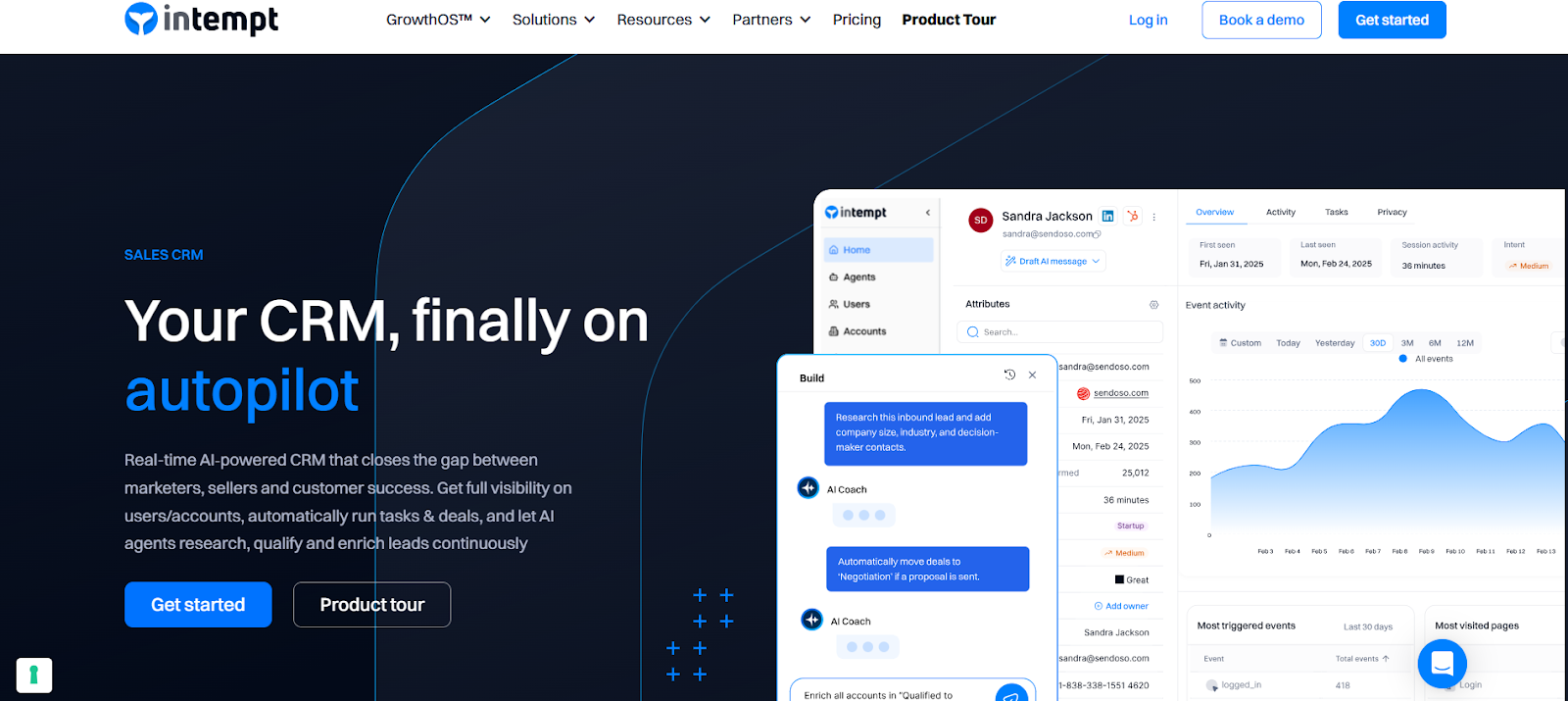
Intempt’s Sales CRM unifies behavioral, transactional, and revenue data from platforms like HubSpot, Shopify, and Stripe into a single customer record. This creates a 360° customer view, every click, purchase, and email engagement mapped into one profile.
It helps you to create, assign, and progress tasks or deals based on customer fit, activity, and journey stage, and use enrichment and research agents to fill in missing attributes using real-time data pulled from public sources. Teams can track deals, revenue impact, and lifecycle stages (lead, MQL, SQL, customer, churn risk) in real time. Its AI intent scoring automatically highlights the highest-converting opportunities, while predictive signals help sales teams prioritize outreach. Unlike traditional CRMs, Intempt doesn’t just store data; it connects it to analytics, orchestration, and personalization flows, turning the CRM into a live growth engine.
Personalization
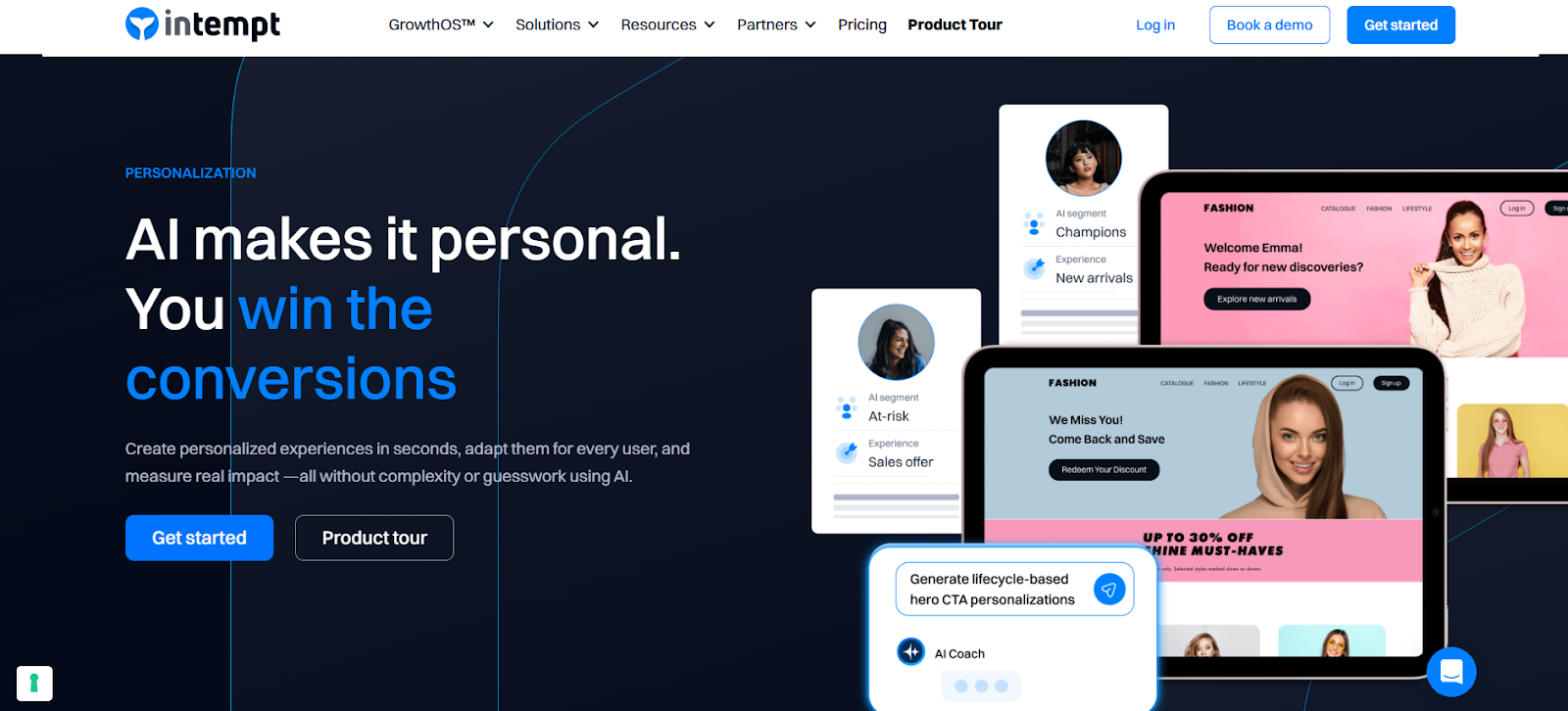
The AI-based personalization engine inside Intempt continuously adapts user experiences across email, web, and product interfaces. Using real-time behavioral tracking and predictive segmentation, it understands what users are likely to do next and serves them the right message or offer automatically.
Content blocks, product recommendations, and CTAs change dynamically based on user intent. Marketers can build these experiences visually, without code, and link them to experiments or campaigns instantly. This significantly reduces the dependency of marketers on developers for various activities. Personalization in Intempt transforms from static audience targeting into an autonomous co-marketer that optimizes every touchpoint. In short, create and manage every personalized flow in one place, build with AI without code, run campaigns with precision, and reach the right audience, every time.
Experiment
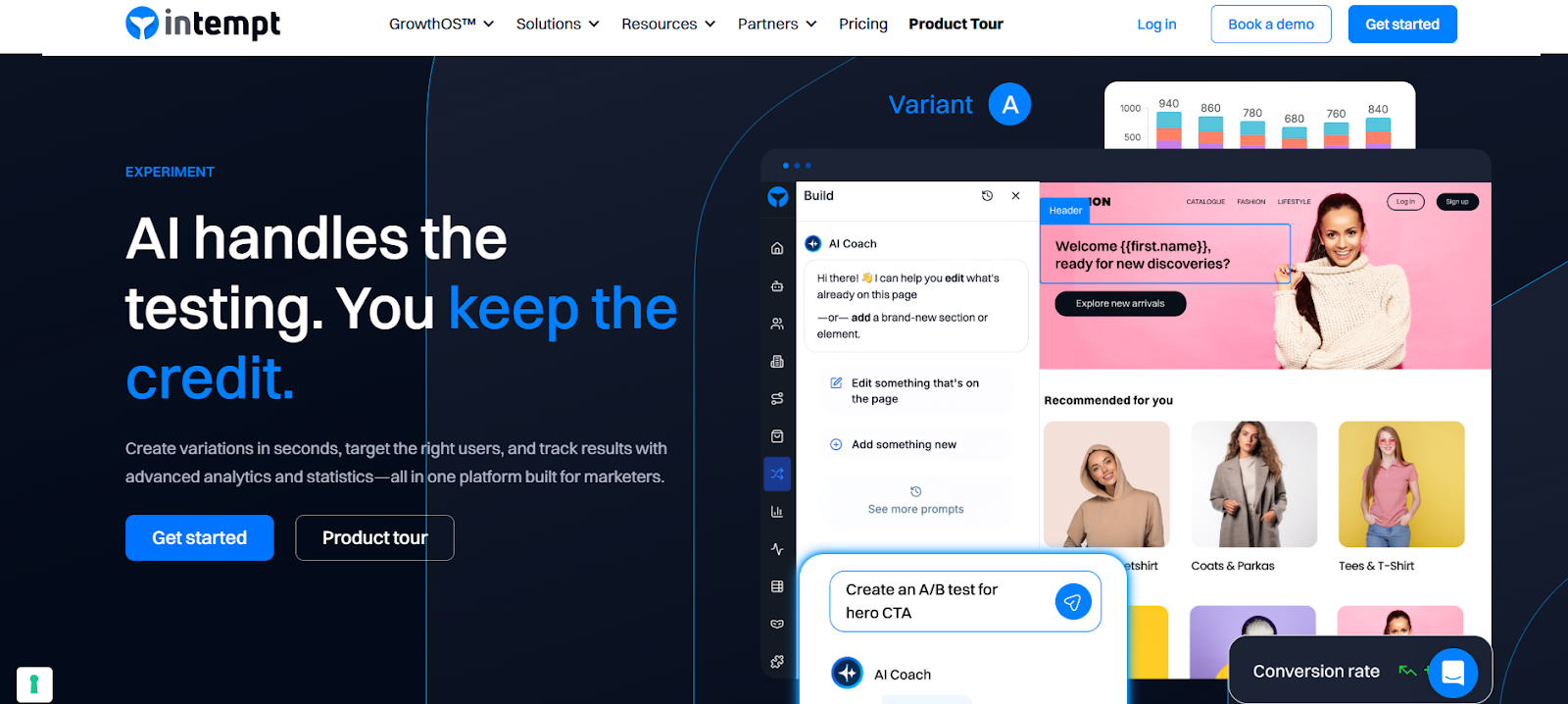
Experimentation is built directly into Intempt’s GrowthOS; no integrations or extra tools required.
Teams can design, deploy, and analyze A/B, multivariate, and holdout experiments directly inside journeys.
Experiments are tied to revenue attribution, so marketers can see not just which variant performs better, but which one drives actual revenue growth. Marketers can run quick UI changes or deep logic tests in one place, no dev queue, no tool-switching, just experiments you control end-to-end. It allows you to combine AI targeting, traffic control, and multi-page experiments to see which changes drive real growth.
It helps you to cut through the noise; the CUPED variance reduction taps into your historical data to smooth out randomness. Tests run shorter, insights arrive quicker, and you get to results that actually mean something. This seamless integration allows teams to continuously test and learn without disrupting live campaigns or waiting for analyst reports.
Recommendations
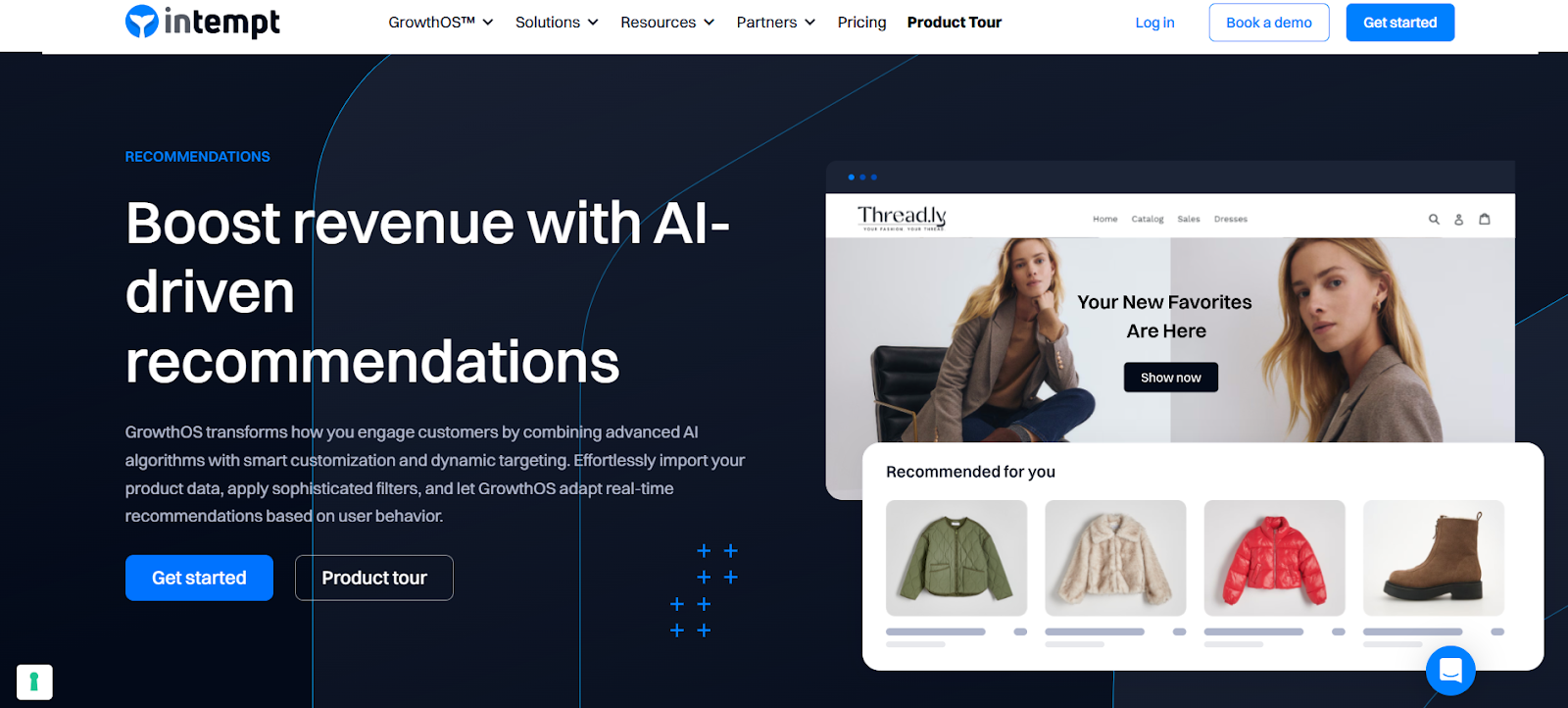
Intempt’s AI recommendation system predicts and delivers the next best content, offer, or product for every user. It draws on real-time behavioral, purchase, and engagement data to surface personalized suggestions, whether it’s the right plan to upgrade to, a blog to read, or a product to purchase.
Recommendations integrate directly into journeys, campaigns, and web pages, ensuring every user interaction feels individually tailored.
Intempt GrowthOS transforms how you engage customers by combining advanced AI algorithms with smart customization and dynamic targeting. Effortlessly import your product data, apply sophisticated filters, and let GrowthOS adapt real-time recommendations based on user behavior.
Over time, the model learns which patterns drive conversion, refining itself automatically to improve performance and relevance.
Journeys
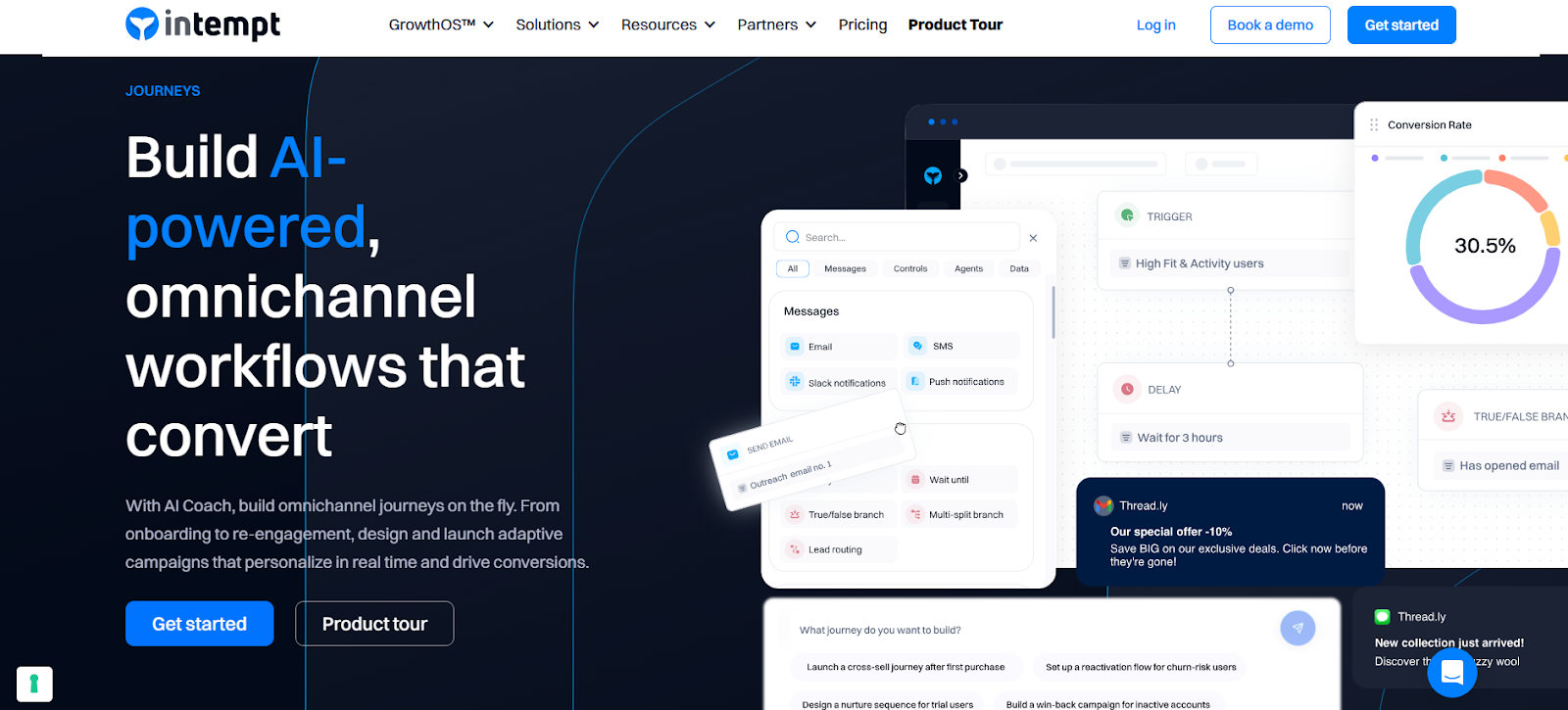
Intempt’s no-code journey builder lets teams design automated, multi-channel workflows visually.
From onboarding to retention and reactivation, marketers can orchestrate entire lifecycle campaigns using drag-and-drop orchestration with triggers and conditions.
Journeys adapt dynamically; if user behavior changes, Intempt’s AI recalculates the best path in real time.
This ensures users always receive the most relevant message or experience, across email, web, app, and CRM.
With Intempt, build workflows with full control over triggers, branching, and logic. Control timing, logic, and sales routing with precision.
It’s not just automation, it’s orchestration powered by intelligence, where each journey learns, optimizes, and improves with every interaction.
When to Choose What?
Choosing between Intempt and Mixpanel doesn’t have to feel like you’re trapped in yet another “analytics vs activation”. Let’s keep it simple. Here’s your marketer-friendly breakdown of who should pick what, and when.
Choose Mixpanel When…
You want clean product analytics, deep behavior tracking, and fast answers to “what are users doing inside the product” without branching into orchestration or personalization. Mixpanel is built for teams who want clarity inside dashboards, not cross-channel action.
Pick Mixpanel if:
- Your primary analysis revolves around funnels, retention, and feature usage inside your product.
- You don’t need native orchestration, personalization, or multi-surface activation.
- You have an existing stack for CRM, lifecycle marketing, and journeys, and you intend to keep it that way.
- Your team prefers manual segmentation and analyst-driven insights over AI-driven predictive cohorts.
- You’re okay with plugging in additional tools for attribution, identity resolution, or cross-channel engagement.
- You’re still in the “analyze first, then manually act” stage of growth rather than “analyze + activate instantly.”
- You want a product analytics engine that integrates nicely with your CDP or data warehouse, not replaces it.
Mixpanel: a strong behavioral analytics engine built for product teams who live in funnels and dashboards and want visibility more than orchestration.
Choose Intempt When…
You want an AI co-marketer who doesn’t just surface insights, but predicts next actions, powers personalized experiments, runs orchestrations, and ties everything back to revenue. Intempt is built for lifecycle, growth, and product teams who need their analytics to think and act.
Pick Intempt if:
- You operate across web, app, email, push, CRM, and sales, not just product analytics.
- You want unified analytics and revenue attribution, and orchestration in the same system.
- You want real-time AI-driven segmentation that updates based on intent, behavior, and product usage.
- You want to run personalized experiments and dynamic experiences, not just observe dashboards.
- You’re ready to move beyond reporting and let an AI co-marketer predict churn, next-best action, and conversion likelihood.
- You need a native CDP with identity resolution, unified profiles, and bidirectional integrations.
- You want to cut developer dependency with auto-event capture, no-code journeys, and drag-and-drop personalization.
- You want revenue-led experimentation, where every test ties directly to dollars, not just clicks.
- You want a platform that scales with your actual customer base rather than message volume, making it significantly more cost-efficient as you grow and engage users across multiple channels.
Intempt: connected intelligence for teams who want more than visibility. If your growth model thrives on real-time behavior signals, multi-surface engagement, predictive analytics, and AI-driven orchestration, Intempt is the smarter future-proof choice.
TL;DR
- Analytics that Think Beyond Dashboards:
Both platforms help you understand user behavior, but Intempt’s analytics are built for real-time orchestration, not just reporting. With auto-event capture, predictive cohorts, and AI-driven revenue attribution, Intempt connects what users do to why they buy. - Mixpanel: Strong at Behavior, Limited on Revenue Context:
Mixpanel remains one of the best tools for behavioral analytics, offering detailed event tracking, funnel visualization, and retention reporting. It’s ideal for analysts who need to slice event data, but less suited for marketers who want instant answers tied to outcomes.
- Analytics that Think vs. Analytics that Track:
Mixpanel gives you visibility into what users did; Intempt goes further, showing why it happened and what to do next. With AI-driven attribution, predictive insights, and real-time orchestration, Intempt connects every event to revenue outcomes, not just metrics. - Integration Depth and Actionability:
Mixpanel connects with your data stack to visualize behavior, while Intempt connects to your CRM, ecommerce, and marketing tools to take action. Its integrations with HubSpot, Shopify, and Stripe don’t just sync data; they power automated journeys and personalized experiments. - Pricing Built for Predictability:
Mixpanel charges by event volume, which can scale costs unpredictably as your data grows. The paid plan for Mixpanel starts from $140/month for 1.5 million events. Intempt’s user-based model ($52.6 per 1,000 MTUs) ensures transparent, stable pricing; you pay for people, not data spikes. - Beyond Analytics- Intempt’s GrowthOS Advantage:
Intempt isn’t just an analytics platform; it’s a GrowthOS combining analytics, orchestration, personalization, and experimentation. Its modules - Sales CRM, Personalization, Experiment, Recommendations, and Journeys work together as one AI co-marketer, predicting next steps and automating outcomes. - The Big Picture:
If Mixpanel helps you analyze what happened, Intempt helps you orchestrate what happens next, turning insight into impact.
FAQs
1) What is the main difference between Intempt and Mixpanel?
Mixpanel is a powerful analytics tool focused on user behavior tracking.
Intempt expands the scope by combining analytics, personalization, orchestration, and experiments to turn insights into actions that drive revenue.
2) Does Intempt replace Mixpanel completely?
Yes, in most cases. Intempt covers all of Mixpanel’s analytics features, plus adds real-time personalization, experimentation, and revenue attribution, making it a full growth platform rather than just an analytics layer.
3) Can Intempt replace Google Analytics?
Yes, it can do even more. While Google Analytics focuses primarily on web traffic reporting and session data, Intempt goes beyond page views to track complete user journeys across web, app, CRM, and revenue touchpoints. You can monitor behavior, segment audiences, analyze funnels, and attribute conversions without relying on cookies, all while staying GDPR- and CCPA-compliant.
4) Which is more cost-effective: Intempt or Mixpanel?
Intempt is simply the cost-effective platform. Intempt uses a Monthly - Tracked - Users (MTU) based pricing model starting at $32.9 per 1,000 tracked users.
Mixpanel, on the other hand, charges based on event volume, which can become expensive as your data grows. Intempt’s model scales predictably and includes orchestration and personalization at the same cost.
5) Can I migrate my data from Mixpanel to Intempt?
Yes, Intempt offers direct Mixpanel data migration through API connectors or CSV imports. Your events, properties, and cohorts can be synced into Intempt’s unified data model. Once migrated, you can extend that data with CRM, revenue, and personalization layers, creating a single source of truth for analytics and orchestration.
6) What’s included in Intempt’s free trial?
Intempt’s free trial gives you full access to its GrowthOS. You can explore real-time analytics, predictive cohorts, funnel analysis, orchestration journeys, and AI-powered personalization with live data tracking for your website or app. It also includes integrations with major tools like HubSpot, Shopify, and Stripe, so you can see how unified analytics and orchestration work together in practice. During the trial, you’ll also get onboarding support from Intempt’s growth team, helping you migrate data, set up auto-event capture, and launch your first AI-powered experiment.
FAQs
Can I trial Webflow before paying?

Sure! You can test out Webflow on our free plan where you can experiment with 2 projects. Your unhosted projects will have a two-page limit, but you can purchase a site plan on a per-project basis to unlock up to 100 static pages and additional CMS pages.
What is a project?
A project is a website that you build in Webflow. You can publish projects to a webflow.io staging subdomain for free, export the code on a paid plan, or add a site plan to connect your custom domain and unlock hosting features.
What can I white label?
Pro accounts can add their own logo to Client Billing forms and the Editor. Pro accounts can also remove references to Webflow in the source code and form submission emails, and hide the Webflow badge from their staging sites.
How much traffic can the hosting handle?
Webflow hosting scales automatically to handle millions of concurrent visits. All site plans serve sites through our Amazon's Cloudfront CDN and accelerated using Fastly, loading sites in milliseconds.
What kind of support does Webflow provide?
We offer fast email support to paid accounts and prioritized help for team accounts. Community support (forum.webflow.com) is available to free accounts.
How long does it take to learn Webflow?
If you're new to building websites, our video tutorials will get up and running quickly. If you already know concepts behind CSS and the box model, you will feel at home in Webflow.
Check out Growth Play Library ➡️
Get started free on GrowthOS ➡️
Book a growth call ➡️
.svg)
Sid Chaudhary
Founder & CEO


Looking for ways to grow faster?
Discover marketing workspace where you turn audiences into revenue.
Learn about IntemptReceive Monthly Insights
Get expert insights & news on the latest promotion trends in our monthly newsletter.
Sid Chaudhary
CEO & Founder

Lifecycle automation tips
Industry tips
Case Studies
You might also like...
%20In-Depth%20Comparison.png)
Intempt v/s Klaviyo (2025): In-Depth Comparison
Marketers want seamless customer journeys, not a maze of rules and manual triggers. If the system feels like work, it’s not automation, it’s stress in a shiny UI. Klaviyo has long been the go-to for e-commerce platforms, powering email, SMS, and now even WhatsApp automation. But 2025 teams want more than AI that writes better subject lines; they want an AI comarketer that thinks ahead. In this comparison, we’ll explore Intempt v/s Klaviyo with a sharp focus on their Journeys to help you find out which one delivers true AI-powered orchestration rather than just automated messaging.

%20In-Depth%20Comparison.png)
Intempt vs VWO (2025): In-Depth Comparison
Marketers don’t just want to test ideas; they want to turn those ideas into real customer experiences. Simple A/B tests and standard conversion lifts were once the gold standard, but now they have become the ghost of the past, because in 2025, growth teams demand more. They want to personalize in real time, orchestrate intelligently, and connect experiment results to revenue outcomes.
Subscribe to The Full Stack Marketer 📈
Zero theory or mindset discussions here; just actionable marketing tactics that will grow revenue today.

Web A/B testing
Use front-end A/B and multi-page experimentation product built for any business size. Run multiple experiments on the same page.

Targeting & personalization
Deliver targeted messaging, personalized offers and recommend the most relevant content for your users.

Visual editor
Empower your team to collaborate with an easy-to-use visual editor without using developer time to get things up and running.

Analytics
Gain insight into the impact of your experiments with statistically valid results. No complex statistical analysis required.

Server & client-side testing
Go beyond client-side testing and deploy experiments on the server-side. Test and optimize content changes and even complete re-brands.

Flexible goal selection
Select the right goal for each personalization and experimentation campaign to ensure you’re optimizing towards the right objectives.
.svg)

.svg)


.svg)
.svg)