.svg)


Best Mixpanel Alternatives in 2025 (How to Choose One)



Quick Summary
Feeling boxed in by Mixpanel? You’re not alone. Many SaaS and e-commerce teams find Mixpanel’s pricing, setup, and limited activation capabilities to be out of sync with today’s growth needs.
Guess what? 2025 is bringing some brilliant, all-in-one analytics platforms like Intempt, Amplitude, Heap, PostHog, and Pendo. They're not just showing us cool data visualizations anymore; they're actually helping us turn that data into real, actionable growth.
This guide is for SaaS, PLG, and eCommerce teams that want speed, flexibility, and actionable insights without burning budget on event-based pricing or juggling disconnected tools.
Who Should Consider Alternatives?
(Why Switch)
If these sound familiar, it’s time to look around:
- Pricing / Contracts: Mixpanel’s event-based pricing can skyrocket as traffic scales. You may also face rigid contracts with limited flexibility.
- Learning Curve / UX: Non-technical teams struggle with setup and event instrumentation. Simple questions often require engineering help.
- Data Quality / Coverage: Limited integrations and inconsistent data capture make it hard to get a full customer view across channels.
Best Mixpanel Alternatives in 2025 (TL;DR Table)
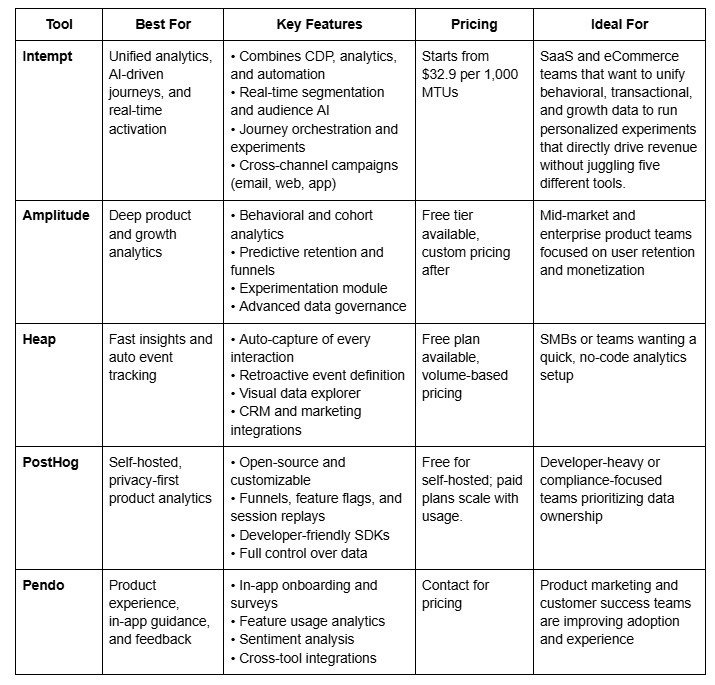
Evaluation Criteria (How We Picked)
When comparing Mixpanel alternatives, we focused on:
- Capabilities: How well they go beyond dashboards to support orchestration, targeting, and experimentation.
- Ease & Time-to-Value: How quickly you can onboard and get insights.
- Pricing & Scale: Transparent pricing that grows with you, not against you.
- Coverage & Compliance: Ability to handle multi-region data and privacy laws (GDPR, CCPA).
- Integrations & UX: Fit with CRMs, marketing tools, and workflows.
Top Picks For You
1) Intempt
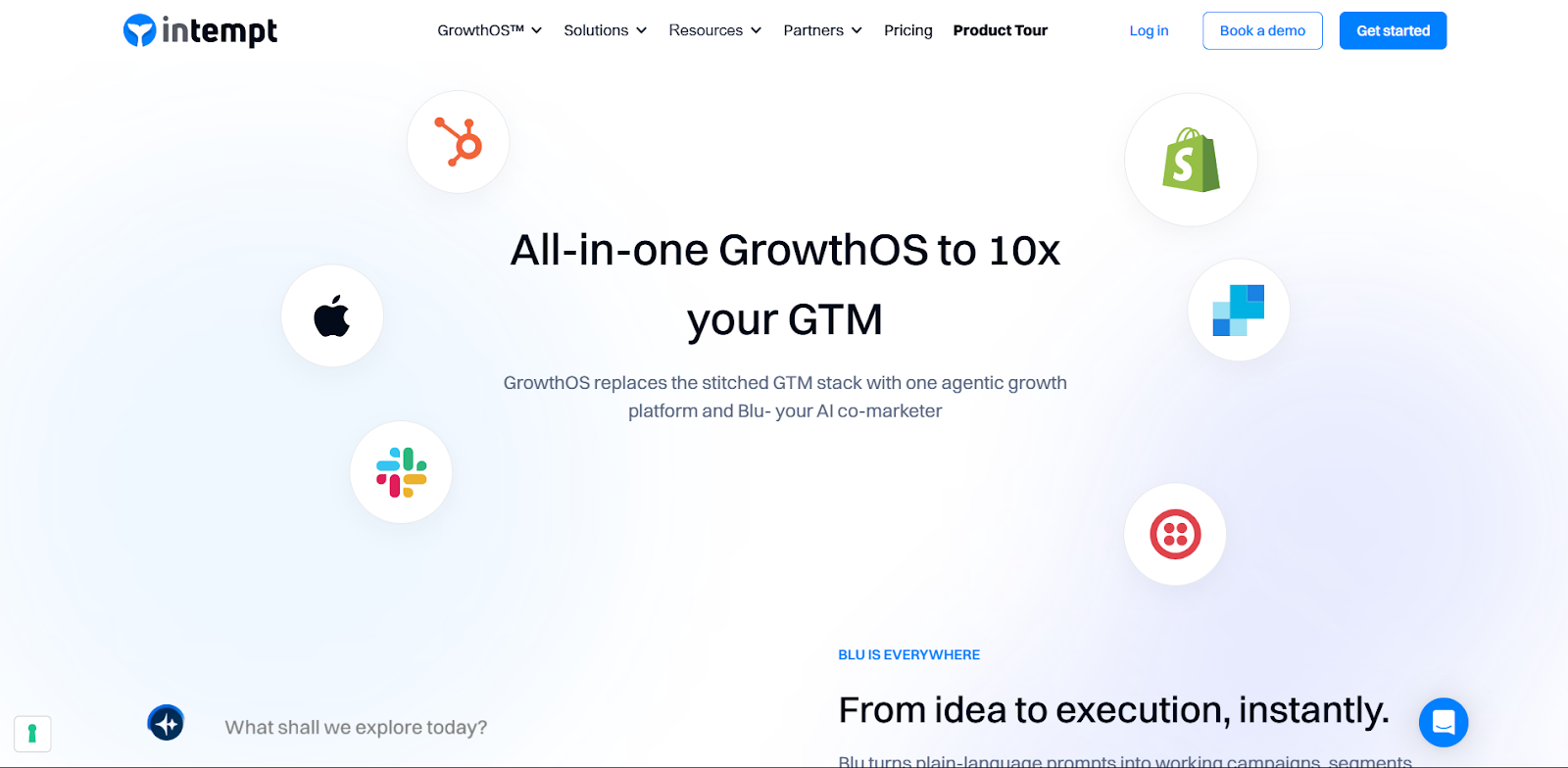
Intempt is a unified GrowthOS that helps SaaS and eCommerce teams understand how users interact across their web and mobile applications, and then act on those insights instantly. Unlike point analytics tools that just report, Intempt blends event tracking, segmentation, and revenue analytics into one platform. It goes beyond visibility to activation, enabling you to design personalized experiments that directly drive conversions and retention.
Key features:
- Unified data from website, app, CRM, Shopify, and Stripe
- Personalized experiments and automated journeys powered by audience intelligence
- Real-time segmentation and AI-based targeting across the user lifecycle
- Revenue analytics tied directly to user behavior and experiments
- Out-of-the-box integrations with key growth tools
Pros:
- Combines CDP, analytics, and experimentation in one place
- Out-of-the-box support for Shopify and Stripe makes setup quick for SaaS & eCommerce
- Ties behavioral analytics directly to revenue metrics - true growth accountability
- Reduces tool bloat by merging analytics and activation into one workflow
Cons:
- Requires initial data setup for full personalization power
- Smaller integration marketplace (but growing fast)
Pricing: Free plan available for 14 days, and paid plans start at $32.90 per month.
Ideal fit: SMB to mid-market SaaS or eCommerce teams seeking analytics, personalization, and journey automation under one roof.
2) Amplitude
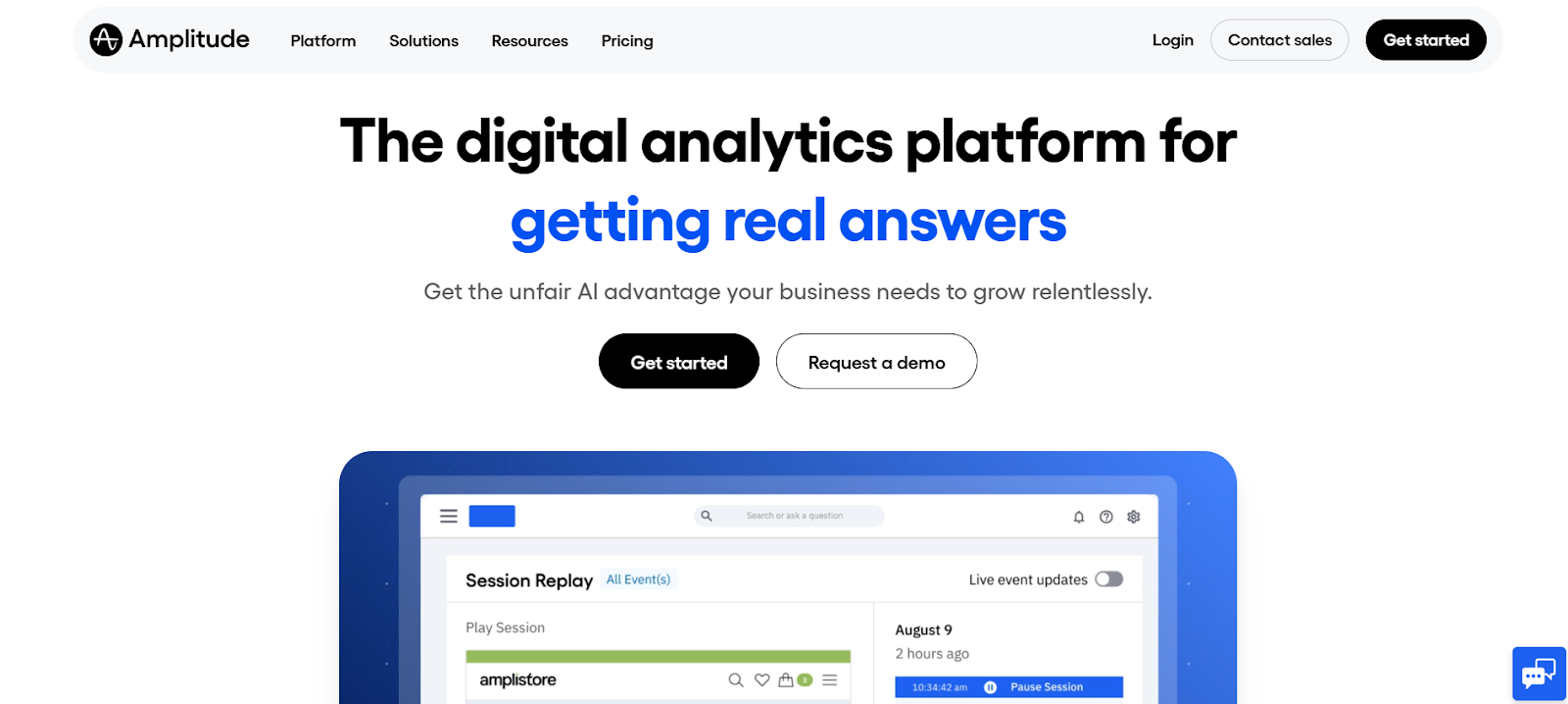
Amplitude is for teams that want to deeply understand user behavior across web and mobile. It offers advanced cohorting, journey analytics, and predictive insights that help product teams identify what drives retention and conversion. While setup requires some technical involvement, the long-term analytical depth it provides is commendable.
Key features:
- Funnel and retention analytics
- Cohort analysis and behavioral segmentation
- Predictive analytics and experimentation tools
- Enterprise-grade governance and permissions
Pros:
- Deep analytics for product-led teams
- Trusted by enterprise companies globally
- Advanced cohorting and retention features
- Reliable data quality
Cons:
- Amplitude requires an engineering-heavy setup.
- Costs can escalate quickly with increased data volume or premium features like Recommend or Experiment.
Pricing: Free plan available, and paid plans start at $61 per month.
Ideal fit: Mid-market and enterprise PLG companies focused on retention and product optimization.
3) Heap
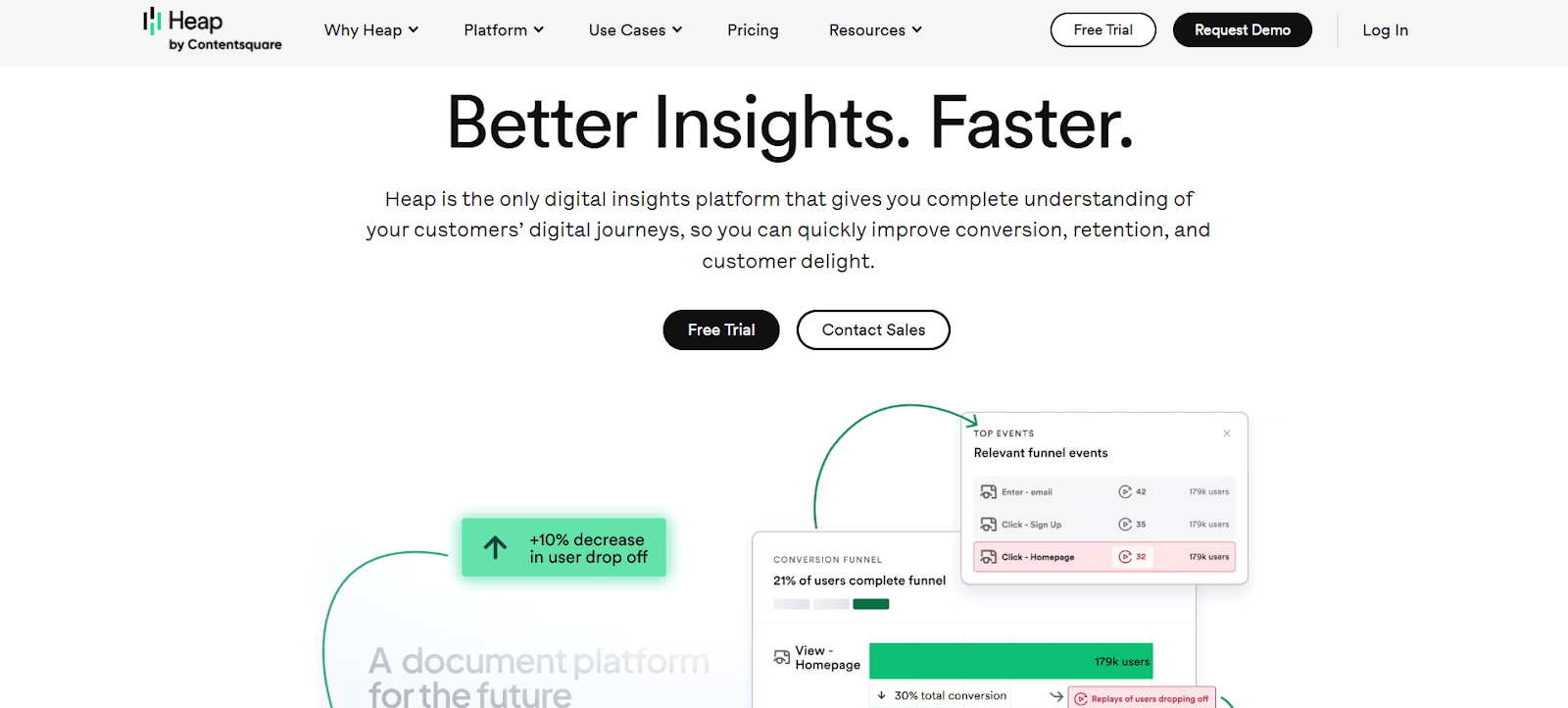
Heap simplifies analytics by automatically capturing every user interaction; no need to predefine events. This makes it easy for teams to explore data retroactively and uncover insights without heavy engineering support. It’s particularly useful for fast-moving teams that value agility and quick decision-making.
Key features:
- Automatic event tracking
- Retroactive analysis
- Visual data explorer
- Integrations with CRMs and marketing tools
Pros:
- Minimal engineering effort
- Fast onboarding
- Great for exploratory analysis
- User-friendly UI
Cons:
- Auto-capture simplifies tracking but can lead to data clutter. Without a cleanup strategy, you’ll end up with redundant or confusing events.
- Limited in multi-platform tracking (e.g., native mobile + backend events) compared to unified systems like Intempt.
Pricing: Free plan available; paid plans scale with usage.
Ideal fit: SMBs or early-stage teams needing quick insights without heavy setup.
4) PostHog
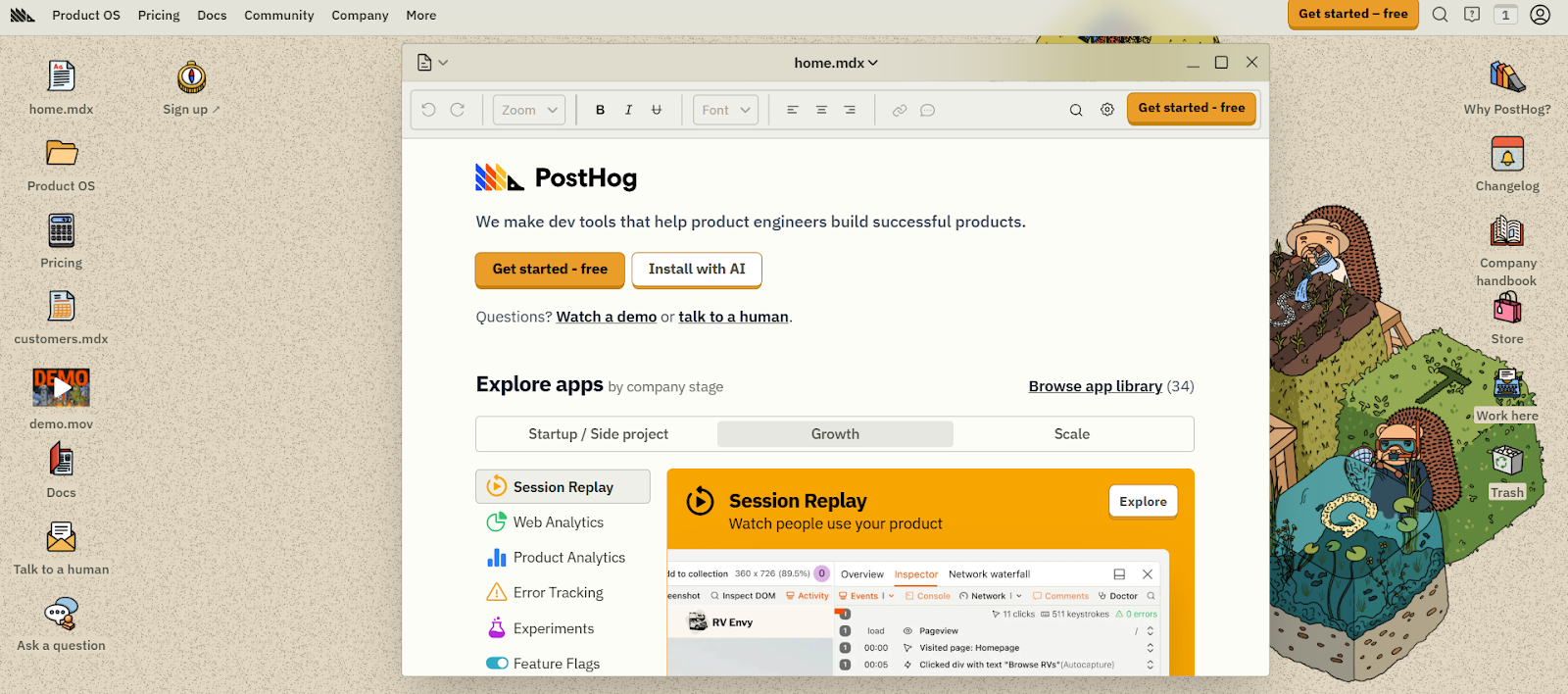
PostHog appeals to technical teams that value flexibility, transparency, and data ownership. As an open-source platform, it can be fully self-hosted, giving businesses complete control over their analytics stack. While it requires more setup and maintenance than hosted tools, PostHog offers customization and privacy for data-conscious organizations.
Key features:
- Self-hosting or cloud options
- Funnels, paths, and retention analysis
- Feature flags and experimentation
- Open API for developers
Pros:
- Full data control
- Great developer experience
- Flexible deployment
- Active open-source community
Cons:
- Requires technical setup and maintenance, especially if self-hosting, not ideal for non-engineering teams.
- Open-source flexibility comes at the cost of UI polish and ease of use; dashboards are functional but not beginner-friendly.
Pricing: Free tier; paid plans scale with usage.
Ideal fit: Technical teams and enterprises prioritizing privacy and customization.
5) Pendo
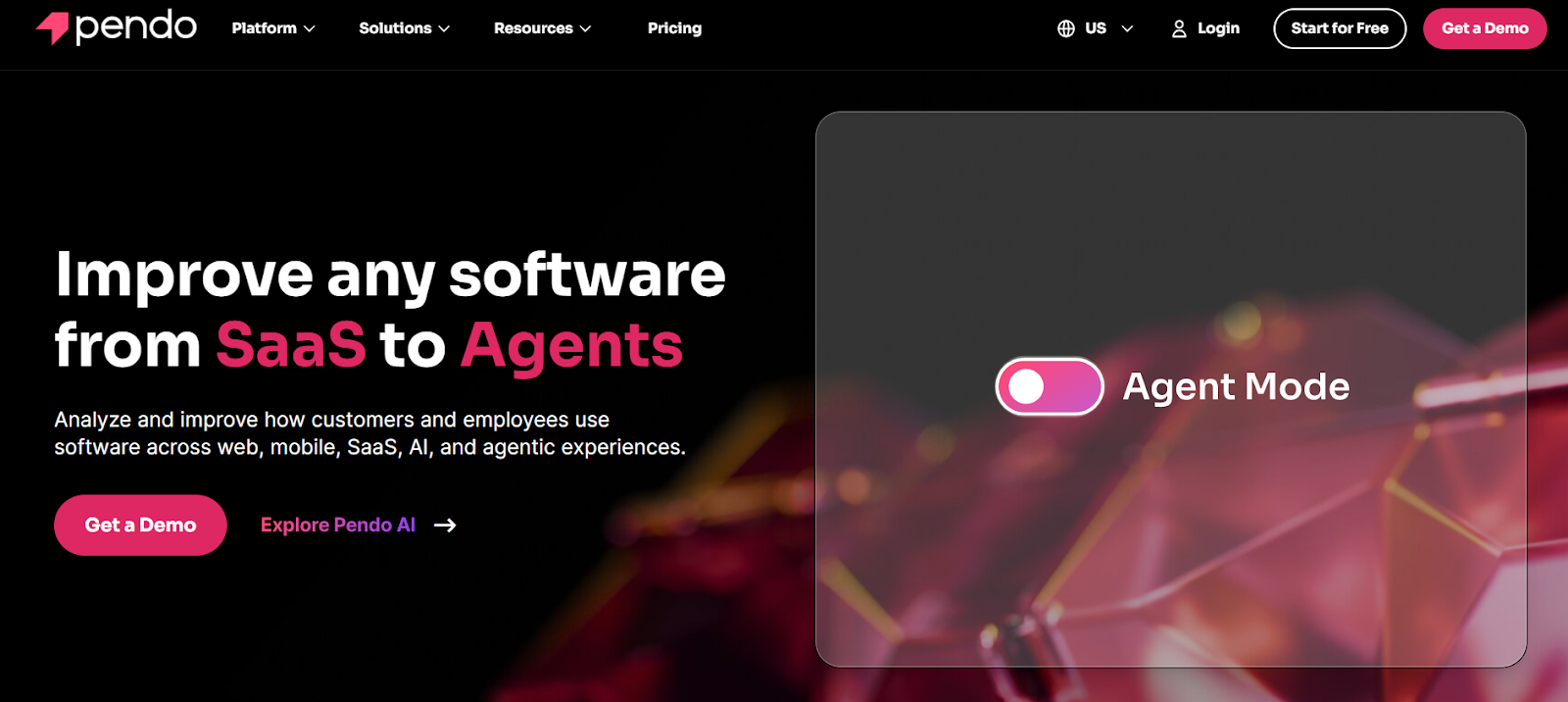
Pendo blends product analytics with in-app engagement tools, helping companies understand user behavior and guide users toward key actions. It’s especially effective for improving onboarding, feature discovery, and adoption within SaaS products. The tradeoff is that Pendo’s analytics depth is more adoption-focused than exploratory.
Key features:
- In-app guides and tooltips
- Product usage analytics
- Feedback collection
- Integration with CRMs
Pros:
- Combines analytics and user experience
- Strong enterprise support
- Useful for onboarding flows
- Good UI for marketers
Cons:
- Heavy UI elements can slow product performance if not configured carefully.
- Limited depth in funnel analytics and event segmentation compared to Intempt or Amplitude.
Pricing: Contact sales for details.Ideal fit: Mid-market to enterprise teams focused on product adoption and user retention.
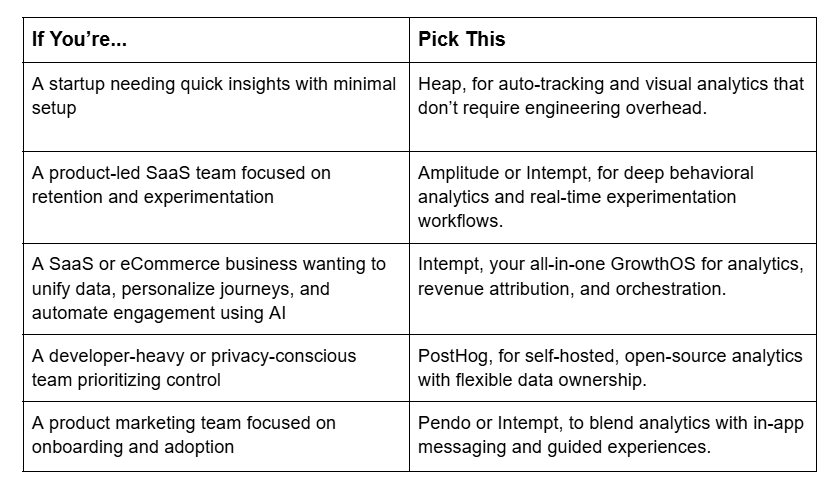
Decision Cheatsheet
Conclusion
Switching from Mixpanel (or evaluating alternatives) isn’t about finding a “perfect tool”, it’s about finding the right fit for your team, your stage, your priorities.
- For deep product insights - Go for Amplitude.
- For a fast start, lower engineering overhead - Try Heap.
- To get unified data + activation for growth with an AI-powered platform - Go for Intempt GrowthOS.
One-line principle: Clarity now (in fit and cost) beats prediction later (hoping your tool will scale magically).
Finally, whichever you pick, run a low-risk trial or side-by-side pilot before a full rollout, observe time to value, ease of use, fit with your data stack, and team skillset.
That’s it, do this and you are ready to Rock & Roll!
TL;DR
If Mixpanel feels too complex or costly, 2025 offers stronger, smarter alternatives, each built for a different kind of growth motion. Here’s your quick guide:
- Intempt: The best overall Mixpanel alternative. Intempt combines analytics, orchestration, and personalized experiments into one GrowthOS, purpose-built for SaaS and eCommerce. With out-of-the-box Shopify and Stripe integrations, you get Revenue Analytics tied directly to user behavior. This means every experiment, journey, and action connects to actual revenue, not just engagement metrics.
- Amplitude: The go-to for deep product analytics. Ideal for PLG and mid-market teams that care about understanding user behavior, retention, and feature adoption through robust cohort and funnel analysis.
- Heap: The easiest way to get instant insights. Auto-captures every user event without tagging, enabling retroactive analysis. Great for fast-moving startups that want quick answers without engineering dependencies.
- PostHog: The privacy-first choice. Open-source, developer-friendly, and fully self-hosted for complete control over your data. Best for technical or enterprise teams focused on compliance and customization.
- Pendo: Best for in-app user guidance. Combines analytics, onboarding walkthroughs, and feedback loops, helping teams understand how users adopt features and improve experiences from inside the product.
FAQs
1) Why are teams looking for Mixpanel alternatives in 2025?
Because they’re hitting scaling issues, rising event costs, and slow onboarding. Teams want faster time-to-value, simpler setup, and tools that go beyond reporting to help them take action.
2) Which analytics tools are easiest to use without technical support?
Intempt, Heap, and Amplitude are popular for their low setup effort. For teams that want both analytics and activation without depending on engineers, platforms like Intempt offer a no-code approach.
3) How important is data activation compared to analytics?
Very important. Analytics tells you what is happening; activation lets you act on it. Growth teams in 2025 want platforms that turn insights into campaigns, personalization, and automated journeys.
4) Are open-source analytics platforms like PostHog worth it?
Yes, if your team has engineering capacity and strict compliance needs. PostHog gives full control over data hosting and privacy, but comes with more setup and maintenance effort.
5) What’s the difference between analytics and product intelligence?
Analytics helps you measure user behavior. Product intelligence combines data, AI, and automation to predict outcomes, test changes, and drive engagement, a space where platforms like Intempt excel.
6) How can smaller teams compete with enterprise analytics stacks?
By adopting unified platforms that merge data collection, analytics, and activation. Instead of buying separate CDPs, CRMs, and dashboards, all-in-one systems like Intempt reduce cost and complexity.
FAQs
Can I trial Webflow before paying?

Sure! You can test out Webflow on our free plan where you can experiment with 2 projects. Your unhosted projects will have a two-page limit, but you can purchase a site plan on a per-project basis to unlock up to 100 static pages and additional CMS pages.
What is a project?
A project is a website that you build in Webflow. You can publish projects to a webflow.io staging subdomain for free, export the code on a paid plan, or add a site plan to connect your custom domain and unlock hosting features.
What can I white label?
Pro accounts can add their own logo to Client Billing forms and the Editor. Pro accounts can also remove references to Webflow in the source code and form submission emails, and hide the Webflow badge from their staging sites.
How much traffic can the hosting handle?
Webflow hosting scales automatically to handle millions of concurrent visits. All site plans serve sites through our Amazon's Cloudfront CDN and accelerated using Fastly, loading sites in milliseconds.
What kind of support does Webflow provide?
We offer fast email support to paid accounts and prioritized help for team accounts. Community support (forum.webflow.com) is available to free accounts.
How long does it take to learn Webflow?
If you're new to building websites, our video tutorials will get up and running quickly. If you already know concepts behind CSS and the box model, you will feel at home in Webflow.
Check out Growth Play Library ➡️
Get started free on GrowthOS ➡️
Book a growth call ➡️
.svg)
Sid Chaudhary
Founder & CEO


Looking for ways to grow faster?
Discover marketing workspace where you turn audiences into revenue.
Learn about IntemptReceive Monthly Insights
Get expert insights & news on the latest promotion trends in our monthly newsletter.
Sid Chaudhary
CEO & Founder

Lifecycle automation tips
Industry tips
Case Studies
You might also like...
%20In-Depth%20Comparison.png)
Intempt v/s Klaviyo (2025): In-Depth Comparison
Marketers want seamless customer journeys, not a maze of rules and manual triggers. If the system feels like work, it’s not automation, it’s stress in a shiny UI. Klaviyo has long been the go-to for e-commerce platforms, powering email, SMS, and now even WhatsApp automation. But 2025 teams want more than AI that writes better subject lines; they want an AI comarketer that thinks ahead. In this comparison, we’ll explore Intempt v/s Klaviyo with a sharp focus on their Journeys to help you find out which one delivers true AI-powered orchestration rather than just automated messaging.

%20In-Depth%20Comparison.png)
Intempt vs VWO (2025): In-Depth Comparison
Marketers don’t just want to test ideas; they want to turn those ideas into real customer experiences. Simple A/B tests and standard conversion lifts were once the gold standard, but now they have become the ghost of the past, because in 2025, growth teams demand more. They want to personalize in real time, orchestrate intelligently, and connect experiment results to revenue outcomes.
%20In-Depth%20Comparison.png)
Intempt vs Mixpanel (2025): In-Depth Comparison
Marketers and product teams thrive on data, and let’s be honest, they hate it when it’s scattered across 2-3 different tools, buried in dashboards, and takes a ton of their time just to get a half-answer. Mixpanel has long been the gold standard for analytics, but 2025 teams want more than charts and funnels; they want action. They want orchestration, personalization, and a clear line from insight to revenue. In this comparison, we’re putting Intempt vs. Mixpanel under the microscope, feature by feature, insight by insight, to help you find the smarter and more future-ready analytics partner for your team.
Subscribe to The Full Stack Marketer 📈
Zero theory or mindset discussions here; just actionable marketing tactics that will grow revenue today.

Web A/B testing
Use front-end A/B and multi-page experimentation product built for any business size. Run multiple experiments on the same page.

Targeting & personalization
Deliver targeted messaging, personalized offers and recommend the most relevant content for your users.

Visual editor
Empower your team to collaborate with an easy-to-use visual editor without using developer time to get things up and running.

Analytics
Gain insight into the impact of your experiments with statistically valid results. No complex statistical analysis required.

Server & client-side testing
Go beyond client-side testing and deploy experiments on the server-side. Test and optimize content changes and even complete re-brands.

Flexible goal selection
Select the right goal for each personalization and experimentation campaign to ensure you’re optimizing towards the right objectives.
.svg)

.svg)


.svg)
.svg)