Agencies running Claude without a skill system get inconsistent output across clients because every team member prompts differently. A Claude Skill is a reusable markdown instruction set with benchmarks, frameworks, and output rules baked in. Intempt built five GTM Skills for the full agency stack: email marketing, cold outreach, ad creative, lifecycle personalization, and landing pages. Every skill is calibrated to 2026 benchmark data from Klaviyo, Woodpecker, Gong, Dynamic Yield, and Iterable. All five run inside Intempt across Journey Builder, Segmentation, Experiments, Experiences, and Blu AI. Agencies using this stack report 3-4x faster client deliverables without the manual quality control loop.
If you run a marketing agency in 2026, you are almost certainly using Claude for something. Email copy. Client briefs. Outreach sequences. Ad headlines. Maybe all of it.
And you are almost certainly getting inconsistent output across clients. Not because Claude is bad at the work. Because you are running it without a skill system.
Here is what Claude without skills looks like inside a real agency: the account manager for Client A has her own way of prompting. The email strategist for Client B pastes a brand doc at the start of every session. The paid specialist for Client C skips the context entirely when the brief is late. When the person who wrote the brand voice document for Client D leaves, three weeks of output sounds like a different company. Nobody notices until the client does.
This is not a Claude problem. It is an instruction architecture problem.
Claude Skills fix it. A Claude Skill is a structured instruction set, stored as a markdown file, that tells Claude exactly how to approach a specific task category. Not a one-off prompt. Not a style guide someone has to remember to paste. A repeatable system that any team member invokes and that holds the right benchmarks, the right frameworks, and the right brand logic every time, regardless of who is running it.
Intempt built five GTM Skills that cover the full agency creative and outreach stack: email marketing, cold outreach, ad creative, lifecycle personalization, and landing pages. Every skill is built on 2026 benchmark data from Klaviyo, Gong Labs, Woodpecker, Omnisend, Dynamic Yield, and Iterable. Together, they replace the six-tool briefing loop that is costing your agency hours per client per week.
This guide covers exactly what each skill does, what benchmarks it runs on, and how to run the full system inside Intempt.
Why This Matters in 2026
According to Composio's 2026 analysis of Claude usage across marketing teams, the highest-performing agencies are not the ones using the most AI tools. They are the ones using fewer tools with better instruction systems. Teams that built reusable Claude Skills documented up to 75% faster campaign production times, measured from brief to deliverable.
The gap between those teams and the rest: the rest are running five to seven separate AI tools per client, each starting from a blank prompt, each producing a slightly different interpretation of the same brand. Output is fast. It is also fragmented. The client brief describes the campaign. It never describes the brand. Every tool fills in that gap differently. The customer sees all of it in one week and feels the inconsistency before they can name it.
Claude Skills fix the instruction layer. They do not ask you to buy fewer tools. They ensure every tool starts from the same place.
The market signal is already there. Klaviyo expanded its Claude integration in May 2026 specifically to bring brand context into Claude workflows. Adobe launched Brand Intelligence. Canva launched Brand Hubs. Stability AI launched Brand Studio. The entire category moved toward the same insight in the same 18-month window: generation without instruction governance is a liability.
- Agencies using Claude without a skill system get inconsistent client output because every team member prompts differently
- A Claude Skill is a reusable markdown instruction set with benchmarks, frameworks, and output rules baked in — not a prompt you paste and forget
- Intempt built five GTM Skills: email marketing, cold outreach, ad creative, personalization, and landing pages
- Every skill is built on 2026 data from Klaviyo, Woodpecker, Gong, Dynamic Yield, and Iterable
- All five run inside Intempt across Journey Builder, Segmentation, Experiments, Experiences, and Blu AI
- Agencies using this stack report 3-4x faster client deliverables without the manual quality control loop
Chapter 1: Why Your Agency's AI Output Is Inconsistent Across Clients
The average DTC-focused agency in 2026 runs three to five AI tools per client account. ChatGPT or Claude for copy. Canva or Adobe Firefly for creative. Jasper or Copy.ai for email. AdCreative.ai for paid social. Notion AI or ClickUp for briefs.
Every one of those tools starts from zero on every brief.
The account manager writes a fresh prompt for the email copy. The creative specialist writes a fresh prompt for the ad assets. The outreach specialist writes a fresh prompt for the cold sequences. Three prompts, three interpretations, one client brand. The email sounds like Mailchimp wrote it. The ads sound like a performance marketer wrote them. The LinkedIn sequence sounds like a different company entirely.
The patch most agencies apply is the brand prompt document. A Notion page. A Google Doc. A pinned Slack message. It holds the brand voice, the tone rules, the color palette notes, the vocabulary the client uses and the vocabulary they never use. Before every AI session, the good team members paste it in. The ones running behind skip it. When the account manager leaves, the document stops getting updated. Six months later, the brand has quietly drifted.
The brand prompt is a workaround for a tool that was never designed to hold memory. You are resetting the brand context manually at the start of every session because the tool cannot hold it on its own.
Claude Skills are not a prompt. They are a persistent instruction architecture. The brand rules, the benchmark targets, the output format, the framework for the specific task — all of it lives in the skill file. Every time the skill is invoked, that context is already there. No pasting. No forgetting. No drift.
Chapter 2: What a Claude Skill Actually Is

A Claude Skill is a markdown file that lives in Claude's settings as a reusable instruction set. When a team member activates a skill, Claude reads it before starting the task. The skill tells Claude not just what to do but how to think about the task: what benchmarks matter, what frameworks to apply, what the output should look like, and what to avoid.
The difference between a Claude Skill and a prompt is the difference between a trained specialist and a freelancer you brief once. The freelancer does the job according to whatever they understood from the brief. The specialist brings a framework, a benchmark awareness, and a set of best practices they apply regardless of how the brief is written.
Intempt's five GTM Skills were built specifically for the tasks agencies run most: email campaigns, cold outreach sequences, ad creative, lifecycle personalization, and landing page copy. Each skill was built on published benchmark data so Claude is not making decisions based on generic training knowledge but on the specific performance data that governs each channel in 2026.
The full skill library lives at github.com/sidchaudhary/gtm-skills. Every skill file and its supporting reference data is open and readable. Here is what each one does.
Chapter 3: Skill 1 - Email Marketing
Skill file: skills/email-campaign/SKILL.md
The email marketing skill covers the full retention stack — welcome sequences, lifecycle flows, campaign copy, win-back, and promotional sends — built on Klaviyo's 2025/2026 ecommerce benchmarks and Omnisend's multi-channel email data. It defaults to click rate as the primary performance metric (not open rate) because Apple Mail Privacy Protection inflates open rates and makes them an unreliable signal. The skill applies the right copy angle for each email type — curiosity-led for browse abandonment, objection-handling for cart abandonment — and flags generic templates that miss the distinction.
- Welcome email benchmarks: Klaviyo data shows flows generate nearly 41% of total email revenue from just 5.3% of sends, with revenue per recipient nearly 18x higher than campaigns. The skill is calibrated to flow performance standards, not campaign averages.
- Apple Mail Privacy Protection context: Open rates are inflated by MPP. The skill defaults to click rate as the performance metric and flags any brief that asks Claude to optimize for open rate alone.
- Post-purchase sequence framework: 4-email structure — order confirmation at T+0, shipping confirmation at T+1 day, product arrival education at T+3 days, review request at T+7 days. The skill enforces this sequence for every post-purchase flow it builds.
- Win-back subject line patterns with documented open rates: "We miss you" performs at 18-22%; pain-acknowledgment lines ("We know you've been busy") perform at 26-30%; curiosity lines ("Something changed") perform at 29-35%.
- Cart abandonment copy distinction: Browse abandonment needs curiosity-led copy. Cart abandonment needs objection-handling copy. The skill enforces this and flags generic "you forgot something" templates.
When you invoke this skill and brief it on a client's brand voice and campaign goal, it produces email copy calibrated to 2026 email marketing benchmarks, not generic AI defaults.
Chapter 4: Skill 2 - Cold Outreach
Skill file: skills/outreach-sequence/SKILL.md
The cold outreach skill covers B2B cold email sequences, LinkedIn outreach, follow-up cadences, and breakup emails built on Woodpecker's analysis of 20 million cold emails and Gong Labs' reply data from 85 million emails. It enforces the 50-125 word body length sweet spot, generates BASHO openers from a company name or trigger event, and defaults to micro-commitment CTAs over direct calendar links. Every sequence covers four touches: Day 1, Day 3-5, Day 7-10, and a Day 14 breakup email.
- Body length sweet spot: 50-125 words. Woodpecker's study found this range achieves a 2.4x higher reply rate than emails over 200 words. The skill flags any draft that exceeds 125 words.
- Subject line performance by type: Gong Labs' analysis of 85M emails found that 1-4 word subject lines that look like internal emails consistently outperform longer, marketing-style subjects. The skill defaults to this format.
- The BASHO opener framework: A research-based personalized first line that connects one specific observable fact about the prospect to the value proposition. The skill generates BASHO openers when given a company name, LinkedIn URL, or trigger event.
- Trigger event library: Five buying signals with documented outreach angles — hiring signal, funding announcement, product launch, leadership change, and content signal. The skill applies the right angle to the right trigger automatically.
- CTA performance: Micro-commitment CTAs ("worth a 15-minute look?") consistently outperform direct calendar links on first touch. The skill defaults to micro-commitment CTAs for cold outreach.
- Full multi-touch sequence: Day 1 (BASHO opener, no ask), Day 3-5 (different angle, light ask), Day 7-10 (value-led, softer ask), Day 14 (breakup email). The skill builds all four when given the campaign brief.
For agencies running cold outreach for B2B clients, this skill replaces the freelance SDR prompt library that produces generic results. Every sequence starts from data, not intuition.
Chapter 5: Skill 3 - Ad Creative
Skill file: skills/creative-brief/SKILL.md
The ad creative skill covers Meta ad copy, LinkedIn B2B creative, UGC scripts, and performance creative angles across funnel stages. It applies pain-led copy for cold top-of-funnel audiences and benefit-led copy for warm retargeting — a split confirmed by AdEspresso's analysis of hundreds of millions in Facebook ad spend. It adjusts copy length by product price point and generates 30-second UGC video scripts in a proven 5-part structure.
- Five proven Meta hook structures with documented click-through patterns: the pain interrupt ("Still doing X the slow way?"), the social proof hook ("How [brand] increased X by Y%"), the curiosity gap ("The one thing most [audience] miss about X"), the contrarian take ("Everyone says X. Here's why that's backwards."), and the identity challenge ("This is for people who actually care about X").
- Pain-led vs. benefit-led by funnel stage: Cold TOF audiences respond to pain-led copy (problem articulation before solution). Warm BOF retargeting responds to benefit-led copy (outcome-first). The skill applies the right framing based on the funnel stage specified in the brief.
- Copy length by product type: Impulse purchases under $50 perform better with short copy (under 50 words). Considered purchases $100+ perform better with longer copy that handles objections. The skill adjusts automatically based on price point.
- The 30-second UGC video script template: Hook (3 seconds, identifies the pain), problem (7 seconds, amplifies why it hurts), solution reveal (10 seconds, shows the product), proof (5 seconds, result or social proof), CTA (5 seconds, direct). The skill generates scripts in this exact format for any product category.
- The "ugly ad" principle: Raw UGC-style creative consistently outperforms high-production creative on cold Meta audiences. The skill flags when a creative brief is leaning into polish over authenticity for cold audiences.
- LinkedIn B2B copy structures: Insight-led (contrarian observation + data + implication), case study story (before state + intervention + after state + lesson), question plus data (provocative question + surprising stat + relevant offer). The skill uses the format that matches the campaign goal.
Chapter 6: Skill 4 - Lifecycle Personalization
Skill file: skills/personalization/SKILL.md
The lifecycle personalization skill covers segment copy for champions, at-risk, and new customers, plus behavioral trigger messaging built on Dynamic Yield's 2023 ecommerce personalization benchmark data and Iterable's email targeting research. It generates copy that acknowledges VIP status without surveillance framing, flags at-risk interventions at the 60-day lapse mark (12% recovery rate) versus the 90-day mark (8%), and defaults to behavioral segment definitions over demographic ones.
- Champions copy framework: Top-tier customers (RFM score 555) generate disproportionate revenue per Dynamic Yield's 2023 benchmark data. The skill generates VIP-tier copy that acknowledges status without making customers feel tracked. Tone: exclusive, appreciative, insider access.
- At-risk intervention timing: Early at-risk intervention (before 60-day lapse) recovers 12% of customers. Late intervention (90+ day lapse) recovers 8%. The skill flags when a win-back brief describes a late-stage audience and recommends a different copy angle for each stage.
- New customer second-purchase copy: The second purchase is the highest-leverage moment for lifetime value. The skill generates copy that moves new customers from one purchase to two using the product they just bought as the entry point for the next recommendation.
- Behavioral trigger library: Pricing page visit (intent signal, nurture angle), feature use milestone (activation celebration, upsell angle), 14-day lapse (re-engagement, friction-removal angle), post-trial-without-buy (objection-handling angle). The skill applies the right copy pattern to each trigger.
- The personalization line: Research documented by MIT Sloan Management Review shows personalization increases conversion when it reduces effort. It decreases conversion when it reveals surveillance ("we noticed you looked at this three times"). The skill enforces effort-reduction framing and blocks surveillance framing in all output.
- Behavioral targeting over job title: Iterable's research shows behavioral segmentation groups subscribers based on actions like page visits, email clicks, and trial usage — intent signals that dramatically outperform static demographic data. The skill recommends behavioral segment definitions over demographic ones when building client audience strategy.
Chapter 7: Skill 5 - Landing Pages
Skill file: skills/landing-page/SKILL.md
The landing page conversion optimization skill covers conversion copy, headline structures, CTA language, form architecture, and social proof placement built on published A/B test results from Highrise, Unbounce, VWO, and CXL Institute. First-person CTAs ("Start my free trial") produce up to 90% higher CTR than second-person CTAs — confirmed by Michael Aagaard's widely cited Unbounce test. Removing action-generic button text ("Submit") in favor of outcome-specific language produces consistent conversion gains across documented studies. Removing site navigation from landing pages produces significant conversion lifts — a VWO case study documented a 100% conversion increase from navigation removal alone.
- Headline A/B test benchmarks: Highrise's headline tests (documented on Signal v. Noise) and an Unbounce case study for bettingexpert.com that generated a 31.54% lift in sign-ups by changing the outcome framing. The skill generates headline variants in the tested format and flags generic headlines.
- First-person CTA language: "Start my free trial" vs. "Start your free trial" — first-person language produces up to 90% CTR lift (Michael Aagaard, Unbounce). The skill defaults to first-person CTA copy.
- Action-specific button text: VWO and Unbounce research consistently shows that action-specific CTAs ("Get my free report", "Start building") outperform generic labels. The skill never outputs "Submit" as a CTA and replaces it with action verbs tied to the specific outcome.
- Multi-step form architecture: A BrokerNotes case study showed conversion jumping from 11% to 46% by restructuring a single-page form into a multi-step flow without changing the number of fields. The skill recommends multi-step architecture for any form with more than four fields.
- Social proof placement by traffic temperature: Cold traffic (paid, direct) converts better with social proof above the fold. Warm traffic (email, retargeting) responds more to specificity lower on the page. The skill places social proof correctly based on the traffic source specified in the brief.
- Navigation bar removal: A VWO-documented A/B test found landing pages without navigation convert up to 100% better than pages with full site navigation. The skill flags when a landing page brief includes standard site navigation and recommends removal.
- Carousel removal: Product carousels average 1% CTR. Removing them and using a single hero image produces 25-100% lift in page performance. The skill blocks carousel recommendations by default for conversion-focused landing pages.
Chapter 8: How to Run All Five Inside Intempt
Intempt is the execution layer where all five skills produce real campaign output. The skills tell Claude how to think about each channel. Intempt gives Claude the client data, the audience context, and the platform to turn the output into live campaigns.
Step 1: Load the client's brand context into Blu
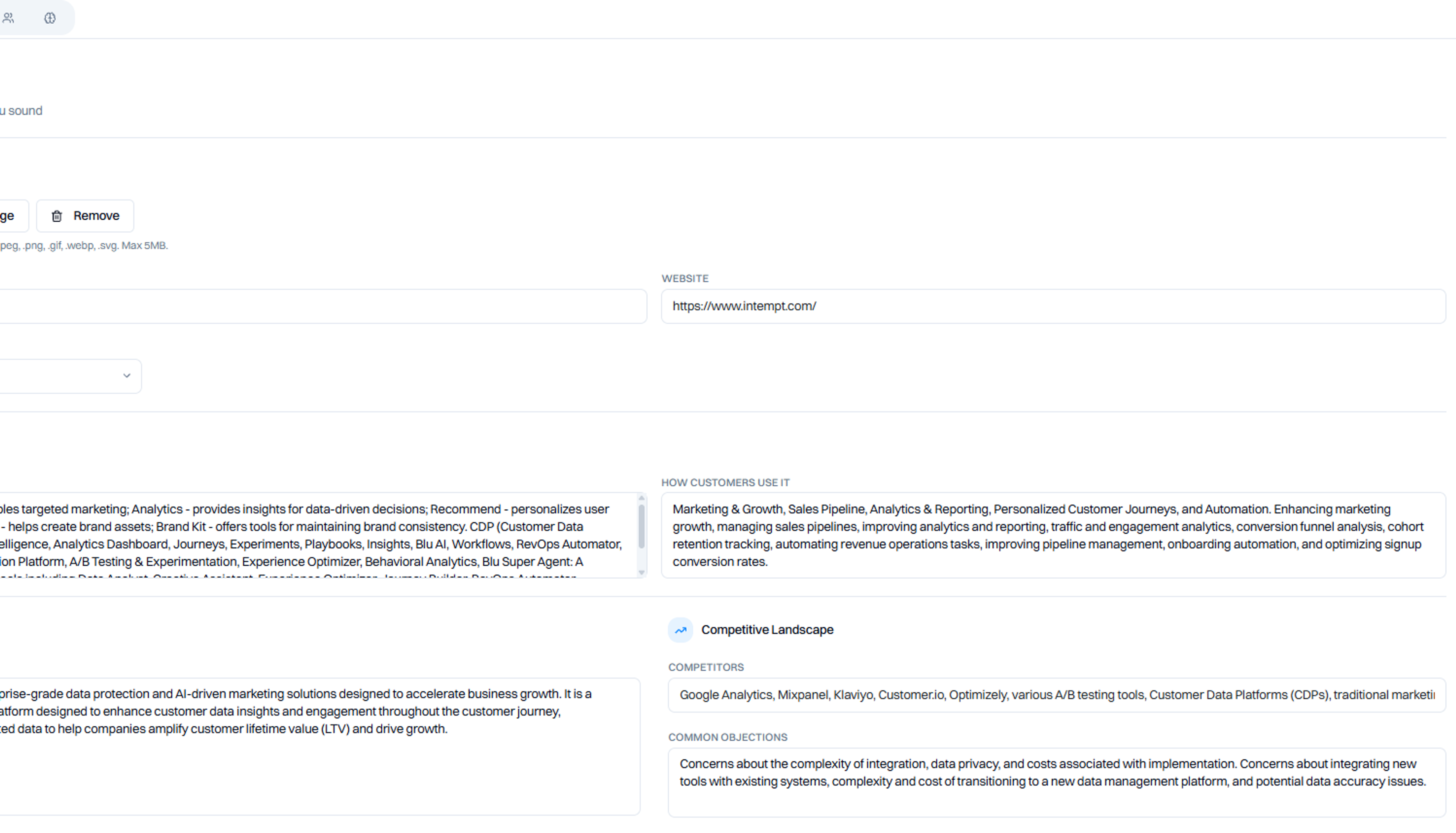
Open Intempt and navigate to Blu AI. Brief Blu on the client's brand voice, ICP, key differentiators, vocabulary rules, and blocked phrases. Blu stores this context and applies it to every output generated for that client workspace. This replaces the brand prompt doc. Unlike a Notion page, it does not go stale and it does not require pasting before every session.
Step 2: Build the audience segments
In the Segmentation module, build segments that match the skill you are activating. For the email skill: new subscribers (last 30 days), active buyers (purchased in 90 days), at-risk (no purchase or engagement in 60-90 days), and champions (top 10% by LTV). For the outreach skill: target account list by company size, industry, and trigger event. For personalization: segment by behavioral trigger (pricing page visit, feature milestone, trial lapse). Intempt segments update in real time, so the audience is always accurate when a journey fires.
Step 3: Invoke the Claude Skill and brief it with client context
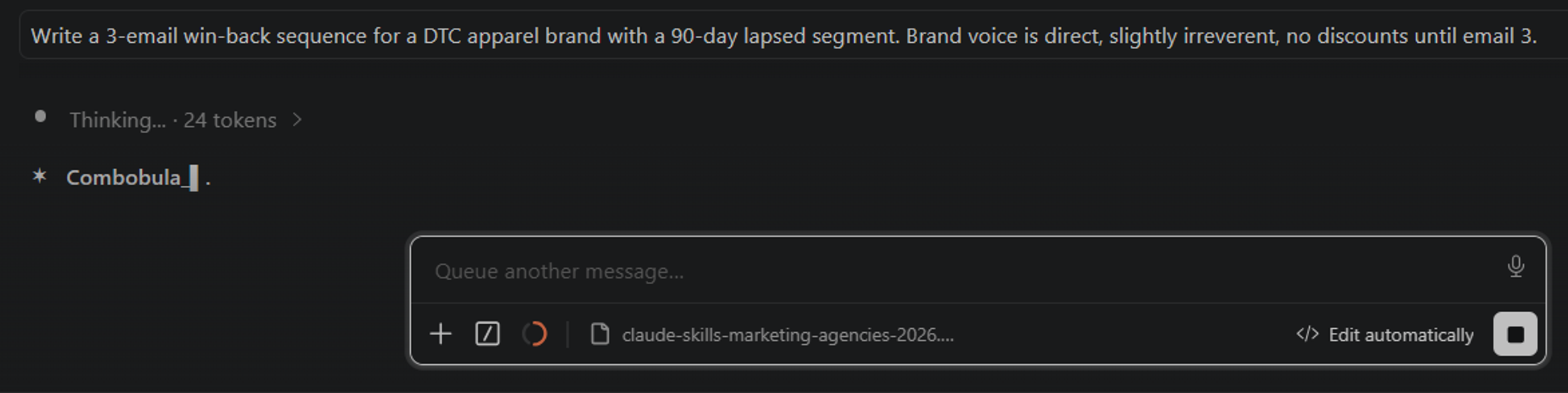
Open Claude with the relevant GTM Skill activated. Brief it with the client brand context from Step 1 and the segment you built in Step 2. For email: "Write a 3-email win-back sequence for a DTC apparel brand with a 90-day lapsed segment. Brand voice is direct, slightly irreverent, no discounts until email 3." The skill applies the win-back benchmarks, the correct copy angle for a late-stage lapsed segment, and the email length guidelines from Woodpecker's research. Output is ready to load into Intempt's Journey Builder.
Step 4: Build the Journey
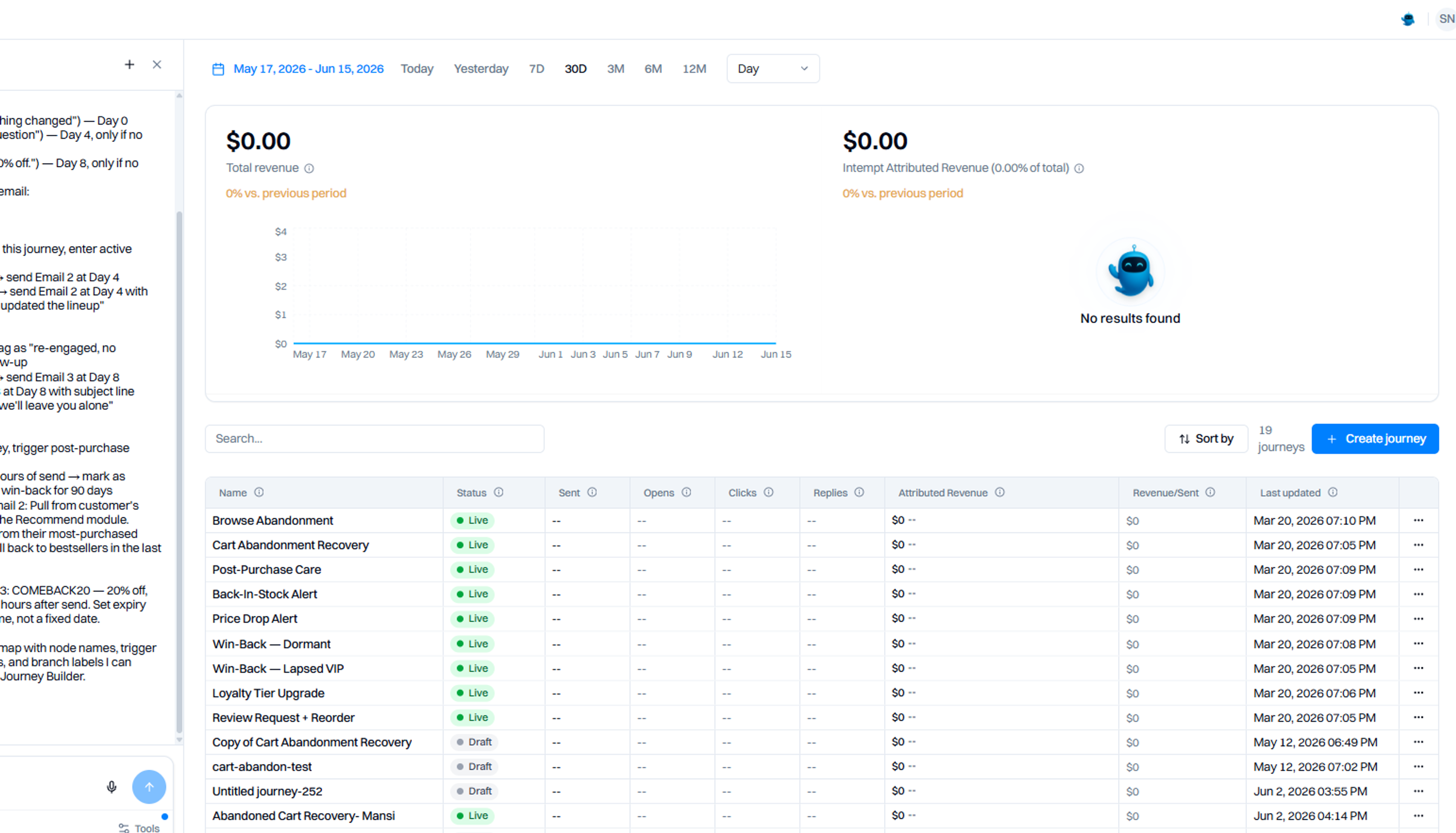
In Intempt's Journey Builder, create the journey triggered by the segment condition you built in Step 2. Load the Claude-generated copy into each email or SMS step. Set the timing delays (T+1 hour, T+24 hours, T+48 hours for cart abandonment; T+0, T+3 days, T+7 days for win-back). Branch the journey by engagement state: opened but did not click, clicked but did not buy, no engagement. Each branch gets its own follow-up angle from the skill output. The journey runs automatically from that point.
Step 5: Run the landing page or ad creative skill for channel expansion
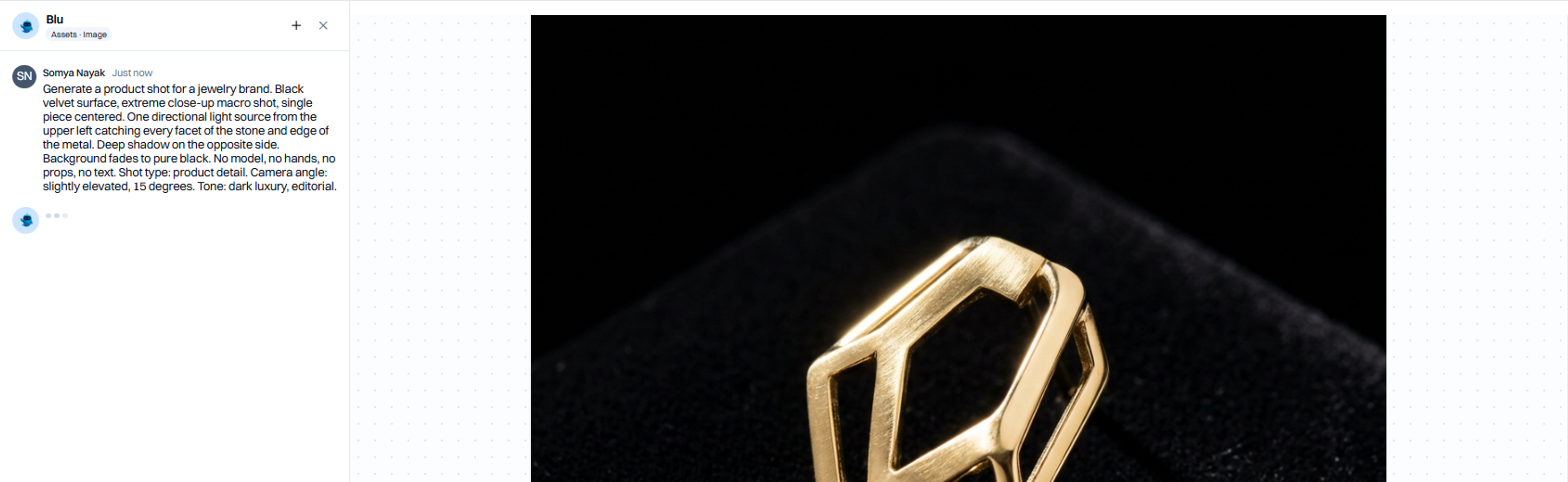
For clients running paid alongside email, invoke the ad creative skill and brief it with the same campaign context. It generates Meta hook variants matched to the funnel stage, a 30-second UGC script if video is in scope, and LinkedIn copy if B2B targeting is live. Load the landing page into Intempt's Experiences module and use the skill's headline variants as the starting point for the A/B test.
Step 6: Run the experiment
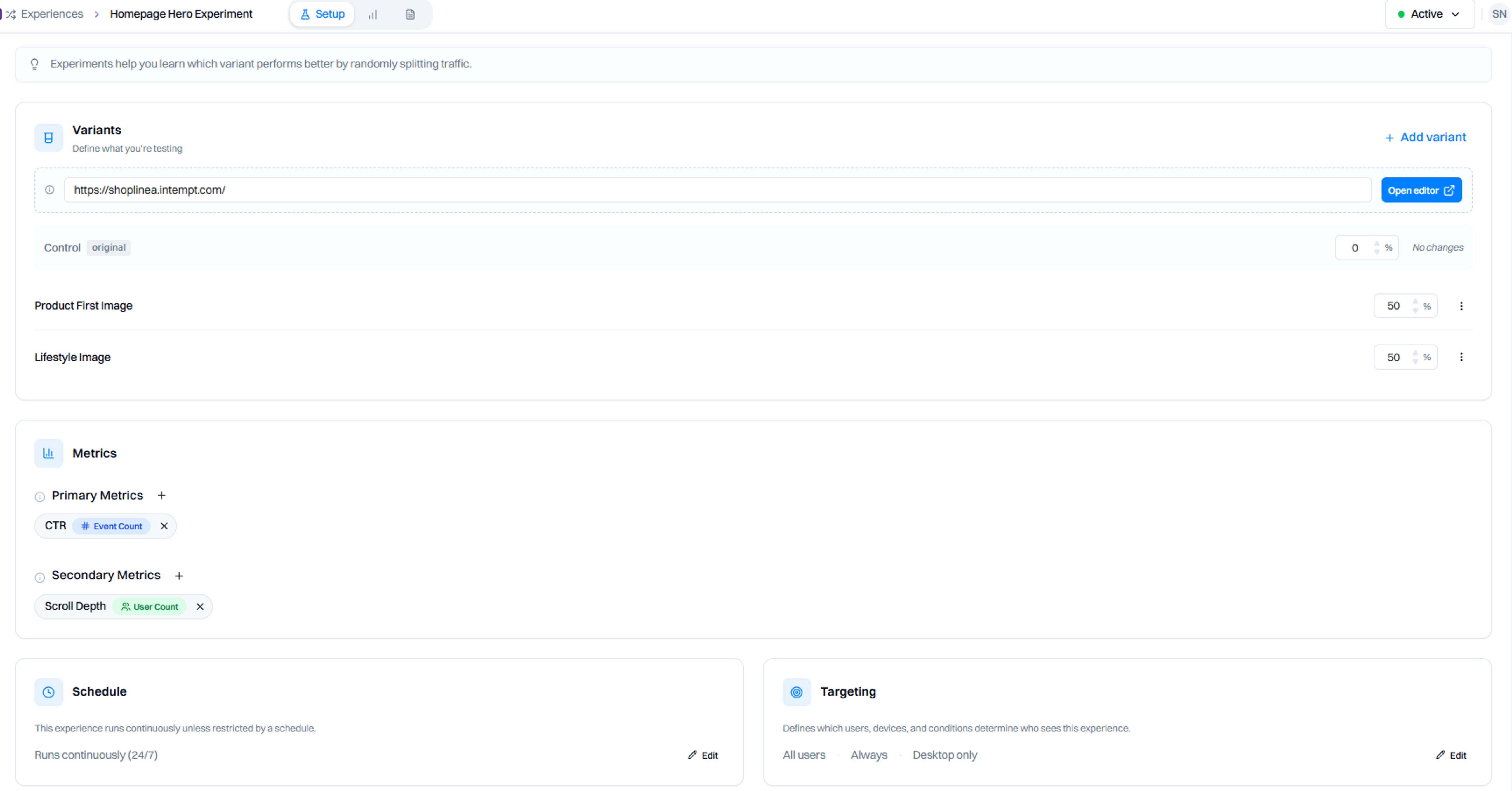
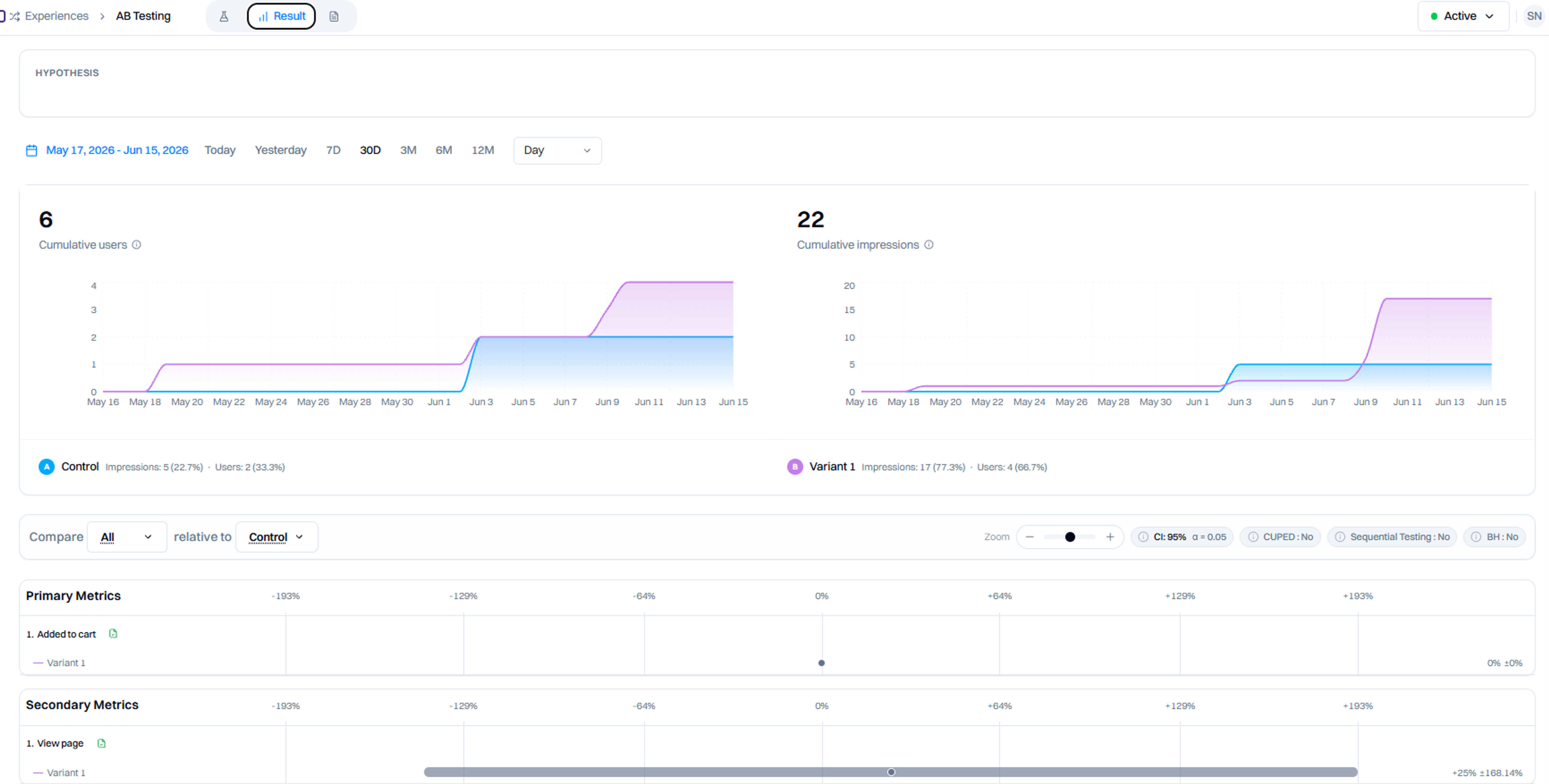
In Intempt's Experiments module, set up the A/B test for the headline or CTA variant the landing page skill flagged. Intempt uses CUPED variance reduction and sequential testing to reach statistical significance 40% faster than standard A/B testing. The experiment runs against the live segment. When a winner is confirmed, it rolls out automatically.
Step 7: Measure in Analytics
Intempt's Analytics module tracks every journey, segment, and experiment result in one dashboard. Ask Blu: "Which email in the win-back journey is driving the most recovered revenue this week?" Get a plain-language answer without exporting a spreadsheet. The same dashboard shows ad creative performance, landing page conversion rates, and segment health across every client account.
The Five Skills, Side by Side
| Skill | Skill File | Primary Benchmark Source | Core Framework | What It Replaces |
|---|---|---|---|---|
| Email Marketing | email-campaign | Klaviyo 2025/2026 ecommerce benchmarks | Lifecycle copy patterns by segment | Generic email brief prompts |
| Cold Outreach | outreach-sequence | Woodpecker 20M email study, Gong Labs 85M emails | BASHO opener, trigger-event sequences | SDR prompt library |
| Ad Creative | creative-brief | AdEspresso multi-million dollar spend analysis | Pain-led/benefit-led by funnel stage | One-off creative briefs |
| Personalization | personalization | Dynamic Yield 2023, Iterable behavioral research | RFM copy tiers, behavioral trigger library | Demographic-based segment copy |
| Landing Pages | landing-page | Highrise, Unbounce, VWO, CXL Institute | First-person CTAs, social proof placement, multi-step forms | Gut-feel CRO copy |
What Breaks This and How to Avoid It
The most common failure point for claude skills for marketing agencies is invoking a skill without first briefing the client's brand context. The skill holds the framework and the benchmarks, not the brand voice. Running skills in isolation — email briefed separately from ad creative — produces copy that does not match across channels. Using demographic segments instead of behavioral triggers for the personalization skill consistently underperforms.
- Not briefing the brand context before invoking the skill. The skill holds the framework. It does not hold the client's brand voice. Brief Blu with the client's specific vocabulary rules, blocked phrases, visual direction, and tone before every new client account. This is a one-time setup per client, not a session-by-session paste.
- Running one skill in isolation. The email skill and the ad creative skill are calibrated to work together within a single campaign. Cold TOF ad copy should match the tone of the email welcome sequence the prospect enters after clicking. If they were briefed separately, they will not match. Brief Claude on the full campaign context even when you are only invoking one skill.
- Using demographic segments for personalization copy. Behavioral segmentation — based on actions like page visits, email clicks, and trial usage — dramatically outperforms job title and industry-based targeting in documented research from Iterable. Build behavioral segments in Intempt's Segmentation module first.
- Skipping the experiment step. The landing page skill generates headline variants benchmarked against known A/B test data. Those are starting points, not guaranteed winners. Running the experiment inside Intempt's Experiments module turns skill output into validated performance data for that client's specific audience.
Frequently asked questions. Answered.
No. Intempt does not have an MCP yet. The GTM Skills are Claude Skill files you activate inside Claude directly. Intempt is the execution platform where the output lives: Journey Builder for sequences, Experiences for landing pages, Experiments for A/B tests, Analytics for measurement. Claude generates the output using the skill. Intempt runs it.
Most published Claude skills for marketing hold tone guidance and output formatting but not benchmark data. Intempt's GTM Skills are built on channel-specific 2026 benchmark data from Klaviyo, Woodpecker, Gong Labs, Dynamic Yield, Iterable, and published A/B test databases from Unbounce, VWO, and CXL Institute. Claude is not guessing what good looks like for a DTC win-back email. It knows the benchmark for that segment and writes toward it.
Yes. The cold outreach skill and the personalization skill are built on B2B data: Gong Labs' 85-million email dataset, Iterable's B2B behavioral segmentation research, and the BASHO personalization framework. The email marketing skill has sections for SaaS activation sequences and feature education emails. The ad creative skill includes LinkedIn B2B copy structures. DTC and B2B clients can both run the full stack.
The skill holds the framework. You hold the client context. Brief Claude with the client's specific vocabulary rules, blocked phrases, visual direction, and tone before invoking the skill. The skill applies its benchmark-calibrated frameworks to that context. You are not replacing client brand knowledge. You are applying a data-backed framework on top of it.
The initial Blu briefing in Intempt takes 5-10 minutes per client. Building the four base segments (new, active, at-risk, champions) takes another 5 minutes in the Segmentation module. Once those are done, invoking any of the five skills and loading output into Journey Builder typically takes under 5 minutes per campaign. The setup is a one-time cost per client. The output is repeatable across every campaign after it.
Yes. Intempt has a one-click Shopify integration that captures cart events, purchase events, product view events, and customer data automatically. The segmentation and journey triggers use this data in real time. No manual event setup required for standard Shopify stores.
Traffic temperature. Cold paid traffic arriving on a landing page has not processed the brand before. The skill places social proof above the fold and uses a pain-led headline for cold traffic. Email traffic is warm: the reader has already processed the brand from the email that got them there. The skill uses a benefit-led headline and places social proof lower, where it reinforces a decision the reader is already close to making.

About the author
Somya Nayak
Growth Marketer
Somya is a product marketer focused on helping B2B and e-commerce teams get more from their marketing stack. She writes about personalization, analytics, and revenue-focused campaigns.
LinkedIn