- Every platform ships the same four templates: welcome, abandoned cart, post-purchase, winback. None of them ship the expansion nurture, so it stays manual.
- Segment's B2B SaaS spec covers 10 events and its V2 ecommerce spec covers 28, and neither has a standard event for a customer needing a product they do not own. No standard event, no template.
- Build expansion as custom work off cross-product usage. Do not wait for your platform to ship it.
Lead nurturing automation is behavior-triggered follow-up that fires without a rep starting each touch. Open a new account on almost any platform and the pre-built journeys waiting for you are close to identical: a welcome series, an abandoned cart flow, a post-purchase flow, and a winback flow. That set has been stable for years and it works.
One nurture program is missing from that list, and it's aimed at the most qualified audience any company has: following up automatically when an existing customer starts showing signs of needing a product they don't own yet. That one doesn't arrive pre-built. It's still a rep or a customer success manager noticing something and writing an email.
The interesting question is why, and the obvious answer turns out to be wrong. It isn't that platforms can't see usage from a second product. They can, and that's exactly what a CDP is for. The real reason is narrower and more boring: the flows that ship pre-built are the ones the industry standardized an event for, and expansion has no standard event.
The short version
- The pre-built nurture set barely varies between platforms. Klaviyo's docs name four to set live first: welcome series, abandoned cart, post-purchase, and winback.
- None of the four is an expansion nurture aimed at a customer who needs a second product.
- Customer success tools do automate expansion signals, then hand them to a person. Gainsight's own copy says its expansion signals "push qualified leads directly into your CRM."
- So the pattern is real: top-of-funnel nurture is automated and templated, and expansion nurture is rep-mediated.
- The reason is not visibility. Sending a second product's events into any of these tools is a documented, supported integration, not a workaround.
- The reason is schema. Welcome flows are templatable because Signed Up means the same thing everywhere. Abandoned cart is templatable because Checkout Started does.
- Segment's B2B SaaS spec standardizes 10 events. Its V2 ecommerce spec standardizes 28. Neither has one for entitlement, product ownership, or unmet need.
- A standard event is necessary and not sufficient: Account Added User is standard and nobody ships a seat-expansion flow either. For cross-product expansion, even the precondition is missing.
- The practical consequence: expansion nurture is custom work in every single account, and custom work that nobody templated is the work that stays with a human.
What lead nurturing automation actually is
Lead nurturing automation moves a lead from interest to readiness through timed, relevant touches that fire on behavior rather than on a calendar. The trigger is the whole definition. A nurture step sends because someone opened your pricing page for the second time in five days. A campaign step sends because it was scheduled for Tuesday.
Most people who fill out your form aren't ready to buy. They're comparing options, building an internal case, or waiting on a budget cycle. Nurturing keeps you present through that window, and automation is what makes it happen for every lead rather than the ones a rep remembered. 80 percent of leads never convert without structured follow-up, and no amount of discipline fixes a timing problem at list scale.
The mechanics are simple enough that the interesting part is elsewhere. A case study after a pricing visit. A re-engagement email after 10 days of silence. A rep alert when a score crosses a threshold. What's worth examining is which of these arrive pre-built and which don't, because the split isn't random.
The four flows that arrive pre-built
Four, and the list barely varies between tools: welcome series, abandoned cart, post-purchase, and winback. Under the heading "Suggested flows to create first," Klaviyo's own flows documentation names those four in that order, and describes what's already sitting in a new account as "best practice flows we have pre-populated for you" with default templates and example copy inside them.
Read that list against what each one is triggered by and the logic shows up immediately. Welcome fires on a signup. Abandoned cart fires on a checkout that started and didn't finish. Post-purchase fires on a completed order. Winback fires on an order that used to repeat and stopped. Every one of those triggers is a thing that happens the same way at every company using the tool.
Post-purchase is the one worth being careful about, because it's cross-sell adjacent. Klaviyo describes it as letting customers "know about related products they might be interested in." That's genuinely automated cross-sell, and it works because the products live in one catalog with one checkout. Recommending a second item from a catalog someone already buys from is a different problem than pitching a separately purchased product to an account that doesn't have it, and the second one is where the templates stop.
Expansion nurture is the exception, and it's still a human motion
Automation for expansion does exist. It stops one step earlier than a nurture flow does: it scores a signal and routes it to a person. Gainsight, one of the most established customer success platforms, describes its own expansion capability as "buying signals are surfaced and scored with AI while there's still time to act," with expansion signals that "score each account's growth readiness and push qualified leads directly into your CRM, so Sales and CS work from the same picture at the same time."
That's a real capability and this post isn't dismissing it. It's a different shape from a welcome series, though, and the difference is the point. A welcome series runs itself for six touches over three weeks and nobody looks at it. An expansion signal produces a scored record and waits for a CSM or an AE to decide what to say. One is a nurture program. The other is a well-built alert.
So the accurate description of the market is narrow: expansion follow-up is not unautomated, and it is not templated as a self-running multi-touch sequence the way top-of-funnel nurture is. The signal layer is mature and the sequence layer is missing, which matches how signal-based selling became a feature inside larger systems rather than a product anyone runs on its own.Anyone claiming no automation exists here is wrong, and anyone claiming you can turn on an expansion nurture the way you turn on a welcome series is also wrong.
Why the pre-built flows are the ones with a standard event
A flow can ship pre-built only if its trigger means the same thing in every account that installs it. That's what an event spec provides, and Segment's spec overview states the mechanism directly: "When you respect these specs, Segment maps these events to particular features within end destinations like Google Analytics and Facebook Ads." Standard event in, pre-wired behavior out.
Two specs cover most of what nurture tools receive. Segment's V2 ecommerce spec standardizes 28 named events across browsing, promotions, core ordering, coupons, wishlisting, sharing, and reviewing, from Products Searched through Order Refunded. Segment's B2B SaaS spec standardizes 10, and here they are in full: Account Created, Account Deleted, Signed Up, Signed In, Signed Out, Invite Sent, Account Added User, Account Removed User, Trial Started, and Trial Ended. Its stated scope is "core user and account lifecycle data."
Neither spec contains the word entitlement, subscription, upsell, cross-sell, or expansion anywhere in it. That's not an oversight to complain about. Both specs cover what companies genuinely do the same way as each other, and product ownership isn't on that list, because what counts as a product, a plan, an add-on, or a seat differs at every company that sells more than one thing.
| Nurture program | Trigger event | Standardized where | Ships pre-built |
|---|---|---|---|
| Welcome series | Signed Up | B2B SaaS spec, one of 10 events | Yes, in default flow sets |
| Trial conversion | Trial Started, Trial Ended | B2B SaaS spec | Yes, commonly templated |
| Abandoned cart | Checkout Started without Order Completed | V2 ecommerce spec, two of 28 events | Yes, the most templated flow in the category |
| Post-purchase cross-sell | Order Completed, plus catalog and Product Viewed data | V2 ecommerce spec | Yes, within a single catalog |
| Winback | A repeat Order Completed that stopped repeating | V2 ecommerce spec, read as an absence | Yes |
| Seat expansion | Account Added User | B2B SaaS spec | No, even though the event is standard |
| Expansion to a product the account doesn't own | No agreed event exists | Neither spec | No, and there's nothing to template against |
The seat expansion row is the one that keeps this honest. Account Added User is a standard event, any of these tools can receive it, and it still isn't in the pre-built sets. So a standard schema is a precondition for a template, not a guarantee of one. What the last row adds is that for cross-product expansion, even the precondition is missing, which puts it a step further back than seat expansion rather than in the same place.
The explanation this post tested and had to drop
The tempting explanation is architectural: a marketing automation platform built around one product's data can't see a different product's usage, so it structurally can't run cross-product nurture. That claim is wrong and worth retiring out loud, because it's the kind of thing that sounds like insight and would fall apart the first time a reader tested it.
Sending a second product's events into Klaviyo, Customer.io, or HubSpot is a documented, supported pattern. Server-side track calls, webhooks, and a CDP in front of all of them are the normal way anyone with more than one data source does this. A CDP's entire job is to take one event stream and fan it out to every destination that needs it, which means a platform's visibility into a second product is an integration decision, not an architectural ceiling. Any post claiming those tools are incapable here is describing a setup nobody bothered to build, not a limit in the tool.
What survives the test is smaller and, unusually, checkable. Cross-product expansion nurture isn't hard to build. What can't happen is shipping it pre-built, because a template needs a trigger that means the same thing everywhere and this trigger is defined per company. So it stays custom work in every account, forever, and custom work that no vendor templated is the work that ends up assigned to a rep. That's a standards story rather than a capability story, and it explains the persistence of the manual motion better than calling it tradition does.
What you have to define yourself before an expansion nurture can run
Four definitions, none of which a vendor can supply for you. Each one is a decision about your own business, which is precisely why it can't arrive as a default template with example copy in it.
- Product boundaries. What counts as a separate product versus a feature of an existing one. A plan tier, an add-on, and a second product are three different sales motions and one ambiguous data question.
- Entitlement state. Which products this account already has. That fact lives in billing or provisioning, not in the event stream, so it has to be joined in before any message can avoid pitching something someone already pays for.
- The qualifying signal. Which behavior in product A means unmet need for product B. This is the part with no analog anywhere else in nurture, because it's specific to what your products do for each other.
- Suppression against open deals. If an AE is already in an expansion conversation, the automated sequence has to stand down. That means reading deal state from your CRM as an exit condition, not just as a report.
Two of those four live outside your behavioral data, in billing and in the CRM. They're joinable, and plenty of teams join them. They're just not standardized, so the join is yours to design and yours to maintain, which is the whole cost that keeps this program unbuilt at most companies.
The five lead nurturing automation strategies that hold either way
These five apply whether you ever build the expansion program or not. They're the difference between a nurture system that responds to people and a drip sequence with a scheduler attached.
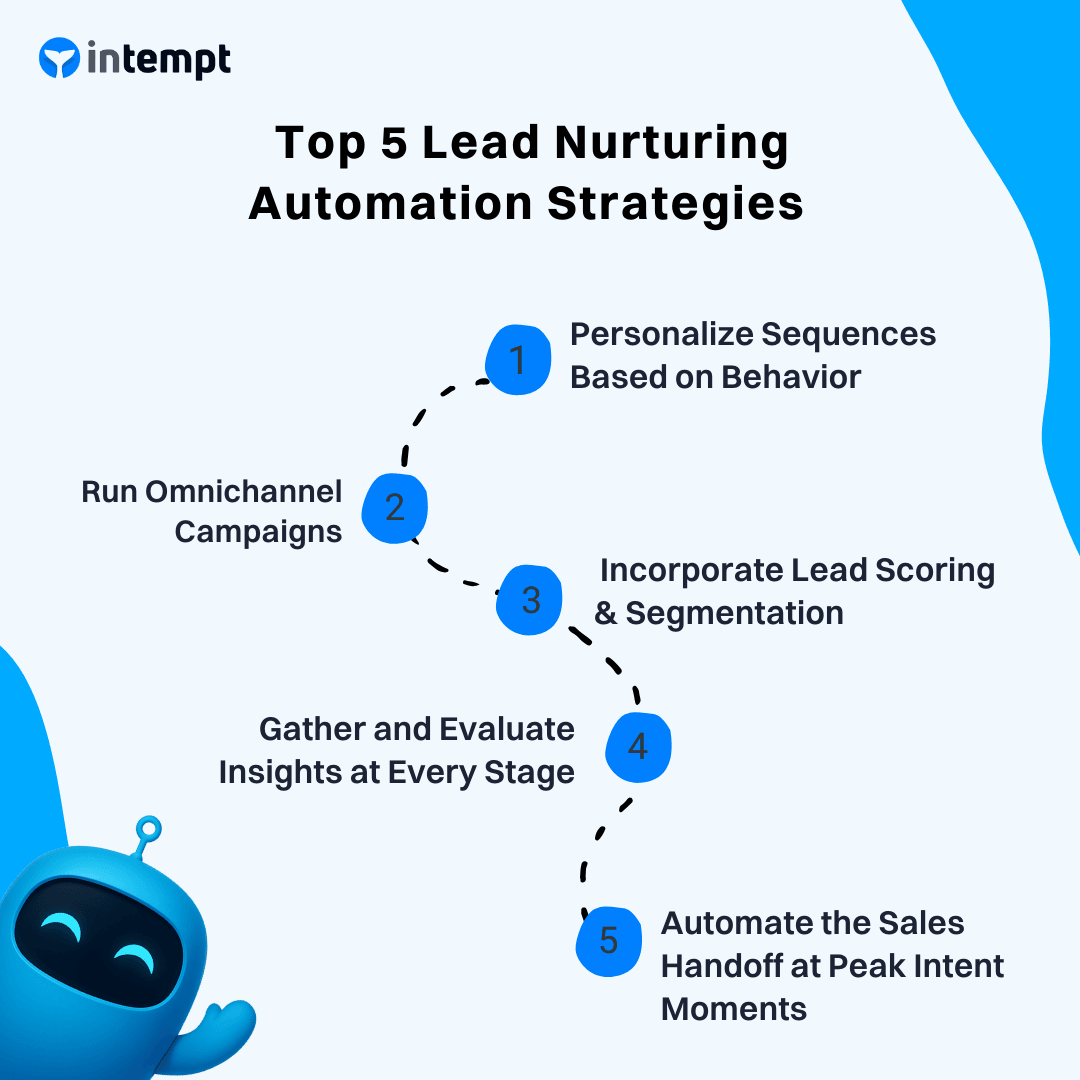
1. Personalize on behavior, not attributes
Job title and company size tell you who someone is. What they did tells you what they want right now, and only one of those changes week to week. A lead who downloaded a competitive comparison is asking a different question than one who watched a product demo, and a sequence that treats both as "mid-market marketing manager" answers neither.
Behavioral personalization means segmenting on actions: content consumed, pages visited, features touched in a trial, emails clicked. Each signal narrows what that person cares about today. The content download nurture pattern is the simplest working version, where the asset someone chose decides what the next three messages say.
2. Coordinate channels instead of adding them
Omnichannel nurture works when channels share state and fails when they don't. The requirement isn't more channels, it's suppression: if a lead converts on email, the retargeting audience and the SMS step have to know within minutes, not on tomorrow's sync.
That's a data problem wearing a channel problem's clothes. Two tools with two contact lists produce two versions of the same person, and the fastest way to look automated in the bad sense is to send a "still deciding?" email to someone who bought yesterday. Layer channels on behavior, and cap by person rather than by channel.
3. Score for routing, then segment for content
Scoring answers one question: is this person ready for a rep? Segmentation answers a different one: what should we say? Collapsing them is the most common scoring mistake, because it produces sequences chosen by a number that was never designed to carry meaning.
Two leads at 25 points, one from a webinar and one from two pricing visits, have the same readiness and different questions. Score routes them the same way and segmentation should not. Getting the second half right is also what makes expansion-qualified leads legible, since an existing customer's readiness score and their product-level need are separate facts about the same account.
4. Measure transitions, not totals
Three numbers per stage: entry-to-engagement rate, stage progression rate, and sequence-to-pipeline rate. Program-level averages hide the specific step where people stall, and the step is the only thing you can actually change.
Healthy opens at the top of a sequence sit comfortably alongside a collapse at step three. Read it monthly rather than quarterly, look for where drop-off spikes, and when you find it the cause is usually one of three things: the content type is wrong for that stage, the timing is off, or the call to action is asking for too much too early. Change one, run 30 days, check again.
5. Automate the handoff, not just the emails
The handoff is where nurture either pays for itself or doesn't. Responding to a sales-ready lead within five minutes is 100 times more effective than waiting 30, so a threshold crossing has to produce a routed, contextualized rep task without anyone checking a dashboard for it.
Context is the part teams skip. An alert that says "lead is hot" makes the rep do the research again. An alert carrying the pages visited, the events that moved the score, and the time window they happened in lets the first message reference something real, whether a rep writes it or an email generator drafts it from those events. The post-demo nurture cadence works on the same principle from the other side of the meeting, and the B2B nurture and deal acceleration pattern is the routing half of it.
Where Intempt fits
Intempt runs into the expansion problem on itself, since it sells four products to the same accounts, which is why the agentic GTM software keeps entitlement, product usage, and deal state on one profile rather than in three systems that reconcile overnight. Two of its recipes show both halves of the split this post describes. The usage spike expansion play is the self-running version, firing on thresholds like fast user growth or usage spreading across teams and routing different content to a champion than to an economic buyer. The seat expansion signal to AE task is the deliberately human version, turning a plan-limit event into a task for a rep instead of an email nobody asked for.
The honest limit: that's a build, not a toggle. Nothing about it is a pre-built flow you enable in an afternoon, because the four definitions above are still yours to make. What a unified profile changes is the cost of making them, not the fact that you have to.
What this post does not claim
- Not that Klaviyo, Customer.io, or HubSpot are incapable of cross-product nurture. Feeding them a second product's events is a documented, supported integration, and a CDP in front of them is the standard way to do it.
- Not that expansion has no automation. Customer success platforms score expansion signals well. They route the result to a person, which is a different thing than a self-running sequence.
- Not that the four pre-built flows are the only templates in existence. Template libraries and marketplaces hold far more than four. The claim is about which flows arrive pre-populated by default and what those share.
- Not that Segment's specs are incomplete. They standardize what companies genuinely do identically. Product ownership isn't in that set for a good reason.
- Not that a standard event guarantees a template. Account Added User is standard and a seat-expansion nurture still doesn't arrive pre-built, which is why this is a precondition argument and not a sufficiency one.
- Not that single-product companies need any of this. One product means expansion nurture has nothing to point at, and the four pre-built flows cover the ground.
There's a one-query test for whether this applies to you. Ask your system for a list of accounts that are heavy users of one product, own none of your second, and have no open opportunity attached. If that list is buildable, you have the data and you're missing a sequence. If it isn't, the missing piece is the join between usage, entitlement, and deal state, and no template was ever going to supply it. Either way, that list is the highest-intent audience your lead nurturing automation isn't talking to yet, and Intempt is built for the version where it is.
Frequently asked questions.Answered.
- Lead nurturing automation is behavior-triggered follow-up that fires without a rep starting each touch. The system watches what a person does, or stops doing, and sends the next relevant message on its own. The difference between this and a scheduled email campaign is the trigger: a nurture step fires because someone visited pricing twice, and a campaign step fires because it's Tuesday.