Your customer just browsed three pricing pages, opened two emails, and abandoned their cart. They then messaged your support team, who had zero context on any of that.
The support agent started fresh. Asked the same questions. Gave a generic response. Your customer, frustrated, left.
And somewhere in your stack, five different tools had pieces of this story. The analytics tool knew they visited pricing. The email platform knew they opened the campaigns. The CRM had their contact info. The support tool had the chat log. But none of them talked to each other. And by the time you could've connected the dots, your customer had already clicked over to a competitor.
This is not a rare edge case. 66% of customers expect companies to understand their unique needs, yet only 34% believe companies actually deliver on that understanding. That gap is not a personalization problem. It is an infrastructure problem. And in 2026, the businesses that close it are the ones winning. The ones that don't? Still asking customers to repeat themselves.
Expected Results
- One unified customer profile that pulls behavioral, transactional, and lifecycle data from every channel into a single source of truth.
- Real-time, behavior-triggered engagement across email, SMS, push, and in-app, without someone manually hitting send.
- Early churn signals surfaced by AI before the customer is already halfway out the door.
- Individual-level personalization that adapts as users behave, not as your team finds time to update a segment.
- Multi-channel journeys that respond to what each user actually does, not what your editorial calendar says.
- A continuous experiment loop that improves your engagement over time instead of resetting every quarter.
What Is a Customer Engagement Platform?
A Customer Engagement Platform (CEP) is software that helps businesses manage, orchestrate, and personalize how they interact with customers across every channel, in real time.
Think email, SMS, push notifications, in-app messages, and web, all working together, not as five separate channels firing independently, but as one coordinated system that responds to what a customer actually does.
The important thing to note here is "respond." A CEP is not about scheduling campaigns and hoping for the best. It is about tracking customer behavior, understanding intent, and delivering the right message at the right moment across the right channel, automatically.
A modern CEP does three jobs really well:
- Builds a unified data layer. It ingests behavioral, transactional, and contextual data from every source and keeps a single, live profile for each customer. No more five half-records stitched together with spreadsheets.
- Makes AI-driven decisions. It uses machine learning to figure out the right message, the right channel, and the right moment for each individual user. Not each segment. Each person.
- Orchestrates cross-channel journeys. It executes multi-step, adaptive sequences that respond to real-time behavior. Not a drip campaign. A living journey.
When a user does something that matters (completes a key action, goes silent after signup, hits a usage milestone), a CEP doesn't wait for someone to notice. It responds automatically, consistently, and at scale. It unifies your customer data, runs behavioral analytics, powers multi-channel journeys, and lets you run personalized experiments, all from one place.
Key Features of a Customer Engagement Platform
Not all CEPs are built the same. But the good ones share a common set of capabilities that make the difference between coordinated engagement and expensive chaos.
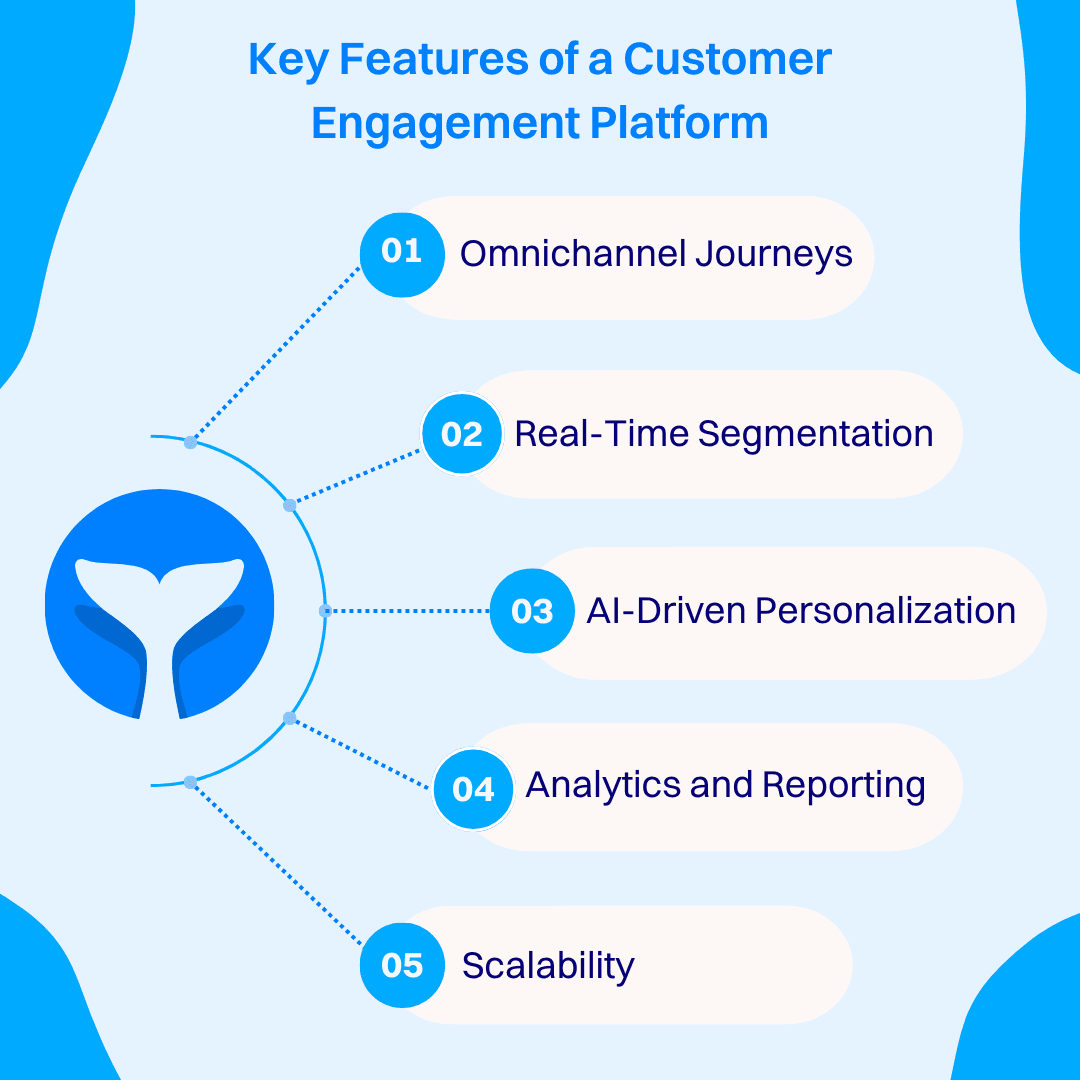
1. Omnichannel Journeys.
This is the engine room of any CEP. Journeys let you visually build and deliver coordinated campaigns across email, SMS, push notifications, and in-app messages, all based on what a customer actually does. Not a broadcast. A conversation that adapts. Each channel informs the next, so your messaging feels like one coherent brand, not five separate teams talking at the same person.
2. Real-Time Segmentation.
Static segments built on last month's data are already wrong by the time you use them. A good CEP segments customers dynamically, updating in real time as behavior changes. Someone who was "active" last week and has gone quiet this week moves into a different segment automatically, triggering the right response without anyone manually rebuilding a list.
3. AI-Driven Personalization.
This goes well beyond "Hi [First Name]." AI-driven personalization analyzes behavioral patterns, purchase history, lifecycle stage, and real-time signals to determine what content, offer, or message each individual customer is most likely to respond to. At scale. Without your team manually segmenting lists every week.
4. Analytics and Reporting.
You cannot improve what you cannot see. A solid CEP gives you a full view of how customers move through your product or store, where they drop off, which campaigns actually drive conversions, and how each channel contributes to the overall journey. Not vanity metrics. Actionable data tied to revenue.
5. Scalability.
Your engagement infrastructure needs to grow with you. Whether you have 1,000 customers or 1,000,000, a good CEP handles the load without requiring you to rebuild your entire stack every 18 months. That means cloud-native architecture, real-time data processing, and the flexibility to add channels and integrations as your business evolves.
CEP vs. CRM: They're Not the Same Thing
People mix these up constantly. And it makes sense, because both tools deal with customers. But they solve completely different problems.
A CRM is your system of record. It stores what happened: who bought what, when they called support, what stage they are in the sales pipeline. It is built for your internal teams, primarily sales and service, to manage customer relationships and track interactions.
A CEP is your system of action. It decides what happens next: which message to send, through which channel, at exactly what moment, based on what the customer just did. Your CRM tells you what happened. Your customer engagement platform decides what should happen next.
Here is how they actually differ:
| Dimension | CRM | AI-Powered CEP |
|---|---|---|
| Primary function | Store and manage customer data | Orchestrate real-time, multi-channel engagement |
| Who uses it | Sales and support teams | Marketing, growth, and product teams |
| Data focus | Historical interactions and records | Real-time behavioral data across all touchpoints |
| Engagement style | Reactive (responds to logged interactions) | Proactive (triggers actions based on live behavior) |
| Personalization | Basic segmentation | AI-powered, 1:1 personalization at scale |
| Channel coverage | Email and CRM notes mostly | Email, SMS, push, in-app, web, all unified |
| Analytics | Sales pipeline and contact reports | Behavioral analytics, predictive scoring, journey analysis |
| Goal | Manage relationships | Drive engagement, conversion, and retention |
Both tools have their place. But if your goal is to engage customers at the right moment, across the right channels, with the right message, a CRM alone will not get you there.
The Challenges with Disconnected Customer Engagement Channels
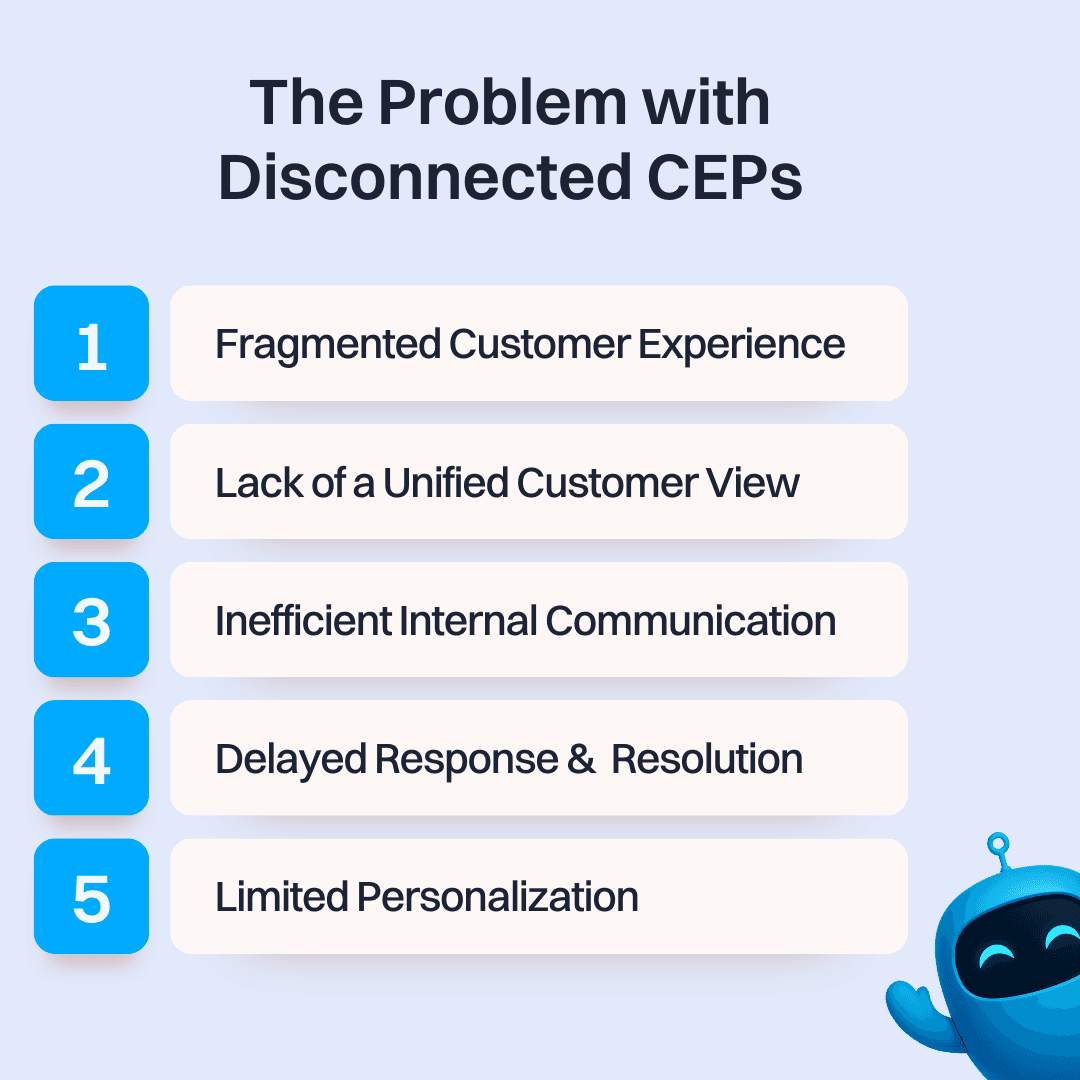
Here is the uncomfortable reality: most businesses are not failing at customer engagement because they lack effort. They are failing because their tools do not talk to each other.
Your email platform does not know what your push notifications are doing. Your analytics tool does not feed into your messaging workflows. Your customer data lives in six places, and none of them agree on who the customer actually is. This is what disconnected customer engagement looks like. And it costs more than most marketers realize.
1. Fragmented Customer Experience
Customers don't stay in one channel. They find you on social, check your site, sign up via email, ask a question through in-app chat, and then talk to sales. That's a six-touch journey, minimum.
73% of retail shoppers engage across multiple channels during their buying journey, averaging nearly six touch-points. Most companies can't maintain context across even three of those. So the customer repeats themselves. Every. Single. Time.
39% of customers abandon brands with disconnected omnichannel experiences. That's not a satisfaction problem. That's a structural one.
2. Lack of a Unified Customer View
Here's what fragmentation actually looks like in practice. Purchase data lives in your e-commerce system. Support tickets live in your helpdesk. Product usage lives in your analytics tool. Email engagement lives in your ESP.
Nobody has the full picture. And your AI, if you're using one, has nothing coherent to learn from.
68% of brands are still struggling with siloed data that prevents a unified customer view. 97% of executives say data silos negatively impact their business. And IDC estimates this costs companies up to 30% of annual revenue.
3. Inefficient Internal Communication
When every team has its own tools and its own customer view, the handoffs break down fast. Marketing launches a re-engagement campaign while support is trying to resolve a complaint from the same customer. Sales sends a discount to someone who already churned. Product sends an onboarding email to a user who activated six months ago.
(We've all seen this happen. It's embarrassing every time.)
These aren't failures of effort. They're failures of infrastructure. Disconnected systems guarantee coordination mistakes at scale, and those mistakes destroy trust one awkward message at a time.
4. Delayed Response and Resolution
Speed matters more than most marketers admit. 90% of consumers rate "immediate" responses as important or very important when they have a service question, and 68% expect proactive service and will switch if it is not delivered.
Disconnected systems make speed impossible. By the time a support agent finds the customer's context across three platforms, the moment has already passed. Real-time behavioral triggers become pipe dreams when your tools are not integrated. And every delayed response is a compounding loyalty problem.
5. Limited Personalization
"Send this email to everyone who purchased in the last 90 days" is not personalization. It's targeted broadcasting. Customers know the difference, and they're tired of it.
Real personalization means understanding what a specific user has done, what they haven't done, what they care about, and what's likely to make them stick around. 74% of customers feel frustrated when content isn't personalized to them. And 38% of organizations say fragmented data is the main reason they can't deliver it.
When you get it right? Personalized campaigns deliver 5 to 15% revenue lifts and 10 to 30% improvements in marketing ROI. That's not a marginal gain. That's a structural one.
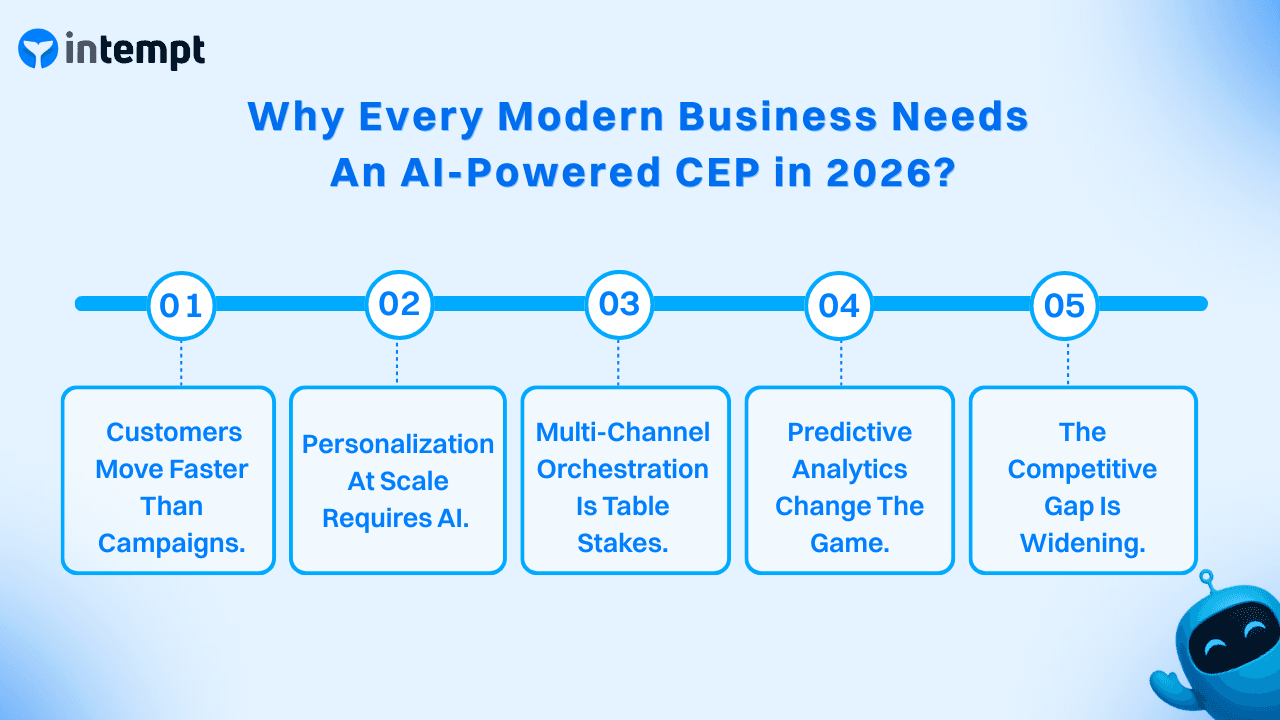
Why Every Modern Business Needs an AI-Powered CEP in 2026?
Let us be direct about something. The marketing landscape in 2026 is not just more competitive. It is structurally different.
AI is transitioning from a back-office efficiency tool to a front-line customer interface, and nearly half of surveyed consumers expect to interact with brands through AI agents by the end of 2026. That is a fundamental shift in how engagement happens. And it demands a platform built for it.
Here is why an AI-powered CEP is not optional anymore:
1. Customers move faster than campaigns.
A customer's intent signal, browsing a pricing page three times in one day, for example, has a half-life of hours. If your platform cannot act on that in real time, the moment is gone. AI-powered CEPs track behavior as it happens and trigger responses automatically. No manual workflows. No campaign lag.
2. Personalization at scale requires AI.
You cannot manually customize messages for 50,000 customers. But AI can. Companies using AI-driven personalization can reduce acquisition costs by as much as 50%, lift revenues by 5-15%, and increase marketing spend efficiency by 10-30%. Those numbers are not achievable with a basic email tool and some segmentation rules.
3. Multi-channel orchestration is table stakes.
Your customers switch between email, SMS, push, and in-app within a single session. A CEP that coordinates all of those channels, so they work as one conversation instead of four separate broadcasts, is the difference between feeling like a coherent brand and feeling like spam.
4. Predictive analytics changes the game.
AI does not just respond to what customers do. It predicts what they are about to do. Churn signals. Purchase intent. Feature adoption likelihood. When you can see these patterns early, you act on them before they become problems. AI-driven predictive analysis can lead to a 20% improvement in anticipating customer needs, and businesses that leverage AI to orchestrate customer journeys see a 33% higher customer lifetime value on average.
5. The competitive gap is widening.
80% of organizations now expect to compete primarily based on customer experience, and that shift is already happening. The companies investing in AI-powered CEPs are building engagement infrastructure that compounds over time. Every month, they run smarter journeys, better personalized experiments, and tighter feedback loops; they pull further ahead. The ones waiting are not standing still. They are falling behind.
Trends Shaping Customer Engagement Platforms in 2026
The platform you evaluate today looks different from what existed two years ago. Here is what is actively reshaping the CEP landscape right now.
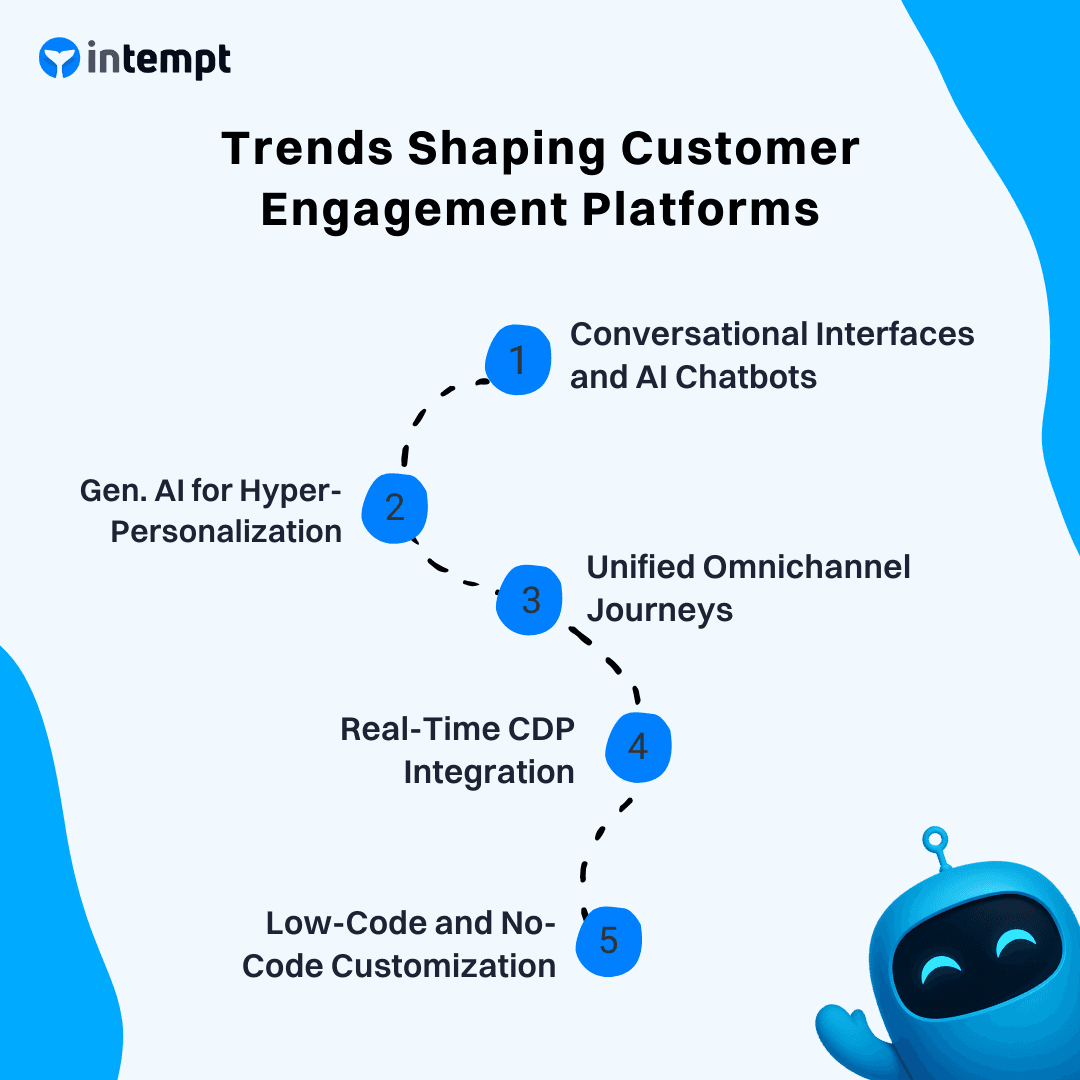
1. Conversational Interfaces and AI Chatbots.
The traditional customer journey (search, browse, click, buy) is being replaced by conversation-driven flows. By 2026, conversational AI has evolved well beyond simple chatbots, with 97% of CMOs saying generative technology is already playing a key role in their customer service strategies. Customers now expect to ask a question and get a precise, context-aware answer, not a link to a FAQ page. CEPs that do not support conversational interfaces are already feeling the gap.
2. Generative AI for Hyper-Personalization.
Generative AI is moving personalization from "segment of one" to genuinely individual. Consumers today expect brands to anticipate their needs, preferences, and next steps, and generative AI makes this possible through hyper-personalization that replaces generic interactions with tailored, data-driven conversations. In practice, this means dynamically generated email copy, product recommendations, and in-app messages that are written specifically for each user, not pulled from a template library.
3. Unified Omnichannel Journeys.
Multichannel is table stakes. The shift in 2026 is toward truly unified journey orchestration, where every channel (email, SMS, push, in-app, web) shares the same data, the same context, and the same understanding of where the customer is in their lifecycle. Generative AI now enables personalized, context-rich responses at scale, and companies that treat this as an opportunity for optimization will fall behind those that understand it as a call for reinvention. Siloed channel tools simply cannot deliver this.
4. Real-Time CDP Integration.
A CEP without a Customer Data Platform feeding it real-time data is just a messaging tool. The trend in 2026 is tight integration between CDP and CEP, so every message is triggered by live behavioral signals, not yesterday's batch export. This is what separates platforms that react from platforms that actually predict.
5. Low-Code and No-Code Customization.
The idea that you need a developer to build engagement workflows is fading fast. 64% of CX leaders plan to increase investment in automation tools in 2026, and much of that demand is coming from marketing and growth teams who want to move without waiting in a development queue. The best CEPs in 2026 give non-technical teams drag-and-drop journey builders, visual campaign editors, and AI-assisted workflow creation out of the box.
How to Get Started with Intempt?
AI-powered CEPs are not a future consideration anymore. They are the infrastructure layer that separates businesses that grow intentionally from businesses that guess loudly.
But knowing you need one and actually implementing one are two different things. Most teams stall not because the technology is too complex, but because they do not know where to start. Which events to track. Which journeys to build first. How to get from zero data to meaningful personalization without a six-month onboarding project.
That is exactly the problem Intempt was built to solve. It brings CDP, AI agents, behavioral analytics, and multi-channel journey orchestration into one platform, and it is designed so that a two-person marketing team can get it running without an engineering department holding their hand.
Here's how to implement this with Intempt:
Step 1: Set Up Tracking

Install Intempt's JavaScript SDK to track user activity across your app or website. This is the foundation. Every click, scroll, feature interaction, and page visit gets captured and unified into a single customer profile. No more guessing what your users are doing. You will see it in real time.
Step 2: Define Goal Events
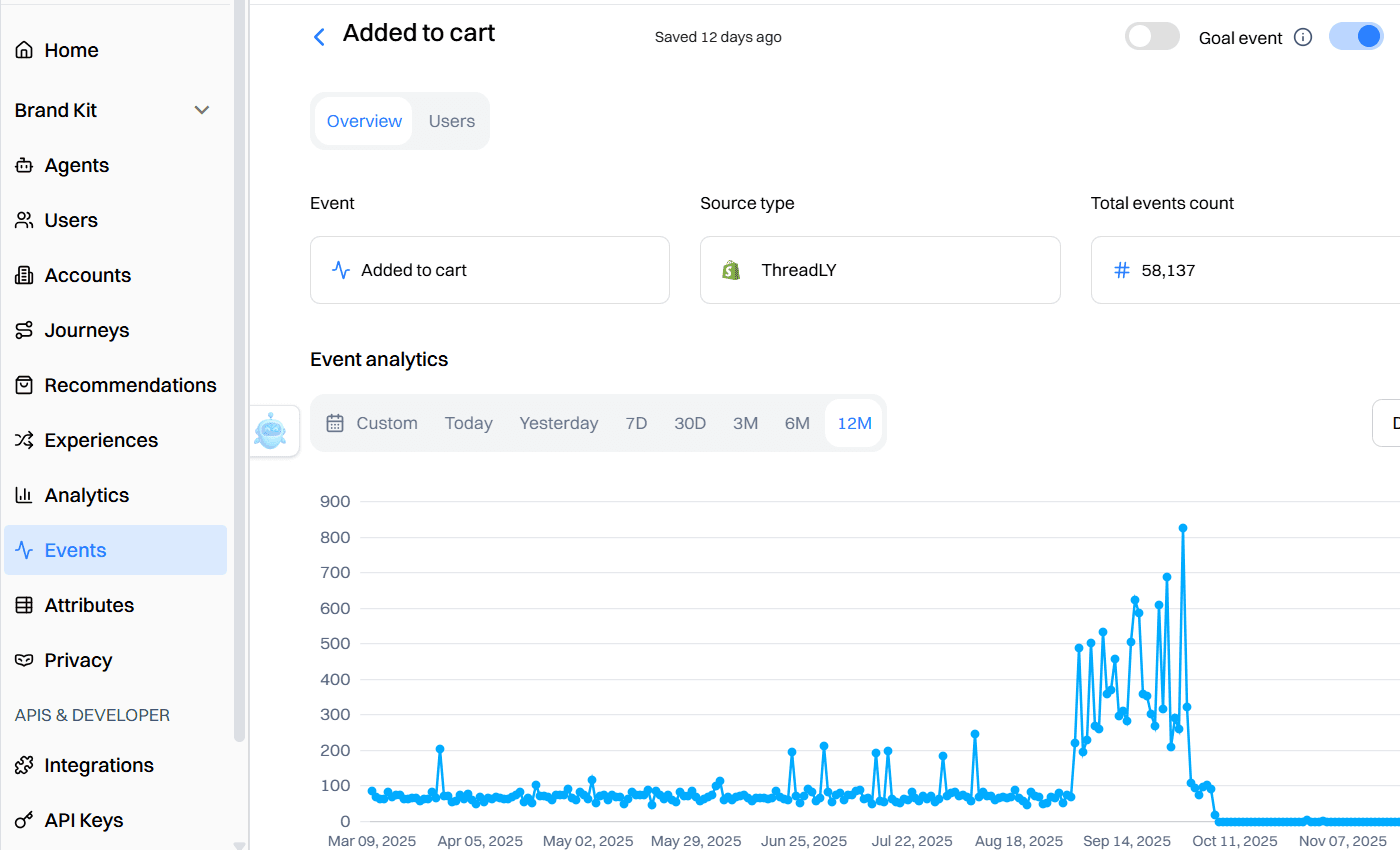
From the Events section, create the key actions that actually matter for your business. Think "added to cart," "activated feature," "completed onboarding," "upgraded plan." These become the behavioral signals your entire engagement strategy runs on. You are essentially teaching the platform what "good" looks like for your customers.
Step 3: Create AI Agents
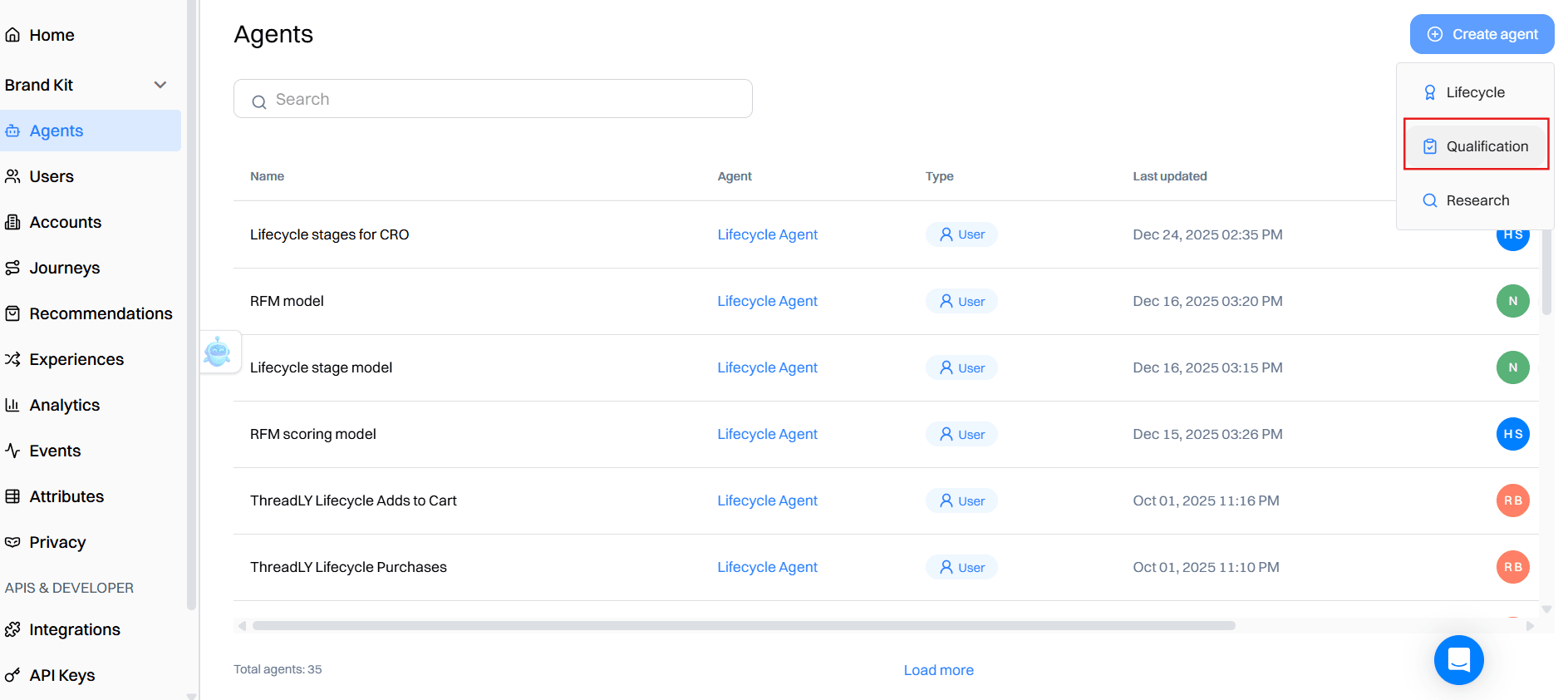
This is where Intempt gets genuinely interesting. Use Intempt's qualification agents for predictive analytics to understand customer behavior patterns at a level manual analysis cannot reach. These agents identify which users are likely to churn, which ones are ready to upgrade, and which ones are showing early signs of disengagement. You stop reacting to problems after they happen. You start addressing them before they do.
Step 4: Build Personalizations
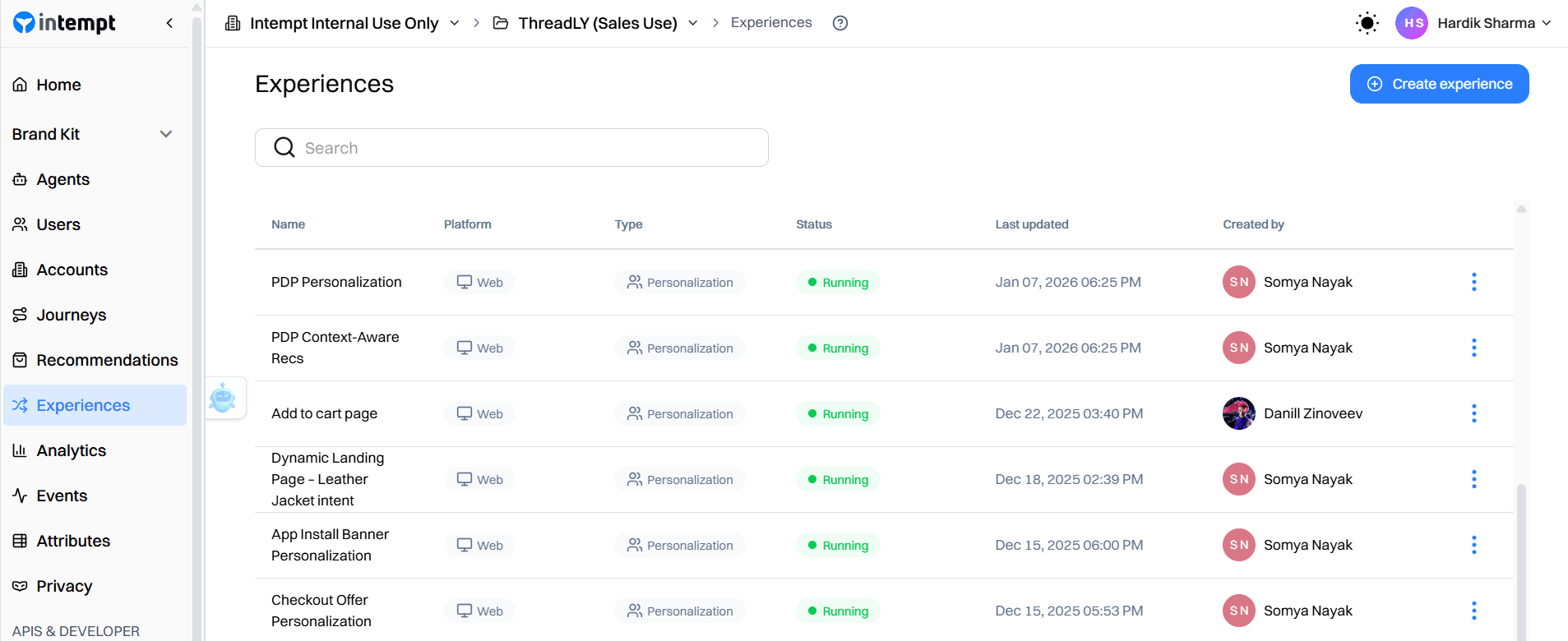
Now you put that intelligence to work. Implement personalized experiments tailored to individual preferences and behaviors. Not "customers in segment X get version A." Actual 1:1 personalization where each user's behavior determines what they see, when they see it, and how it is framed. This is what moves conversion rates, not generic campaigns.
Step 5: Launch Multi-Channel Journeys
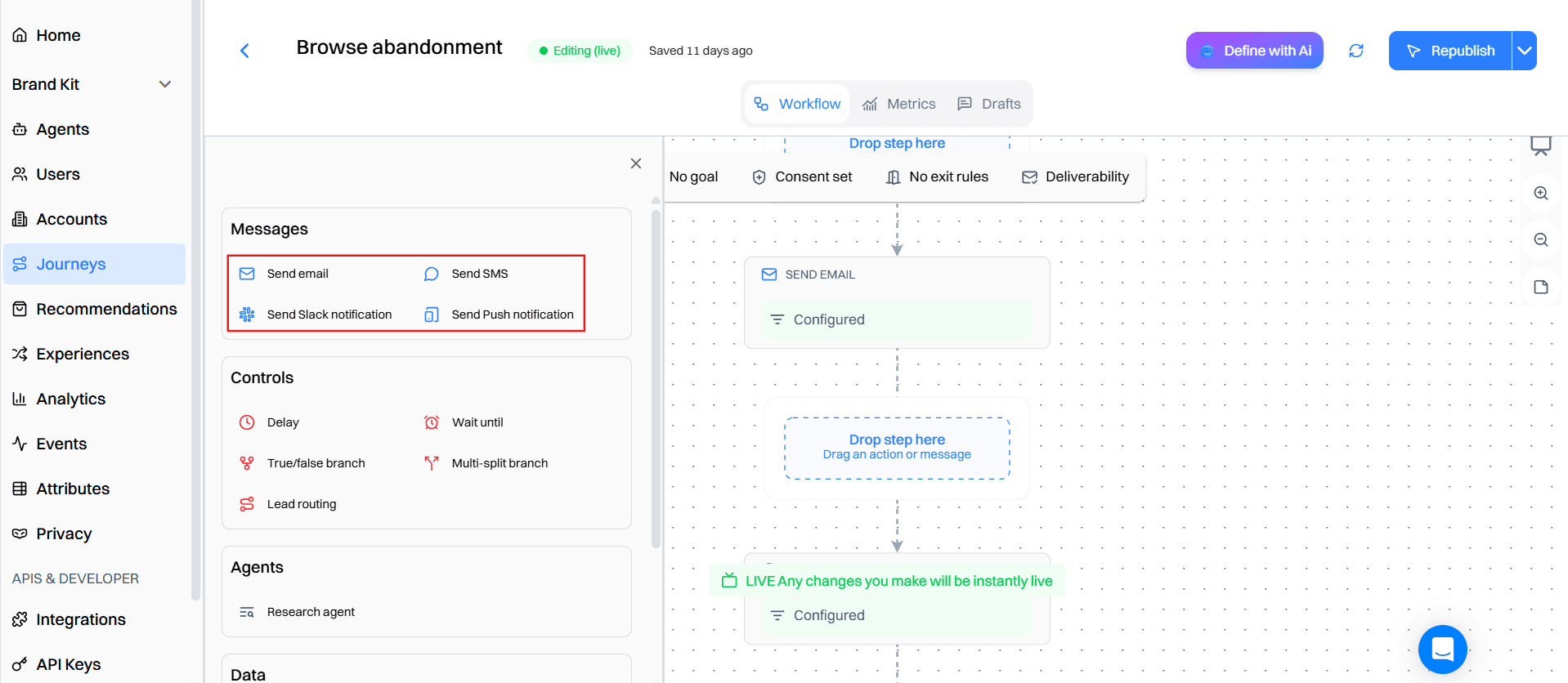
Set up automated journeys that combine email, push notifications, SMS, and in-app messages into a single coordinated flow. These journeys respond to real-time user data. If a customer completes an action you expected to nudge them toward, the journey updates. They get the next relevant message, not the one you pre-planned before you knew what they would do.
Step 6: Run Experiments
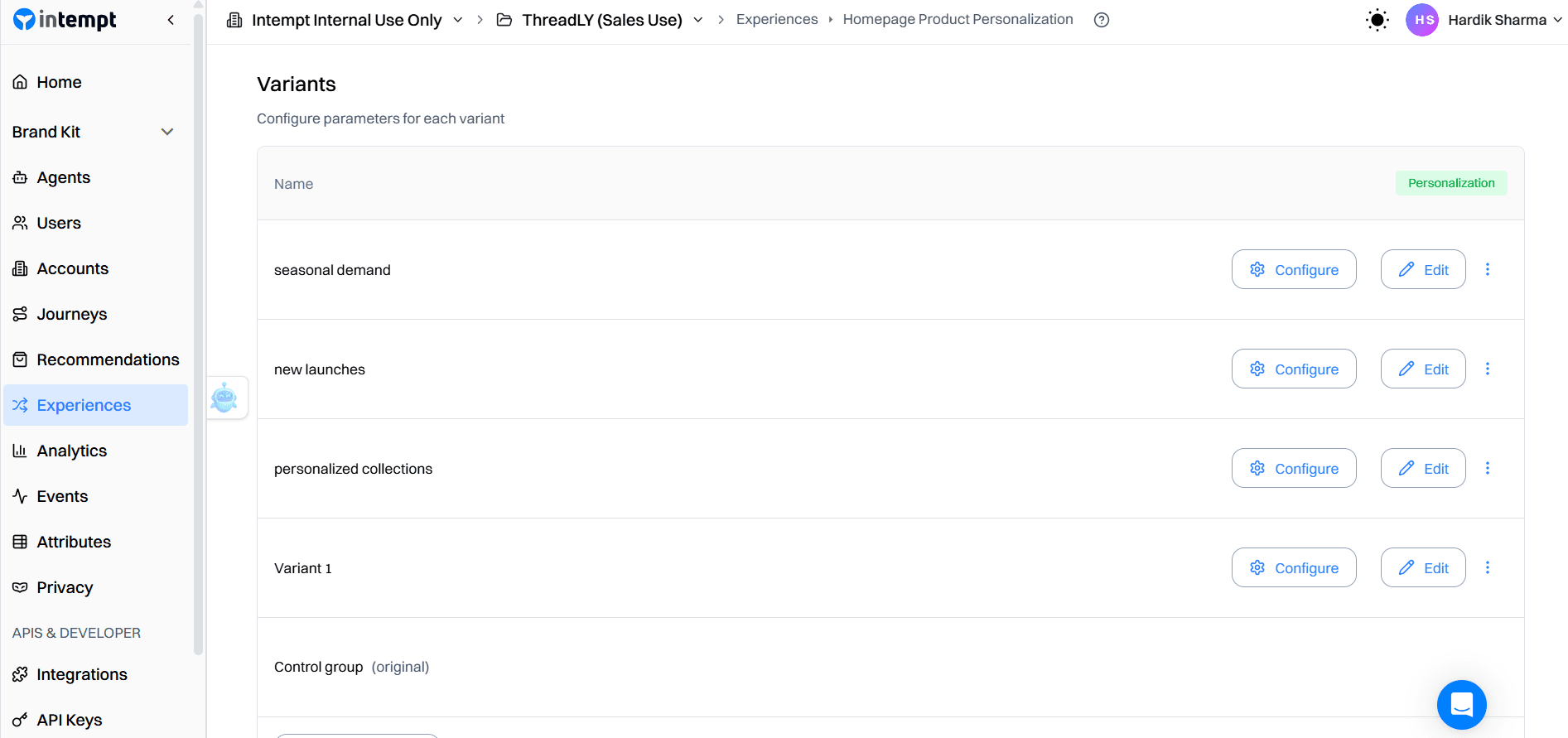
A/B test different strategies to identify the most effective approaches. Test subject lines, message timing, channel order, and offer framing. The experiments surface what actually works for your specific audience, not what works in a case study someone else published. This creates a feedback loop where every campaign makes the next one smarter.
The result is engagement that predicts what each user needs next and acts on it automatically, without your team having to manually trigger anything after the initial setup.
Bottom Line
The fragmented customer experience isn't some mysterious business problem. It's what happens when you build your engagement stack one point solution at a time with no unifying layer. An email tool here, a support desk there, a CRM nobody fully maintains, an analytics dashboard that takes a week to answer a simple question. Each tool does its job. They just don't do it together.
An AI-powered customer engagement platform is what ties it all together. It connects the data, coordinates the actions, and closes the loop between what your customers do and how you respond. In 2026, that loop needs to close in minutes, not days, because that's where behavioral signals are most actionable and customer patience is thinnest.
This isn't about replacing your team. The best CEP implementations make your team better. The AI handles pattern recognition, timing, scale, and personalization logic. Your team handles strategy, creative direction, and the high-stakes conversations that need real human judgment.
The companies getting this right are structurally harder to compete with. Higher retention, faster revenue growth, better product adoption, and a customer experience that actually improves over time because the system learns.
U.S. businesses lose $1.6 trillion annually to customers switching to competitors over poor service. That cost is distributed among companies still running fragmented stacks and hoping nobody notices.
They notice.
TL;DR
- Most businesses run 5+ disconnected tools that cannot share data, coordinate channels, or act on real-time customer behavior. The result is fragmented experiences that silently drain revenue and customer trust.
- A Customer Engagement Platform (CEP) orchestrates real-time, multi-channel engagement based on live behavioral data, not scheduled campaigns built on guesswork.
- A CRM tells you what happened. A CEP acts on what is happening right now. They are not interchangeable, and using one as a substitute for the other is costing you customers.
- 66% of customers expect companies to understand their unique needs, yet only 34% believe brands actually deliver. That is an infrastructure gap, not a messaging one.
- Disconnected channels are expensive: bad data alone costs companies $12.9 million annually, 70% of customers abandon brands after two bad experiences, and U.S. businesses lose $1.6 trillion a year to poor service.
- AI-powered CEPs do not just react to customer behavior. They predict it. Churn signals, purchase intent, and feature adoption likelihood all surfaced before they become problems.
- Personalization is now a baseline expectation: 71% of consumers expect it, 76% get frustrated without it, and fast-growing companies generate 40% more revenue from personalization than slower-growing competitors.
- The 2026 CEP landscape is being shaped by conversational AI, generative hyper-personalization, unified omnichannel journeys, real-time CDP integration, and low-code tools that let marketers move without waiting on developers.
Frequently asked questions. Answered.
An AI-powered CEP tracks what customers do across your app, website, and channels, and automatically responds based on those behaviors. Unlike basic email tools, it connects behavioral data, predictive analytics, and multi-channel messaging in one place. Every message is triggered by real actions, not a pre-set calendar.
A CRM is a system of record. It stores what happened: who bought what, when support called them, and where they are in the pipeline. A CEP is a system of action. It decides what happens next based on what the customer just did. You need both, but they solve completely different problems.
A behavioral trigger fires an automated action when a customer does something specific. Viewed pricing twice without signing up? An email goes out. Went quiet after onboarding? An in-app nudge fires. Intempt handles this through event tracking and its multi-channel journey builder. You define what good behavior looks like, and the platform handles the rest.
Yes, and this is exactly why teams switch to a unified platform. Managing separate analytics, email, push, and SMS tools means constant context-switching and manual data syncing. With Intempt, once tracking is set up and journeys are built, the AI agents and automated workflows handle ongoing execution without daily manual input.
It means your customer is experiencing your brand as multiple disconnected conversations. They get an upsell email while a support ticket is still open. They receive a discount on a product they already bought. Each of these moments signals that your teams do not talk to each other, and 54% of customers will leave a brand when they have to repeat themselves.
AI spots churn signals your team cannot catch at scale: login frequency dropping, key features unused, support tickets increasing. Intempt's qualification agents score users continuously based on predicted behavior. When a churn risk surfaces, an automated journey kicks in, without anyone manually monitoring dashboards to trigger it.

About the author
Hardik Sharma
Growth Marketer
Hardik researches and writes about marketing tools, sales technology, and customer engagement platforms. His work helps teams evaluate software with honest feature and pricing breakdowns.
LinkedIn