You finally win the customer. The ad worked. The landing page worked. The checkout worked. Your customer acquisition engine did its job.
Then the customer disappears.
No second purchase. No meaningful product usage. No habit. Just a quiet churn you only notice when revenue flattens.
Retention marketing exists for this exact moment. It's how you stop treating "purchase" as the finish line and start treating it as the start of a relationship. And according to Bain & Company, a 5% increase in customer retention can boost profits by 25% to 95%.
Most growth teams spend 80% of their budget chasing new customers. Meanwhile, the ones they already have are leaving quietly. One at a time.
That's the problem retention marketing is built to solve.
Expected Results
Done right, customer retention marketing compounds over time. Here's what teams consistently see when they build a real retention system:
- Repeat purchase rates increase 20-40% within 90 days of implementing structured lifecycle journeys.
- Customer lifetime value (CLV) grows 30-50% as behavioral triggers replace one-size-fits-all campaigns
- Churn drops 15-25% when proactive re-engagement replaces reactive win-back campaigns
- Revenue from existing customers reaches 65% of total business revenue, reducing dependence on expensive acquisition channels
- Profits improve 25-95% with just a 5% lift in retention.
These aren't theoretical. They're what happens when you stop treating every customer like a first-time visitor.
What Is Retention Marketing?
Retention marketing is the practice of engaging existing customers after their first interaction to encourage repeat purchases, deepen product usage, and build long-term loyalty. It covers loyalty programs, lifecycle emails, personalized recommendations, re-engagement journeys, and win-back campaigns.
Here's the distinction that actually matters: acquisition marketing gets someone in the door. Retention marketing makes them want to come back. Both matter. But most teams over-invest in the door and forget about everything after.
The job retention marketing does is simple: keep the customers you already paid to acquire. And increase their lifetime value in the process, not just their purchase frequency.
Retention vs. Acquisition Marketing: What's the Difference?
Both acquisition and retention marketing are essential to growth. But they operate on different logic, target different audiences, and measure success differently. Understanding where each one fits saves you from pouring budget into the wrong place at the wrong stage.
| Factor | Acquisition Marketing | Retention Marketing |
|---|---|---|
| Primary Goal | Win new customers | Keep and grow existing ones |
| Target Audience | Prospects, leads, lookalike audiences | Existing customers, lapsed buyers |
| Cost | 5-25x more expensive per outcome | Lower cost per repeat purchase |
| Channels | Paid ads, SEO, cold outreach, influencers | Email, SMS, push, loyalty programs |
| Key Metrics | CAC, conversion rate, ROAS | Churn rate, CLV, repeat purchase rate |
| Timeline | Short-term (win the first purchase) | Long-term (maximize lifetime value) |
| Revenue Impact | Drives new revenue | Grows existing revenue, more efficiently |
| Personalization Level | Broad, persona-based targeting | Deep behavioral and transactional segmentation |
The honest truth? Most companies treat acquisition like strategy and retention like an afterthought. That's expensive. 82% of companies confirm retaining a customer costs less than acquiring a new one. Yet most marketing budgets don't reflect that math.
Why Acquisition-Only Marketing Eventually Breaks?
Let's be honest about the numbers. Customer acquisition costs have risen 222% since 2013. CPCs are up. Social ad performance is down. Attribution is messier than ever.
If you're spending to fill a leaky bucket, you'll always be filling the bucket. You'll never build anything.
Here's exactly where acquisition-only marketing breaks down.
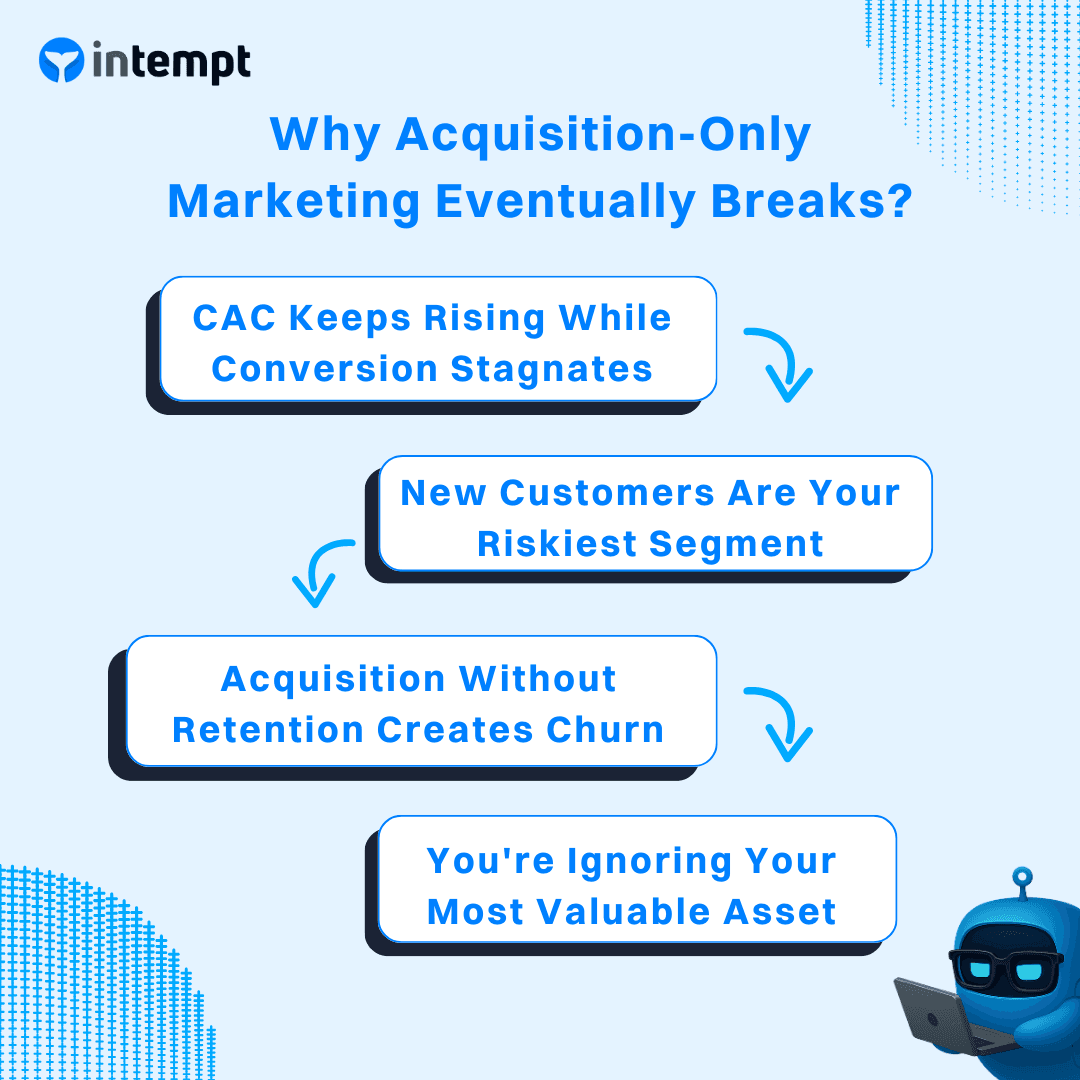
1. CAC Keeps Rising While Conversion Stagnates
You can optimize your funnel. You can A/B test your landing pages. But you can't sustainably outrun rising platform costs.
When the cost to acquire each customer climbs every quarter and average order value stays flat, you're not growing. You're maintaining. One bad quarter breaks the whole model.
2. New Customers Are Your Riskiest Segment
A brand new customer hasn't built a habit yet. They don't know your product. They haven't experienced what makes you different.
72% of customers will switch to a competitor after just one bad experience. With a new customer, that first bad experience is more likely because trust hasn't formed yet. You're one friction point away from a permanent goodbye.
3. Acquisition Without Retention Creates Churn Debt
Every cohort you acquire has a natural churn curve. If you don't intervene with retention programs, you're leaking. And the leak compounds.
U.S. businesses lose $168 billion per year to customer churn. Most of that is preventable. It just requires shifting some attention from winning customers to keeping them.
4. You're Ignoring Your Most Valuable Asset
Your existing customers already trust you. They've bought from you. They're 31% more likely to try a new product and significantly more likely to convert on new offers.
Acquisition is necessary. But scaling acquisition while ignoring retention is like filling a bathtub with the drain open.
Benefits of Retention Marketing
The business case for customer retention marketing isn't subtle. The numbers make the argument better than any pitch deck.
65% of a company's revenue comes from existing customers. Not new ones. The customers you already have are doing most of the heavy lifting, whether or not you're actively working to keep them.
Here's what a real retention focus delivers:
- Lower cost per repeat purchase: Retention costs 5-7x less than acquisition per customer.
- Higher spend per transaction: Returning customers spend 67% more than new customers. That's not a small delta.
- Compounding profit growth: A 5% lift in retention produces a 25-95% increase in profits, per Bain & Company.
- Stronger referral engine: Loyalty members show 39% higher referral rates. Your best customers become your best marketers.
- Lower churn risk over time: Loyalty program members have 47% lower churn rates compared to non-members.
- Compounding LTV growth: 92% of customers revisit brands they feel emotionally connected to. Retention programs build that connection systematically.
Companies focused on retention are 60% more profitable than those laser-focused on acquisition. That gap only grows as acquisition costs keep climbing.
5 Best Customer Retention Marketing Strategies
There's no shortage of tactics in retention. But strategy is different from tactics. These five approaches consistently move the metrics that matter.
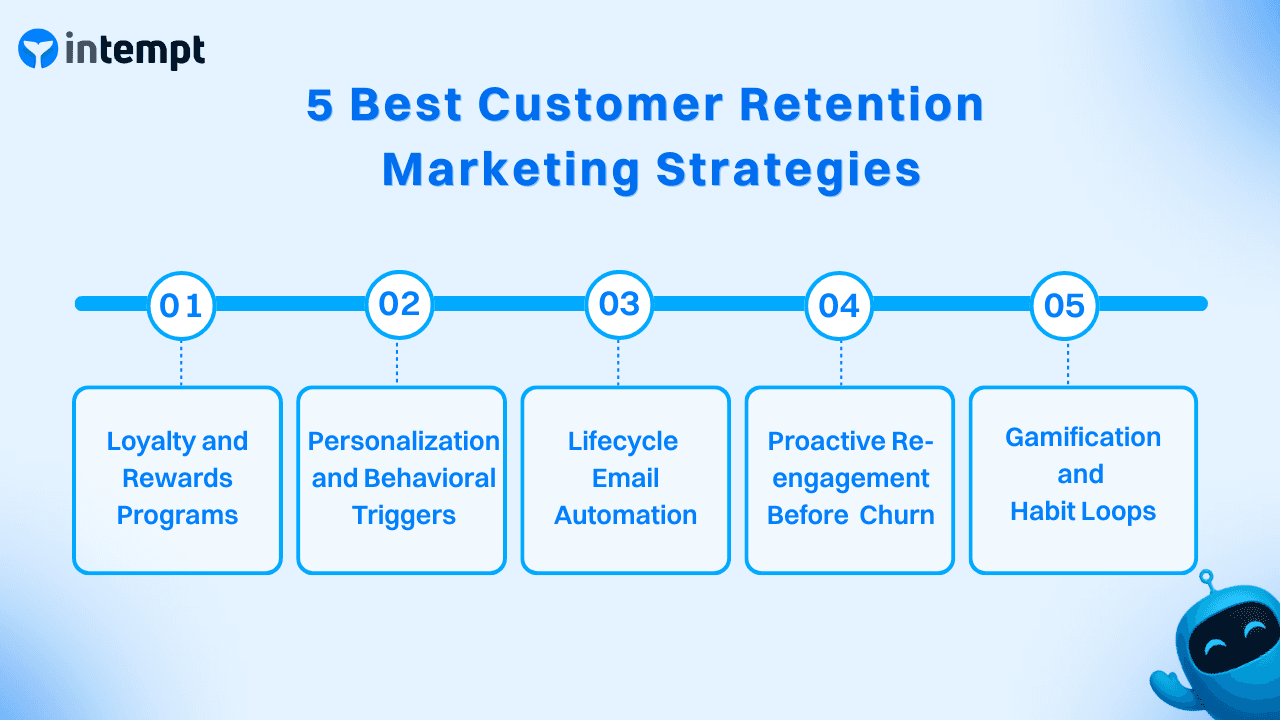
1. Loyalty and Rewards Programs
Loyalty programs work because they make repeat purchases feel like progress, not just transactions. Customers earn points, unlock tiers, and access perks they'd lose by leaving.
83% of companies report positive ROI from loyalty programs, with average returns of 5.2x. 72% of loyalty program members say they're more likely to stay with a brand because of the program.
The key is designing rewards that feel meaningful, not transactional. Points that expire before customers can use them backfire. Tiers that feel out of reach kill motivation. Simple, attainable rewards with visible progress keep people engaged.
Pro tip: Add a time-limited bonus event every quarter (think Starbucks' "Double Star Days"). Standard programs plateau. Timed challenges drive the engagement spikes your baseline program can't.
2. Personalization and Behavioral Triggers
Generic messaging is a churn accelerator. Customers notice when you're not paying attention to what they've already done.
78% of consumers are more likely to repurchase from brands that personalize their experience. Behavioral triggers, emails sent based on what a customer actually did (abandoned a cart, hit a milestone, went 30 days without activity), drive significantly better outcomes than broadcast campaigns.
Brands using segmentation see a 37% increase in retention. That's not from complex AI. That's from paying attention.
Pro tip: Start with three behavioral triggers before anything else: a post-purchase sequence (days 1, 3, 7), a milestone recognition email (10th order, 1-year anniversary), and an at-risk email when someone goes silent for 21 or more days. Those three alone will move your retention numbers.
3. Lifecycle Email Automation
Email remains the highest-ROI channel in marketing, delivering approximately 4,200% ROI. The gap between teams using lifecycle automation and those sending newsletters is wide.
Lifecycle automation improves email open rates by 83.4%, click rates by 341.1%, and conversion rates by 2,270%. Those numbers sound extreme. But they make sense when you consider the alternative: sending the same message to everyone regardless of where they are in their journey.
A lifecycle program maps every customer stage (new, active, at-risk, lapsed) and has a pre-built response for each transition. Someone moves from active to at-risk? A re-engagement sequence fires automatically. Third purchase? A loyalty nudge kicks in.
Pro tip: Don't automate volume. Automate relevance. Five well-timed, behavior-triggered emails outperform 50 generic weekly newsletters every time.
4. Proactive Re-engagement Before Customers Churn
Most retention programs are reactive. They wait until someone cancels or goes six months without a purchase, then launch a win-back campaign. By then, the relationship is already cold, and customers churn.
Proactive re-engagement, reaching out before the disengagement completes, increases retention by 15-20%. Companies that follow up within 5 minutes of a signal (a dropped cart, an inactive account, a failed renewal) see 35% higher retention.
The shift is from monitoring to anticipating. If a customer used to log in daily and hasn't logged in for 10 days, that's a signal. Act on it before the habit breaks completely.
Pro tip: Build a basic "risk score" based on recency and engagement frequency. Anyone trending toward at-risk should get a proactive touchpoint, not a win-back email they'll ignore after they've already churned.
5. Gamification and Habit Loops
Retention is fundamentally about habit. If using your product or buying from your brand becomes routine, churn drops dramatically.
Gamification gives customers a reason to return that isn't just "buy more stuff." Streaks, leaderboards, progress bars, challenges, and badges all tap into the same psychological drivers that make habits stick.
Duolingo is the clearest proof of this. Users with a 7-day streak are 3.6x more likely to stay engaged long-term. Their streak-saver push notification produced a 5% rise in daily active users. XP leaderboards drive 40% more engagement.
The mechanism is simple: give customers something to protect. A streak, a status, a tier. Loss aversion is a powerful retention tool.
Pro tip: You don't need a complex gamification system to start. A simple "X orders to VIP status" progress bar at checkout drives repeat purchase behavior with almost zero engineering lift.
Examples of Retention Marketing Done Right
The best way to understand customer retention marketing in practice is to look at companies that have built their entire growth model around it.
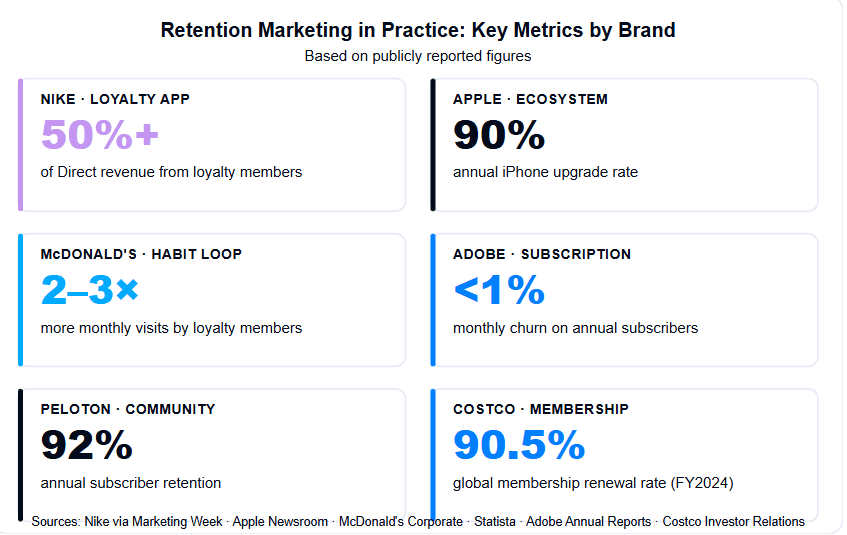
Nike: Turning a Loyalty App Into a Daily Habit
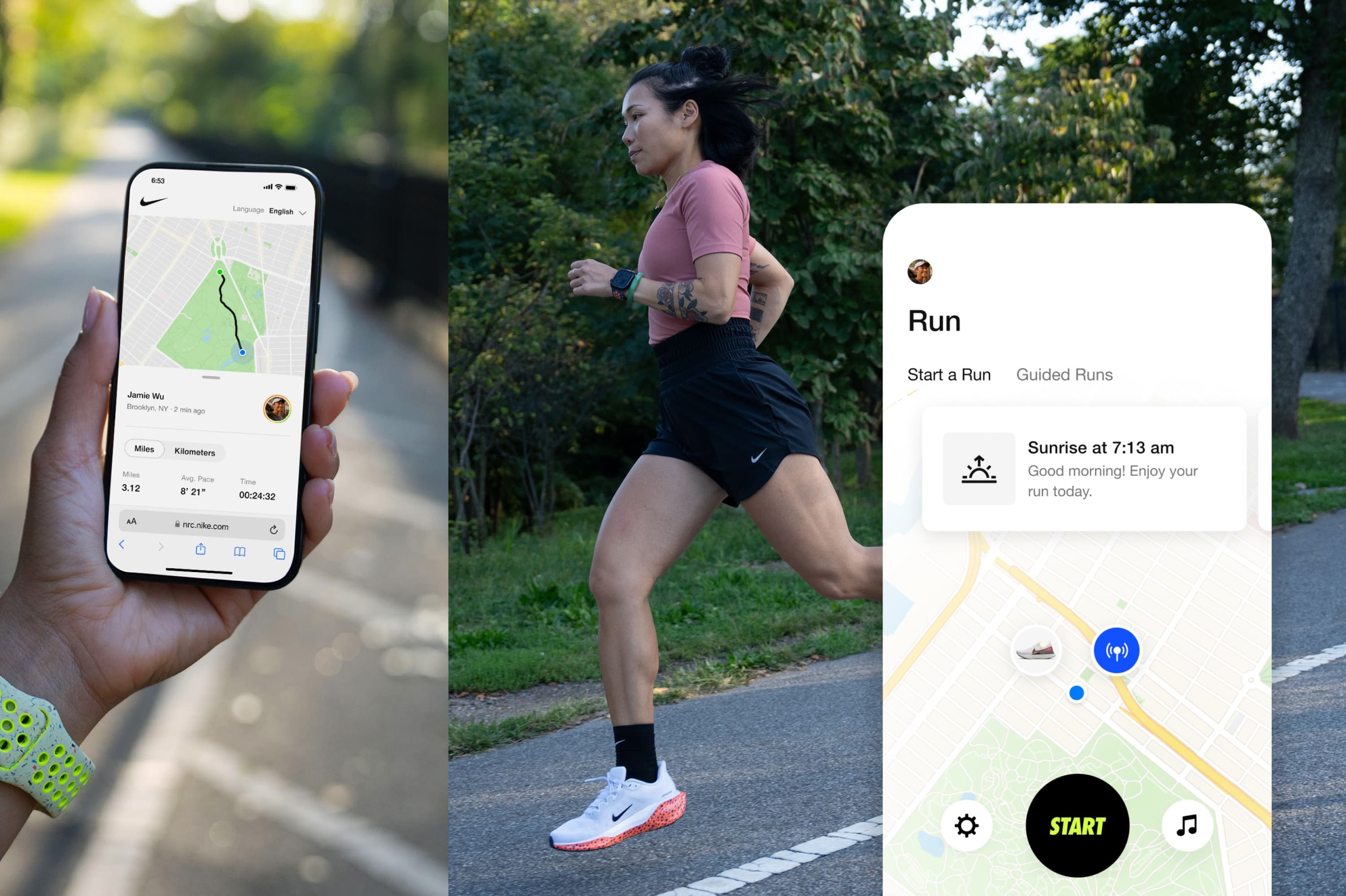
*(Image source: Nike)*
Nike's retention strategy doesn't rely on discounts. It relies on identity.
The Nike Run Club and Nike Training Club apps give members a reason to engage with the brand every day, not just when they're shopping.
The NikePlus membership program ties that daily behavior to exclusive products, early access, and personalized milestones.
The result: loyalty members visit Nike.com 3x more frequently than non-members and convert at significantly higher rates.
Nike reported that members in their loyalty ecosystem generate a disproportionate share of total revenue. Over 50% of Nike Direct revenue is driven by loyalty members.
The app creates retention that no paid ad can replicate: a daily habit with the brand embedded in it.
Apple: The Ecosystem Lock-In Model

*(Image source: Gadget Hacks)*
Apple doesn't run a traditional loyalty program. They don't need one. Their retention strategy is product design.
Once a customer owns an iPhone, the friction of switching becomes almost prohibitive. AirDrop, iMessage, AirPods seamless switching, iCloud, Handoff, Apple Watch integration -- every product deepens the moat.
This ecosystem approach delivers an annual iPhone upgrade rate of approximately 90% among existing iPhone owners. That's not brand loyalty. That's switching cost engineered into the product.
Apple's services revenue, which includes iCloud, Apple TV+, Apple Music, and the App Store, reached $96.2 billion in FY2024. That's recurring revenue built entirely on retention.
The product retains customers. The services compound the value of staying.
McDonald's: The App That Turned Fast Food Into a Habit Loop
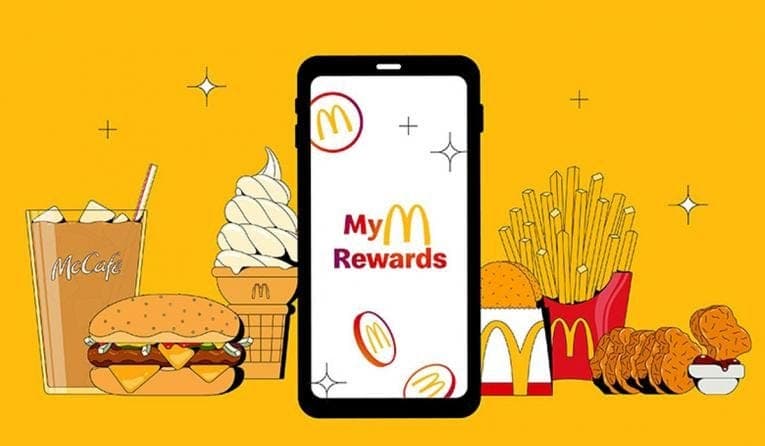
*(Image source: Medium)*
McDonald's MyMcDonald's Rewards app crossed 150 million enrolled members globally within two years of launch and now drives over $20 billion in annual systemwide sales.
That's a retention program generating more revenue than most companies will ever see total.
The mechanic is straightforward: earn points on every order, redeem for free food. But the deeper play is behavioral conditioning.
Digital ordering, personalized deals, and mobile-exclusive offers create a habit loop that brings customers back more frequently and increases average order value.
McDonald's reported that loyalty users visit 2-3x more per month than non-loyalty customers. Frequency is the whole game in QSR. They cracked it with an app.
Adobe: Subscription Conversion as Retention Architecture

*(Image source: CG channel)*
When Adobe killed Creative Suite perpetual licenses and moved to Creative Cloud subscriptions in 2013, many predicted a customer revolt. The opposite happened.
Adobe's ARR grew from approximately $1 billion to over $19 billion by FY2024. Monthly churn on Creative Cloud sits below 1% for annual subscribers.
The retention driver isn't just the product: it's the switching cost. Learning curves, cloud storage, shared libraries, team collaboration features, and integrated workflows make leaving Creative Cloud a significant operational disruption for any creative team.
Adobe turned their product depth into a retention wall.
Costco: Membership Renewal as a Business Model
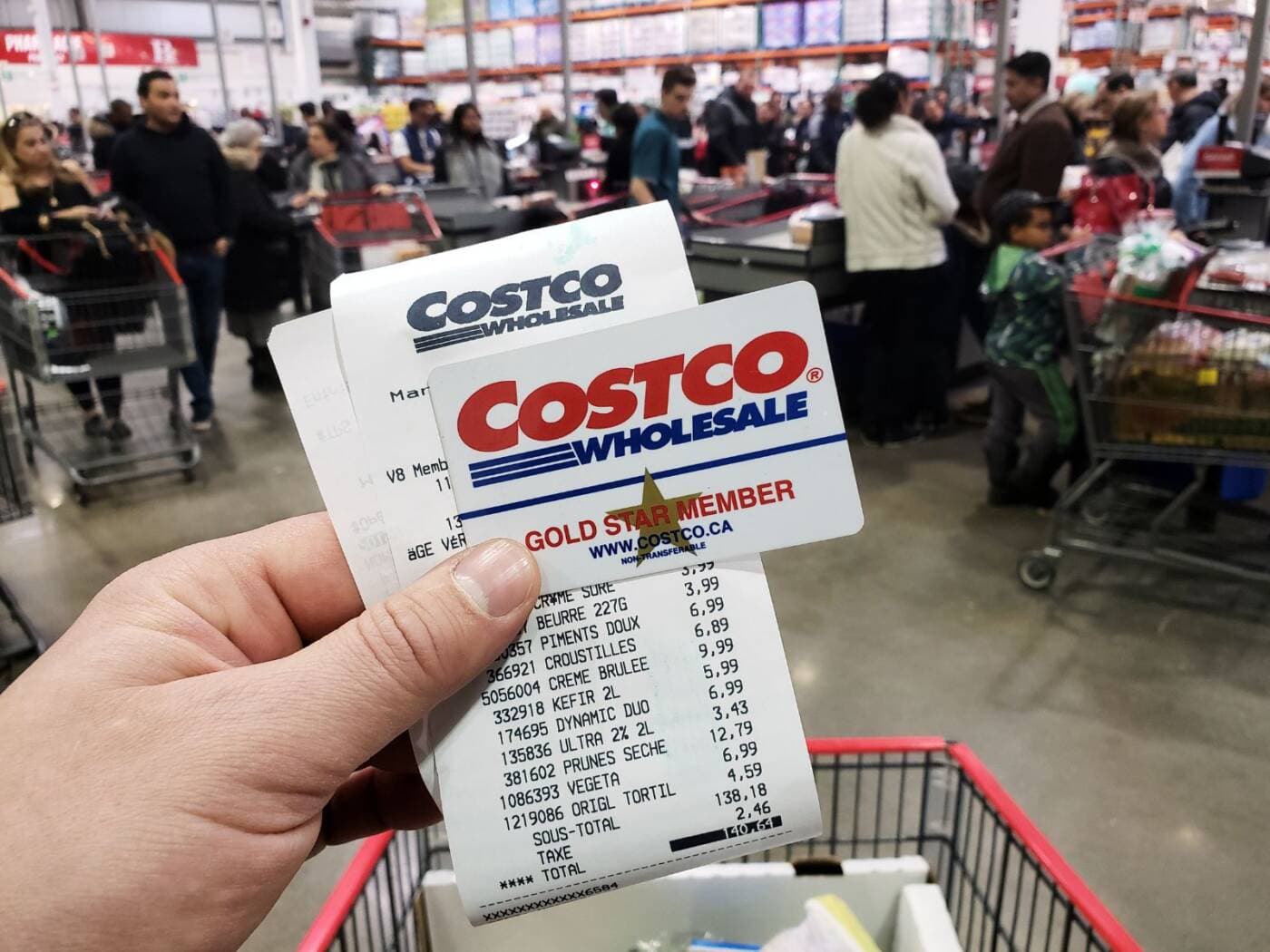
*(Image source: Costco)*
Costco's entire business model is a masterclass in retention marketing. They barely profit on merchandise. The real business is the membership fee.
Costco's global membership renewal rate hit 90.5% in FY2024, and 92.9% in the US and Canada specifically. Membership fee revenue was $4.8 billion in FY2024.
Their retention strategy is simple: deliver so much perceived value (bulk pricing, Kirkland quality, free samples, low-markup gas) that non-renewal feels irrational.
When your retention rate is 90%+ and renewing is an automatic decision for most customers, you've built the most durable retention system possible: one where not staying feels like a mistake.
Best Practices for Retention Marketing
| Best Practice | What It Means in Practice |
|---|---|
| Segment before you send | Never blast your full customer list. Separate new, active, at-risk, and lapsed customers and message each differently. |
| Trigger on behavior, not time | Set automations based on what customers do (or stop doing), not calendar-based schedules. |
| Make the next step obvious | Every retention touchpoint needs one clear CTA. Confusion is a churn driver. |
| Reward before they disengage | Don't wait for churn signals to offer value. Build proactive touchpoints at key milestones (30 days, 90 days, 1 year). |
| Test your win-back window | Optimal re-engagement timing varies by business. Test 14-day, 30-day, and 60-day intervals to find yours. |
| Measure CLV, not just repeat purchase rate | Repeat purchases matter. But CLV tells you whether those purchases are growing or shrinking over time. |
| Don't over-message active customers | Retention fatigue is real. Active users don't need weekly nudges to return. Respect engagement frequency. |
| Use omnichannel, not just email | The most effective retention programs sequence [email, SMS, push](/studio/messages), and in-app touchpoints together intelligently. |
| Make loyalty visible | Show customers their points balance, tier status, and progress toward the next reward. Visibility drives action. |
| Close the feedback loop | Programs that include regular NPS or CSAT touchpoints catch churn signals that behavioral data misses. |
How To Boost Retention With Intempt?
Intempt is a unified growth platform combining a CDP, behavioral analytics, and lifecycle automation in one place. For teams building retention programs, that means you're not stitching together five separate tools to see what your customers are doing and then act on it.
Here's how to build a working retention marketing system with Intempt.
Step 1: Track Key Events
.png&w=3000&q=75)
Define and track goal events like "added to cart," "activated feature," "completed onboarding." Create new events if they're not available.
Step 2: Create a Lifecycle Agent
.png&w=3000&q=75)
Go to the Agents section and create a lifecycle agent. Select your conversion goal event (like "Purchase") and filter out users you don't want in the training data. Add all your category-specific events as potential actions for the model.
Step 3: Set Up Journeys
.png&w=3000&q=75)
Create separate journeys for each lifecycle segment: Champions, Regulars, Promising, Needs Attention, and At Risk customers. Each segment needs different messaging and offers.
Step 4: Deploy Personalized Experiments
.png&w=3000&q=75)
Navigate to Personalized Experiments and create personalization campaigns. Set up personalized content for each lifecycle segment within the campaign.
Step 5: Measure Performance
.png&w=3000&q=75)
Track journey analytics for conversions and conversion rates. Compare performance across segments to optimize your campaigns.
Bottom Line
What is retention marketing, really? It's the discipline of treating customer relationships as compounding assets, not one-time transactions.
The economics are clear. Retaining a customer costs 5-7x less than acquiring a new one. Returning customers spend more, churn less, and refer more often.
Yet most growth budgets still tilt heavily toward acquisition while retention programs run on autopilot or not at all.
The fix isn't complicated. Segment your customers. Trigger journeys on behavior. Make loyalty visible. Intervene before churn, not after.
With a platform like Intempt, these workflows can be running within days, not quarters. Start with your data and your segments. Everything else follows from building a real retention marketing program.
TL;DR
- What is retention marketing? It's the practice of engaging existing customers to drive repeat purchases, deepen usage, and build long-term loyalty.
- Customer acquisition costs have risen 222% since 2013. Retention is now the more efficient growth lever for most businesses.
- A 5% lift in retention can increase profits by 25-95%. Returning customers already spend 67% more than new ones.
- The 5 most effective customer retention strategies are loyalty programs, personalization, lifecycle email automation, proactive re-engagement, and gamification.
- Real-world proof: Amazon Prime renews at 98% in year two. Spotify Wrapped drives 425 million shares annually. Netflix saves $1 billion/year through personalization. Duolingo grew DAU 4.5x through streaks.
- Best practice: segment before you send, trigger on behavior not time, measure CLV not just purchase frequency, and reward customers before they disengage.
- Intempt unifies your customer data, segmentation, lifecycle automation, and loyalty programs in one platform so you can build retention workflows without stitching together multiple tools.
- Start with four segments (new, active, at-risk, lapsed) and three behavioral triggers. The rest builds from there.
Frequently asked questions. Answered.
Retention marketing is the practice of using targeted communications and programs to keep existing customers engaged after their first purchase. It works by identifying where customers are in their lifecycle and delivering relevant messages, offers, or experiences at the right moment, typically through email, SMS, loyalty programs, or in-app notifications.
Retaining a customer costs 5-7x less than acquiring a new one, according to Harvard Business Review via Invesp. Some estimates put the gap even higher: it can cost 16x more to bring a new customer to the same spending level as a returning customer. The math strongly favors investing in retention.
Churn rate is the percentage of customers who stop buying from or using your product within a given period. Calculate it by dividing customers lost during a period by customers at the start of that period, then multiply by 100. A healthy rate varies by industry: SaaS averages around 5-7% annually, retail averages closer to 37%.
Retention benchmarks vary significantly by sector. SaaS companies typically aim for 85-95% annual retention. Retail averages around 63%. Media and subscription services average 75-80%. Platforms like Intempt let you track your own cohort retention curves against historical performance, which is often more actionable than benchmarking against an industry average alone.
The most effective strategies are loyalty programs (83% of companies report positive ROI), behavioral personalization, lifecycle email automation, proactive re-engagement before churn, and gamification mechanics that build daily habits. Teams using platforms like Intempt can connect all five in one system rather than managing separate tools for each strategy.
CLV is the total revenue a business can expect from a single customer over the entire relationship. It matters for retention because it tells you how much a customer is worth over time, not just at first purchase. Teams using Intempt can track CLV by cohort and connect lifecycle campaigns directly to CLV growth, making it easier to see which retention tactics actually move the number.

About the author
Hardik Sharma
Growth Marketer
Hardik researches and writes about marketing tools, sales technology, and customer engagement platforms. His work helps teams evaluate software with honest feature and pricing breakdowns.
LinkedIn